Capturing Byzantine Gold-Ground Variations on Orthodox Vestments
The Gold-Ground Is Not Background
The Mount Athos-affiliated monastery contacted the studio with an unusual brief: conserve the liturgical embroideries on a 19th-century episcopal vestment set that had been used continuously since its donation and had received no documented treatment. The vestments included a sticharion, epitrachelion, and cuffs with gold-ground icon embroidery in the Greek post-Byzantine tradition. The silk weft colors — the reds, blues, and greens of the embroidered figures — had faded substantially. The gold-ground appeared intact.
The monastery's liturgical director had a specific concern: the icon figures needed to read as icons, not as decorative patterns, and icon-standard color — the specific red of a martyr's mantle, the specific blue of the Theotokos's maphorion — carries theological weight that "close enough" does not satisfy. A martyrology-red that reads too orange in the sanctuary's oil-lamp light fails to communicate the martyr's blood; a Theotokos blue that reads too cool in the same light shifts toward a secular aesthetic rather than the warm, deep indigo of the Marian iconographic canon. These are not aesthetic preferences — they are liturgical requirements that the vestment's original dyers understood and that the conservation workflow must honor.
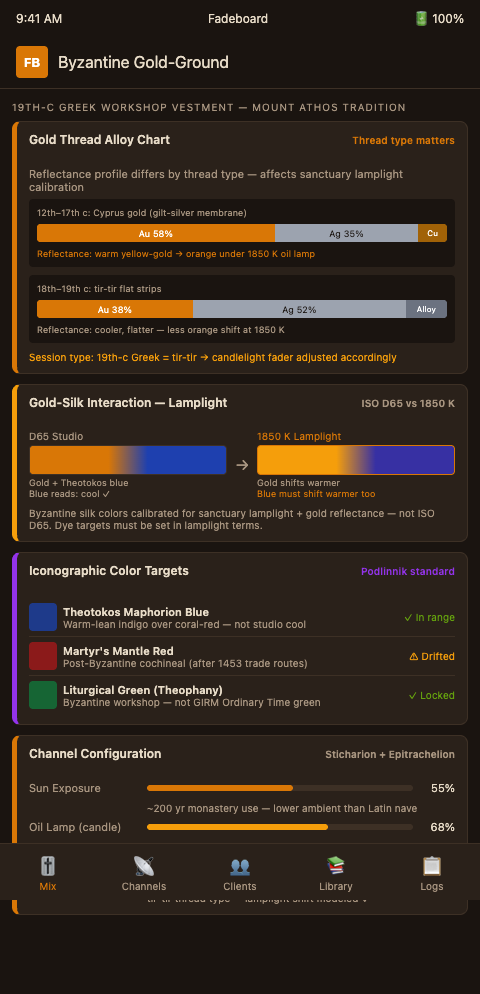
Post-Byzantine embroidery traditions were sustained in monastery workshops and Greek urban workshops, with vestment production continuing from Byzantine-period practice after 1453 in Constantinople, Bursa, and Thessaloniki (Why Vestments? An Introduction to Liturgical Textiles of the Post-Byzantine World, Orthodox Christian Laity). The gold thread in this tradition was Cyprus gold — gilt-silver membrane thread over silk or linen core — used from the 12th through the 17th century in wire types specific to Byzantine-Greek production (Cypriot Gold Thread in Late Medieval Silk Weaving and Embroidery, Academia.edu). A 19th-century vestment from a Greek workshop may use later types — tir-tir, flat strips, sequins alongside traditional forms — that shift the reflectance profile of the gold-ground (Dressed to Impress: Metal Threads in Greek Ecclesiastical Garments, Academia.edu).
This thread-type distinction directly affects the Fadeboard gold-ground channel calibration: tir-tir thread produces a cooler, slightly flatter reflectance profile than Cyprus gilt-silver, which means the candlelight-equivalent illuminant adjustment for the silk colors will differ between a 14th-century piece with Cyprus gold and an 18th-century piece using later thread types.
The Gold-Silk Interaction in Fadeboard Channels
Fadeboard's approach to Byzantine gold-ground vestments uses the gold-ground as a calibration anchor for the silk color channels, rather than treating silk and gold as independent restoration problems.
The gold-ground's reflectance profile is measured first. Under ISO D65, gilt-silver thread in good condition reads as a warm yellow-gold. Under sanctuary lamplight — which Orthodox liturgical use assumes — the same gold reads warmer, with more orange component. The silk weft colors in Byzantine embroidery were calibrated to read against sanctuary lamplight falling on gold-ground, not against ISO D65. The Fadeboard candlelight channel models this shift: once you know how the gold-ground's reflectance changes from ISO D65 to lamplight-equivalent illumination, you can project what the silk colors needed to be in lamplight terms rather than studio terms.
This matters because a silk blue that reads correctly under ISO D65 when placed against gold may read too cool under lamplight. The icon painter working in the Orthodox tradition understood this calibration intuitively; the textile dyer replicating the embroidery silk for conservation purposes needs it quantified.
The Thessaloniki Epitaphios, dated c.1300 and linked to the Hilandar Monastery through workshop connections to Mount Athos Protaton paintings, documents the relationship between specific gold-ground embroidery and the icon-painting tradition it references (The Thessaloniki Epitaphios, Princeton Mapping Eastern Europe). Gold thread and brilliant colors from Byzantine imperial workshops defined a visual standard that post-Byzantine parish vestments aimed to reproduce at varying scales of resources (Byzantine Silk, Wikipedia).
The sun-exposure channel for a 19th-century Greek workshop vestment in continuous monastery use accounts for approximately two centuries of sanctuary oil-lamp and later electric light exposure. Monastery sanctuaries typically have lower ambient light levels than Latin-rite parish naves, but they also use oil lamps intensively, which adds both the warm-spectrum light and the combustion-product exposure to the degradation profile. The candlelight fader in Fadeboard models oil-lamp exposure as a closer analog to beeswax-candle exposure than to electric light — both involve concentrated warm-spectrum emission and combustion products at close range to the textile.
MA-XRF mapping applied to heritage textiles identifies gold leaf, gilded-silver thread distribution, and spatial variation in metal composition across icon-embroidered vestments — the technique is directly applicable to Byzantine vestment analysis (Non-Invasive Analysis of Heritage Textiles with MA-XRF Mapping, npj Heritage Science). If your commission includes MA-XRF analysis, the resulting metal-distribution map feeds into Fadeboard's gold-ground channel to spatially vary the reflectance model across the embroidered surface.
Advanced Tactics: Iconographic Color Standards
Orthodox iconographic color conventions are documented in workshop manuals (podlinnik) and in the analytical literature on surviving icons. The Theotokos's maphorion is a specific warm-leaning indigo over a coral-red undergarment; the martyr's mantle is a specific warm red that reads as neither the Roman crimson nor the Sarum kermes red of Latin vestments but occupies its own position in the colorimetric space.
When you set the Fadeboard channels for an epitaphios or epitrachelion, the iconographic color standard functions as an external constraint on the restoration target. The channel settings that produce a Theotokos blue in the correct position are constrained by what "correct" means in the iconographic tradition — which is the same constraint the original workshop dyers were working under. If the projected original falls outside the canonical iconographic position, the channel settings need review.
For the reds in Orthodox vestment embroidery, the historical shift from Byzantine kermes (used through the fall of Constantinople) to post-Byzantine cochineal (adopted after Spanish trade routes opened in the 16th century) means that the appropriate red target depends on the vestment's manufacture date and the workshop's documented dye sources.
Diocesan Approval Edge Case: Eastern Rite Color Standards in Roman Rite Dioceses
In dioceses where Eastern Catholic communities share administrative oversight with the Roman rite — the case in several American eparchies — vestment conservation decisions occasionally require approval from a diocesan commission that is staffed primarily with Latin-rite expertise. An epitrachelion submitted for restoration review under a Ruthenian or Melkite eparchy may receive a canonical color challenge based on the commission's Roman rite reference standards rather than the appropriate Byzantine canonical standard.
The Fadeboard channel record provides the essential documentation in this edge case. The session file should include an explicit canonical reference note identifying the iconographic color tradition governing the restoration target — citing the relevant podlinnik tradition or workshop provenance — and the dual-illuminant proof should demonstrate the color under sanctuary oil-lamp equivalent lighting, not just under ISO D65. A review board that sees the restoration target positioned at the correct Theotokos-blue iconographic position, documented against a Byzantine workshop reference curve rather than a GIRM-compliant Latin violet, can make an informed canonical determination rather than defaulting to the nearest Roman rite equivalent.
In-dyeing work on damask ground weaves for Orthodox vestment restoration — where the woven ground is being re-dyed to match the surviving icon embroidery colors — requires understanding the gold-ground interaction established here, covered in more detail in damask in-dyeing for vestment grounds. For fragmentary orphrey bands where the embroidery pattern provides only partial color reference, orphrey fragmentary loss and pigment matching addresses reconstruction from incomplete data. The chromatic capture challenge of vaudeville-era magenta costumes — where the relationship between foreground color and colored-light background was similarly calibrated for performance conditions — is examined in vaudeville magenta costume color capture.
Restoring the Sanctuary Light Standard
Your Orthodox vestment's silk weft colors were calibrated for the gold-ground and the sanctuary lamp, not for the studio daylight under which you are measuring them. Fadeboard's gold-ground channel corrects for this shift and produces restoration targets that will read correctly in the liturgical context the vestment was made for. If your monastery or parish has icon-embroidered vestments whose figure colors have faded past liturgical recognition, the gold-ground channel analysis will tell you what those colors need to be — and in what dye-bath sequence to get there.
Conservators working with Byzantine and post-Byzantine vestments can apply to join the Fadeboard waitlist now. Schedule a soundboard demonstration using MA-XRF or UV documentation from your current commission, and see how the gold-ground channel translates analytical data into a sanctuary-calibrated dye-bath specification before Pascha or the feast of the Theotokos's Dormition arrives.