Capturing Aniline Magenta Variations on Vaudeville Corsets
The Fuchsine Family and Its Unstable Members
The discovery of fuchsine in 1858 — a result of competing research by Verguin in Lyon and Hofmann's group in London — introduced a dye that was simultaneously brilliant and problematic. The Royal Society of Chemistry's account of the "battle for magenta" documents how fuchsine dye (also known as rosaniline, magenta, and under various brand names) rapidly became the defining color of fashionable dress in the 1860s and moved into theatrical costuming shortly after. (The Battle for Magenta — RSC Education)
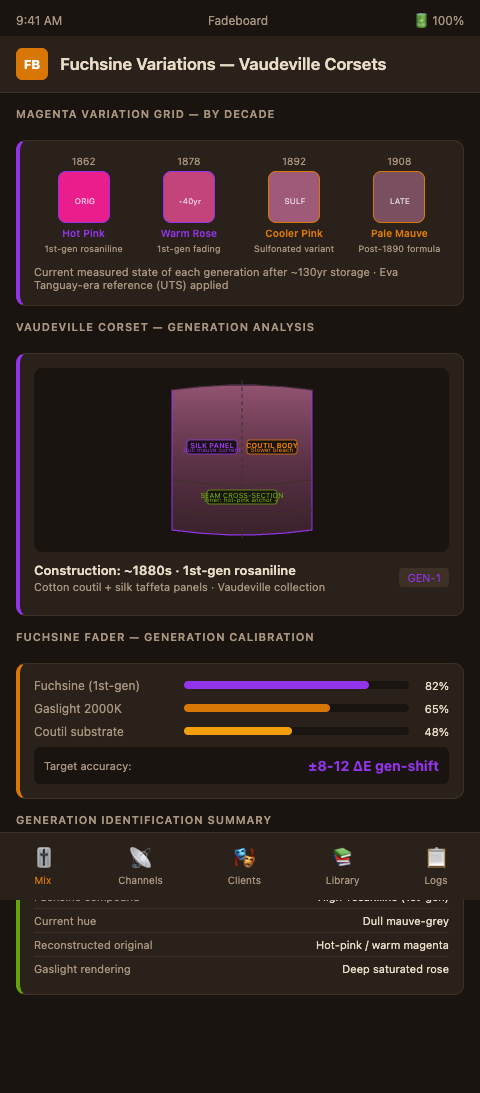
Fuchsine's commercial lightfastness varied depending on the specific rosaniline base used. The MFA Boston CAMEO materials database entry on fuchsine documents that the compound has poor lightfastness on most natural fibers, fading from a vivid hot-pink toward a muted, slightly violet pink, then toward a pale mauve, and eventually toward near-neutral as the chromophore degrades completely. (Fuchsin — MFA Boston CAMEO) The trajectory is not random — it follows a predictable photooxidation pathway — but the starting point varies with the specific batch chemistry, the mordanting method, the fiber type, and the application temperature.
For vaudeville corsets, this variation matters practically. The American Vaudeville Museum Collection at the University of Arizona Libraries holds performer costumes and accessories from the 1850s onward, representing a range of fuchsine applications on corset coutil, silk taffeta, and cotton satin from different manufacturers and decades. (American Vaudeville Museum Collection — University of Arizona Libraries) Any given corset in such a collection could represent an early-1860s fuchsine application that has degraded for 160 years, a 1890s application that degraded for 130 years, or a 1910s application that degraded for 110 years — and each will have a different current hue despite all starting as "magenta."
A peer-reviewed historical analysis of fuchsine chemistry published in PubMed confirms this: the commercial rosaniline preparations sold under the fuchsine/magenta name between 1858 and 1910 were not chemically identical, and their degradation products are correspondingly variable. (Fuchsine or Magenta: 150th Anniversary Memoir — PubMed / NIH) This has direct implications for the soundboard model: the fuchsine fader cannot have a single calibration. It needs a range that accounts for which generation of the dye chemistry is in the garment.
Building the Fuchsine Fader for Vaudeville Work
Fadeboard's approach to vaudeville-era fuchsine variations follows a generation-identification protocol before any fader calibration is attempted. The goal is to determine which point in the fuchsine-production timeline the garment represents — and therefore which degradation trajectory to model in the channel.
The starting point is production date estimation. Corsets from major performers like Eva Tanguay — documented in academic analysis at UTS — can sometimes be dated from construction details, label information, or performance records. (Unravelling the Costumes of Vaudeville's Queen, Eva Tanguay — UTS Open Access) For costumes without provenance records, construction features — corset boning type, coutil weave, closure hardware — often narrow the production window to a decade or less. The production date constrains the fuchsine generation: pre-1880 corsets were almost certainly dyed with first-generation high-rosaniline fuchsine; post-1890 corsets may include sulfonated variants with different, sometimes marginally better, lightfastness.
Once the generation is identified, the fuchsine fader is calibrated against the known endpoint color for that variant. First-generation fuchsine on cotton coutil, after 120–150 years, typically presents as a dull mauve with visible greying. The fader's maximum-restoration position targets the vivid hot-pink that a 5600K light source would render as a saturated magenta — though as with all vaudeville-era work, the gaslight-era translation channel must be engaged simultaneously, because the original magenta was selected and presented under 2000K or lower conditions.
Think of the fuchsine fader as analogous to an audio noise-floor reduction channel. Noise-floor reduction in audio does not restore detail that was recorded below the noise floor — it removes the overlay of noise to expose what was captured above it. The fuchsine fader removes the overlay of photooxidation — the chromophore-degradation products that have accumulated over the original signal — to expose the remaining dye signal. What it cannot do is restore dye molecules that have degraded below detection threshold. A heavily bleached zone on a vaudeville corset may have lost too much fuchsine to support reconstruction; those zones are flagged in the session log as below-threshold rather than assigned a speculative restoration value.
For archivists working with contemporaneous Gilbert and Sullivan productions — the Savoy Theatre wardrobe used aniline yellows in close proximity to the same fuchsine-era context — the Gilbert and Sullivan yellow dye analysis provides complementary calibration methods for the yellow-range aniline channel that often runs alongside fuchsine in operetta costuming.
Advanced Tactics for Vaudeville Magenta Work
Use the FIT documentation of 1880s dyed corsets as a reference anchor. The Fashion History Timeline at FIT NYC documents a specific 1880s red corset case that includes material and dye composition details. (1880 Red Corset — Fashion History Timeline, FIT NYC) For fuchsine-adjacent corset dyes from the same decade — where the red component may be rosaniline-based rather than pure fuchsine — the FIT documentation provides comparison material for calibrating the fader range.
Look for the classic fuchsine fade gradient. Because fuchsine fades by photooxidation, a corset with significant surface exposure will show a fade gradient from the outermost surface inward. If the corset has a slit or seam that reveals a cross-section of the fabric, the inner layers will retain higher saturation than the surface. This gradient is direct evidence of the original dye depth — the inner layer reading is the upper anchor for the fuchsine fader, even if the surface has bleached past the point of useful signal.
Account for coutil substrate behavior. Corset coutil — a tightly woven twill typically in cotton or cotton-linen blend — absorbs fuchsine at different rates than the silk taffeta used for decorative panels on the same garment. The V&A's technical documentation on Victorian underwear fabrics notes that coutil's tight weave retarded surface cleaning but also slowed dye penetration, meaning coutil-bodied corsets may show shallower dye penetration and faster apparent bleaching than silk-overlaid examples from the same production. (Corsets, Crinolines and Bustles — V&A) Weight the fuchsine fader accordingly for mixed-substrate corsets: silk panels and coutil panels from the same garment may need different channel calibrations despite being dyed in the same bath.
Document the mourning-black interface if present. Some vaudeville corsets combined fuchsine-dyed outer panels with logwood-black trim or mourning-black structural elements — a combination that creates a diagnostic challenge, because logwood black degrades toward reddish-brown while fuchsine degrades toward mauve. A zone at the interface between the two dye types may show a composite intermediate hue that resembles neither. The mourning black comparison workflow covers the logwood-black fader calibration in detail.
For collections that include 19th-century corsets alongside other color-critical antique objects, the analysis method for cheek rouge variations on German bisque dolls applies a comparable generation-identification and fader-calibration methodology to another fugitive aniline-era dye context.
For Vaudeville Collection Stewards
If your archive holds vaudeville corsets, performance bodices, or decorative stage garments from the fuchsine era and you are preparing the collection for exhibit, catalog documentation, or production loan, Fadeboard can build a generation-specific fuchsine fader model for each garment.
The single most useful piece of provenance information is construction decade. A corset manufactured in the 1860s carries first-generation high-rosaniline fuchsine, which degrades to a dull mauve in 130–160 years of normal storage. A corset from the 1890s may carry a sulfonated fuchsine variant with marginally better lightfastness, which degrades along a slightly different trajectory to a pale, cooler pink rather than the warmer mauve of the earlier compound. These differences are meaningful when setting the fuchsine fader's maximum-restoration position — getting the generation wrong shifts the target color by 8–12 delta-E, which is visible at a normal viewing distance.
For archives preparing a full collection survey before beginning individual restorations, the generation identification step is most efficient when run as a batch protocol: photograph all corsets under UV, sort by fluorescence pattern into probable generation groups, then run FORS readings on two or three representative pieces from each group. The Fadeboard session for the representative piece serves as the calibration model for the full group, and only outlier pieces with anomalous readings require individual full sessions.
Contact us with whatever production date evidence you have — construction details, provenance records, photographs — and we will calibrate the magenta channel against the appropriate generation of fuchsine chemistry, giving you a documented color reconstruction that the exhibit team or production designer can work from.