Capturing Cheek Rouge Variations on German Bisque Dolls
When German Bisque Rouge Refuses to Match
A client arrives with two German bisque dolls — a Kestner 171 and a Kämmer & Reinhardt 101 — both purchased at the same estate sale, both believed to be original companions, both showing faded cheek rouge. The client wants both restored to a matching tone. You mix to what the Kestner shows, apply to both, and the dried result is brownish-red on the Kestner and a slightly orange-tan on the K&R. They do not match. You did not make an error — Kestner and K&R used different rouge formulations, and those formulations have aged to different endpoints.
The Chronicle Collectibles antique doll valuation reference documents that German Kämmer & Reinhardt rare examples reach $20,000 or more at auction and that the condition of cheek and facial pigment is a primary value factor. When two companion dolls need matched restoration, getting the cross-manufacturer rouge chemistry wrong affects both pieces simultaneously.
Factory Differences in German Bisque Rouge Chemistry
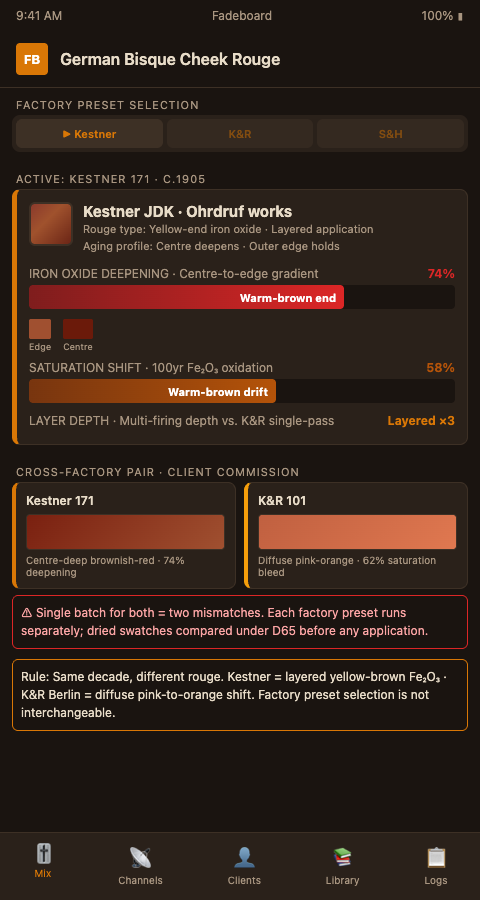
Kestner. The Kestner manufacturer reference documents that Kestner made entire dolls including the bisque, applying successive pigment layers for cheek depth across multiple firings. Kestner's rouge was characteristically a warm iron oxide — leaning toward the yellow-brown end of the iron oxide range — applied in layers rather than as a single concentrated application. Over a century, layered iron oxide deepens and warms in a gradual gradient from cheek edge to center, rather than fading uniformly. On an aged Kestner, the center of the cheek arc often reads deeper than the outer edges, because the outer edges bore more UV exposure.
Kämmer & Reinhardt. The K&R manufacturer reference documents that K&R assembled their dolls using Simon & Halbig bisque heads, applying their own face-painting at their Berlin workshop. K&R face-painting from the 1890s and early 1900s tended toward a pinker, more saturated rouge — closer to the red end of the iron oxide spectrum — applied in a more diffuse blush pattern rather than the concentrated cheek circle common in earlier doll production. Aged K&R rouge shows a different warmth-shift profile than Kestner: the pink saturation bleeds toward orange more noticeably as the iron oxide oxidizes.
Simon & Halbig own-production heads. S&H heads sold under the S&H mark (rather than assembled for K&R or Jumeau) used factory-standard rouge that sits between the Kestner and K&R formulations in character — slightly more saturated than Kestner but less diffuse than K&R's workshop application.
Fadeboard captures this variation through maker-specific rouge channel presets. Rather than a single "German bisque cheek" fader position, the channel system loads a factory profile that sets the warmth-direction and saturation-shift parameters appropriate for the documented pigment chemistry of that specific manufacturer. A Kestner preset sets the rouge channel to expect layered deepening from center to edge; a K&R preset sets it to expect diffuse pink-to-orange shift. Once the cheek rouge is calibrated to factory chemistry, the lip restoration requires its own separate fader profile — restoring historic madder red lip paint covers how madder red ages differently from iron oxide rouge, which is a necessary second step after the rouge channel is confirmed.
The LOC pigments tracking project documents exactly this kind of systematic colorant-difference recording: Library of Congress pigments staff build reference databases that allow comparison of historical colorants across makers and periods. The same comparative discipline applied at the single-studio level — noting which rouge formula each German factory used and how it shifts — is what Fadeboard systematizes for independent restorers without lab infrastructure.
Handheld XRF technology can detect iron oxide and manganese non-destructively on bisque surfaces — giving precision identification of rouge compound composition that allows exact channel calibration. For studios without XRF access, the free XRF spectroscopy pigment reference database provides a comparison baseline for identifying iron oxide grades from visual descriptions and known factory associations.
UV fluorescence photography is a no-contact option for mapping rouge distribution on bisque surfaces without sampling. Under UV, different iron oxide grades fluoresce with slightly different intensities, allowing identification of application pattern — layered versus diffuse — that the channel preset selection depends on.
Advanced Tactics for Cross-Factory Rouge Matching
When restoring two dolls meant to match across different factories, three techniques reduce the final color gap.
Set factory-specific channels first, then calibrate to each other. Start with the Kestner at its factory-correct channel settings and mix the Kestner rouge first. Then open the K&R session with its factory-correct settings and adjust the saturation fader — not the formula — until the K&R swatch matches the Kestner test swatch in dried condition. The channel adjustment is the traceable record; the mix formula follows from it.
Use the same Bristol card batch for both swatches. Paper lot variations affect how tinted washes dry. Cutting both swatches from the same sheet eliminates one variable from your swatch comparison.
Match under D65, not your workbench lamp. If both pieces will be displayed under the same light source, that is the light source to match under. But for restoration purposes, D65 is the standard reference that gives you a neutral comparison baseline before you introduce display-lighting variables. On cross-factory pairs like a Kestner 171 and a K&R 101, viewing under D65 typically separates the rouge chemistry more clearly than viewing under incandescent — the warm-source renders both pieces toward orange, narrowing the apparent gap between the Kestner's center-deepened warmth and the K&R's diffuse pink. The D65 view reveals the actual hue relationship, which is what the fader calibration needs to anchor.
Common pitfall: using the same mixing batch for both dolls. Some restorers mix a single rouge batch intended to serve as a midpoint between the two factory chemistries — reasoning that splitting the difference produces a compromise that looks acceptable on both. This produces two dolls that neither match each other nor match their factory chemistry. The correct approach is two separate batches, each calibrated to its factory preset, then evaluated dry on Bristol card side by side under D65. If the dried swatches are still visibly different, note the ΔE and decide with the client whether the factory-accurate divergence is acceptable or whether a consensus tone is preferred — making that a documented client decision rather than a unilateral restoration choice.
Documenting cheek highlight inpainting approaches for bisque work is the next step once the base rouge channel is calibrated — highlights on aged bisque are subject to the same factory-variation logic and should be set from the same manufacturer profile. A Kestner highlight sits closer to the cheek center (following the layered rouge gradient) while a K&R highlight radiates more diffusely — the same factory chemistry that governs rouge application also governs where the restorer should target the highlight inpainting.
For restorers who also handle textile work, the madder variations in 1880s red-and-white quilts post covers the same cross-lot variability challenge: madder dye from different dyehouse suppliers ages to different endpoints, just as iron oxide rouge from different factories ages along different trajectories.
The Same Decade, Different Rouge
German bisque manufacturers of the 1880s–1910s were neighbors in the same export market, but their rouge formulations were not interchangeable. Fadeboard's factory-specific channel presets encode the differences that your recipe log currently has no way to represent — making cross-manufacturer matching a structured problem rather than a trial-and-error process.
If you currently handle Kestner and K&R heads with the same rouge formula and find the results diverging in dried condition, that factory chemistry gap is exactly what the channel presets address. The Fadeboard waitlist is open for independent German bisque restorers now — join with a note on which factory combination gives you the most persistent cross-doll matching problem, and that pair will be the first factory-preset comparison built into the early-access release.
Bring your most recent cross-factory commission to the first session you run. Load the Kestner and K&R presets side by side, run both swatches against your own dried test-card results from the job, and the divergence you have been explaining to clients as normal variation will resolve into two distinct factory chemistry signatures — each correctable on its own preset rather than averaged into a compromise neither doll wanted.