Mixing Historic Madder Red for Doll Lip Restoration
What Madder Red Actually Is
The lip color on a Jumeau bébé from 1882 was not chosen arbitrarily. The period palette for doll face painting was constrained by what pigments were commercially available and cost-effective at scale, and for reds in the 1870s and 1880s, that meant madder lake in one of its several commercial formulations.
According to ColourLex's documentation on madder lake, the pigment is defined by its alizarin-to-purpurin ratio, and that ratio is critical: purpurin-rich lakes are unstable and may fade noticeably within months of application, while alizarin-dominant lakes are comparatively stable but still vulnerable to light over decades. The cheaper commercial madder lakes used in industrial doll-face painting tended toward purpurin-rich formulations — the economics of batch factory production favored cost over permanence. This means that by the time a doll has aged 140 years, a significant fraction of the original madder lake's chromophore content has degraded, and what survives is a cooler, more muted red than was applied.
The Webexhibits pigment history archive documents that natural madder supplied the world's red dye needs until 1868, when alizarin was first synthetically duplicated. Dolls made before 1868 used natural madder from plant roots; dolls made after 1868 might have used either natural madder or synthetic alizarin, depending on the factory's sourcing. The two have subtly different spectral profiles, and an 1875 Jumeau may have a different red chemistry than an 1885 Simon & Halbig.
Jackson's Art Blog's documentation on fugitive pigments confirms that organic lake pigments like madder cannot be made lightfast — UV-protective framing slows but cannot stop fading. Every madder-based lip color on every antique bisque doll has faded to some degree, and the degree depends on the doll's storage history: glass case versus open shelf, south-facing window versus interior room.
Calculating the Original From the Current
This is where Fadeboard's fader model produces its most distinctive value for lip restoration. Rather than asking "what color should I mix to match what I see?" — which is the wrong question, because you're matching a degraded state — Fadeboard asks: "given the fade channels I dial in, what was the original, and what is the current match-point for that aged surface?"
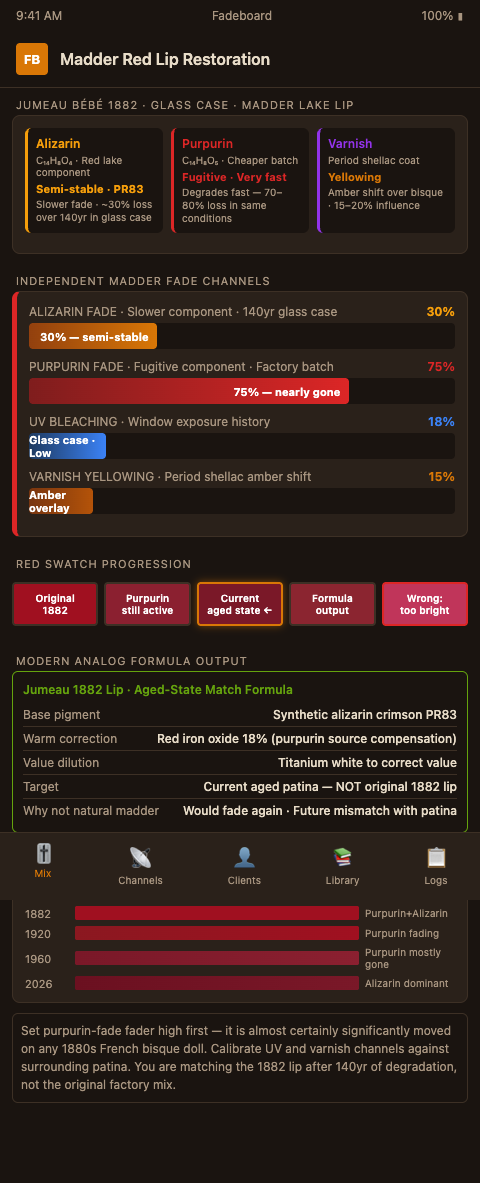
The soundboard metaphor is literal here: you have independent faders for the alizarin-fade channel, the purpurin-fade channel, and the UV-bleaching channel. You also have a varnish-yellowing fader that represents any amber shift from period overcoating. Each channel operates independently, as on a mixing board — moving the purpurin-fade fader doesn't change the alizarin setting, and the UV-bleaching channel doesn't assume anything about the varnish condition.
For a typical 1880s French bisque lip color that has been stored in a glass case (low UV, low humidity variation), a working starting point has the alizarin-fade fader at about 30%, the purpurin-fade fader at 70-80% (purpurin degrades much faster), and the UV channel at 15-20%. The resulting formula output is not "the original madder red" — it is the current aged state that matches the patina of the surrounding face, which is exactly what you need for a period-accurate lip restoration that integrates naturally with the existing surface. The methodology in predicting 50-year fade on restoration pigments extends the same fader logic forward: once you know the current channel positions, you can model where the alizarin crimson substitute will be relative to the surrounding original in 2076 — ensuring the restoration stays matched not just at application but across decades.
Parameters affecting photodegradation of dyes and pigments from ScienceDirect confirms that both UV and humidity accelerate organic dye fading, and that mordants improve lightfastness on solid substrates. For dolls stored in high-humidity environments — cellars, attics — the humidity acceleration channel in Fadeboard should be elevated even if UV exposure was low.
Choosing the Modern Analog
You cannot use natural madder lake for restoration — its inherent instability means a period-accurate pigment would fade again within years, creating a future mismatch with the doll's then-current patina. The standard approach is to use synthetic alizarin crimson (PR83) as the base and modify it toward the aged madder hue.
Alizarin's documented photochemical behavior is now used as a calibration standard in light-exposure testing — the very instability that makes natural madder problematic for restoration provides a known degradation curve that lets you predict where synthetic alizarin will be in 20 years. For a lip restoration meant to remain stable and matched for decades, you want a pigment that won't race ahead of the surrounding face.
The Forbes Pigment Collection at Harvard Art Museums houses 2,500+ pigment samples including historical reds — this collection functions as a conservation reference standard for identifying what a specific factory's madder lake looked like in its original state. If you can establish which factory produced the doll and approximately when, the Forbes collection can narrow down the original pigment specification considerably.
Practically, for a Jumeau bébé from the 1880s, the formula typically runs: alizarin crimson at base, modified with a small proportion of red iron oxide to warm the undertone (compensating for the purpurin component that's gone), and diluted with titanium white to arrive at the correct value. The Fadeboard output will specify the ratios; your job is to mix them accurately and test on Bristol card before application.
Edge Cases in Lip Restoration
Asymmetric fading. If one corner of the lip has faded more than the other — common on dolls that sat at an angle near a window — you need two Fadeboard settings: one for the more-faded zone, one for the less-faded zone, blended across the center. This is a single-sitting operation but requires two color cards and careful graduated application.
Lip liner versus lip fill. Many French bisque dolls had a darker, more saturated lip liner application at the lip edges, with a slightly lighter fill in the central zone. Confirm from a reference photograph whether the original had this two-tone treatment before applying a uniform formula. A correct uniform fill over an original two-tone lip reads as visually flat.
Wet-looking lips. Some Jumeau and Bru lips received a gloss finish — a thin coat of period varnish over the madder fill to simulate the shine of natural lips. If the surrounding face surface shows evidence of selective glossing in the lip zone, your restoration formula needs a varnish topcoat, applied only within the lip outline.
The binder choice interacts significantly with long-term stability; the egg tempera vs casein binder comparison covers how protein binders affect red pigment stability specifically — casein's specular-reflection increase over time is particularly problematic for madder-red lip zones where the surrounding original bisque paint is definitively matte.
Ecclesiastical vestment conservators working with Tyrian purple analogs for high-feast vestments face structurally identical decisions — how to reproduce a historically unavailable or unstable pigment using modern substitutes that match the current aged state. The Tyrian purple analog workflow for high-feast vestments documents the substitute-selection logic that parallels the madder-to-alizarin substitution described here.
The Calculation That Changes the Result
Every restorer who has mixed a lip color by eye and found it too bright, too blue-shifted, or diverging from the cheek patina after a year has been matching the wrong target. You're not matching the original 1882 lip; you're matching the 1882 lip after 140 years of purpurin loss, UV bleaching, and ambient patination. Fadeboard's fader model gives you that calculation explicitly rather than requiring you to reverse-engineer it from experience alone.
If you have a Jumeau or Bru Jeune with degraded lip color on your workbench, open a Fadeboard session, set the purpurin-fade fader high (it's almost certainly moved significantly), and calibrate the UV and varnish channels against the surrounding patina. The formula output — modified alizarin crimson at the ratios Fadeboard specifies — gives you a lip color that integrates with the current patina and will remain stable alongside it. One mixing session, one Bristol card test, one correct application.