Comparing Egg Tempera and Casein for Doll Facial Restoration
The Binder Question Nobody Answers Directly
An independent restorer with a damaged Bru Jeune cheek surface and a completed Fadeboard formula can still produce a mismatched restoration if the binder medium she chooses behaves differently from the original factory paint on aging. The formula gives you the pigment ratios; the binder determines how those pigments sit on the surface, how they dry, and how the optical relationship between pigment and surface will evolve over decades.
A 2023 PR Newswire market report placed the doll collectibles market at 42% year-over-year growth with an 8.2% CAGR through 2033. The restorations completed in this market peak will be evaluated by appraisers and collectors for decades — a binder choice that looks correct at six months and diverges at five years is an invisible liability that lands in future hands.
The question is not egg tempera versus casein as abstract media — it is which binder's aging trajectory most closely parallels the original bisque face paint, and which introduces the least systematic divergence from the Fadeboard formula's calibrated output over the lifetime of the restoration.
Egg Tempera on Bisque: The Stable Option
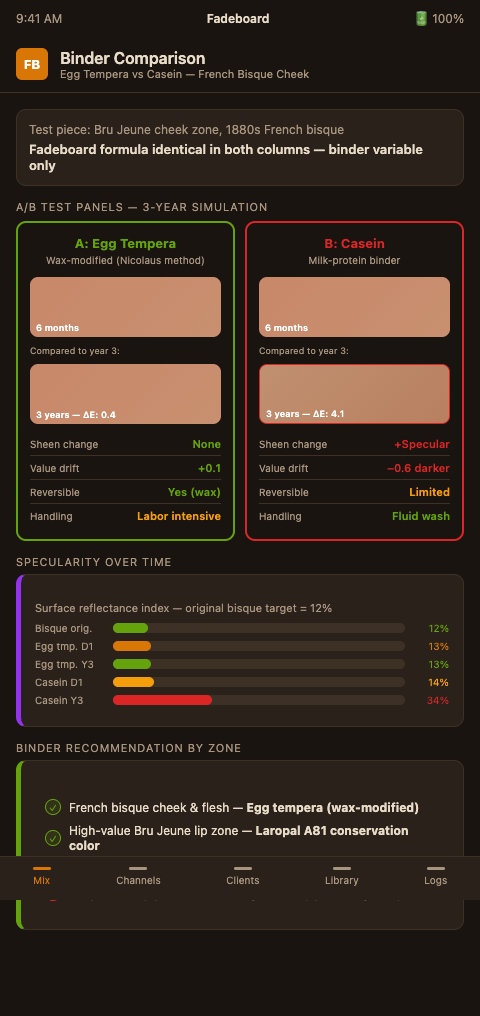
Egg tempera's documented behavior — it dries insoluble from water, with beeswax addition (the Nicolaus method) restoring reversibility for conservation use — makes it attractive for bisque facial restoration where reversibility is an ethical requirement. The AIC standard requires all inpainting to remain detectable and removable; egg tempera without wax addition violates the removability requirement over time as the protein binder cross-links.
Webexhibits' historical documentation of egg tempera confirms that egg tempera was the primary panel medium through approximately 1500, that it dries crystal clear, and that it has excellent archival stability without the yellowing that affects oil-based binders. On bisque, this translates to a restoration medium that does not shift the value or chroma of the Fadeboard formula output over time — what you calibrate on day one is still what the formula delivers at year twenty.
The handling limitation of egg tempera on bisque is building time. Egg tempera requires many thin, fast-drying strokes rather than the fluid washes that gouache allows. For a small loss zone on a bisque cheek, this can mean working with a size-1 sable and building three to five layers before the correct opacity is reached. The formula remains accurate throughout; the application is simply more labor-intensive.
Casein on Bisque: The Specularity Problem
Casein's profile is more complex. Britannica's entry on casein painting documents the basic properties: milk-protein binder, water-soluble when wet and insoluble when dry, brittle film that requires a rigid support. For bisque, the rigidity of fired ceramic satisfies the support requirement, and casein's water solubility during application allows fluid, gouache-like working.
The problem is aging behavior. RSC Analytical Methods research on proteinaceous binders identifies that casein markedly increases specular reflection and causes measurable color darkening compared to other protein binders. Translated to bisque restoration: a casein-bound inpainting that matches the matte bisque surface at application will develop a slightly higher sheen and darker value over time — precisely the divergence from the original patina that a correctly calibrated Fadeboard session is designed to prevent.
This does not mean casein never works on bisque. For composition body restoration — where the substrate has some flexibility and the original factory paint used synthetic enamel-type binders — casein's handling properties and reasonable adhesion on flexible surfaces make it more defensible. On bisque heads specifically, the specularity increase over time disqualifies casein as the primary binder for cheek and flesh-tone inpainting zones where the surrounding original surface is definitively matte.
Palaeoproteomics research from Scientific Reports used mass spectrometry to distinguish egg, casein, and glue binders in 15th-century painted artworks — confirming that these binders are chemically distinguishable and that their aging behaviors are distinct, not interchangeable. This level of analytical precision underpins the conservation community's position that binder choice matters for long-term outcome, not just handling convenience.
Integrating Binder Choice With the Fadeboard Session
The Fadeboard session calibrates for the original bisque surface's matte, slightly porous optical behavior. When you translate that calibration into an application medium, the binder choice either preserves that optical relationship or introduces a systematic divergence. Egg tempera with the Nicolaus wax addition preserves it; casein compromises it over the medium term.
The AIC Conservation Wiki's survey of inpainting binders and media covers the full range of retouching binders — egg tempera, gouache, and synthetic resins — with reversibility notes. The practical summary for bisque doll work: gouache is the entry-level option with adequate results for small losses; egg tempera (wax-modified) is the standard for French bisque facial zones where long-term optical stability is required; Laropal A81-based conservation colors (Gamblin's Laropal A81 research documented 3,000-hour aging tests with maintained solubility) are the high-performance option for restorers who need both stability and reversibility but can manage petroleum distillate solvents.
Casein is not in the recommended tier for French bisque facial restoration — but understanding precisely why helps you recognize when it might be appropriate (composition body, non-facial zones, reversibility not required by client) versus when it introduces unacceptable risk. For cases where the Effanbee or composition body material history affects binder compatibility decisions, the Effanbee pigment forensics methodology covers the substrate analysis that precedes any binder selection — on composition, casein's structural brittleness compounds with the substrate's dimensional movement in ways that bisque does not present.
The Test for Your Specific Bisque
No two bisque bodies behave identically. Before committing to any binder for a specific head, run a comparative absorption test on a sherd from the same manufacturer and period, if available, or on an inconspicuous zone of the doll itself. Apply the Fadeboard formula with each candidate binder, allow full cure (minimum 72 hours for egg tempera, 48 hours for casein), then evaluate under raking light, direct light, and UV. The binder that produces the closest optical match to the original surface under all three conditions is the correct choice for that specific job.
For the long-term stability question — predicting where the restoration will sit relative to the original in 50 years, accounting for both binder aging and pigment fade — the methodology in predicting 50-year fade for restoration pigments uses Fadeboard's forward-projection channels alongside the binder aging data to model long-term divergence.
Ecclesiastical conservators making analogous binder decisions for silk vestment restoration — where wax- and protein-based binders must be assessed against their effect on silk's natural sheen — draw on the same AIC inpainting media survey. The kermes versus cochineal scarlet cope comparison discusses how vestment medium selection interacts with the spectral properties of the substrate in ways that parallel the bisque binder question described here.
Choose the Medium That Ages With the Surface
The guiding principle for binder selection in bisque doll restoration: choose the medium whose aging trajectory most closely parallels the original surface, not the medium that is easiest to handle at application. Egg tempera, wax-modified for reversibility, is the defensible choice for French bisque facial zones. It requires more time and skill to apply, but it preserves the optical relationship that the Fadeboard formula calibrated for — and it remains optically stable alongside the original surface over the decades the doll will spend in a collector's glass case.
If you're currently using casein on bisque cheek zones because it handles more like gouache, run a comparison test against egg tempera on a sacrificial shard. Place both test panels on a windowsill for 30 days and compare them against your original reference under raking light at the end. What you observe will make the binder decision straightforward — not because theory says one is better, but because you will see the specularity difference developing in real time. Let Fadeboard calibrate the formula; then choose the binder that keeps that calibration intact.