Workflow for Restoring Logwood Black on Mourning Quilts
Why Logwood Black Fails in Layers, Not All at Once
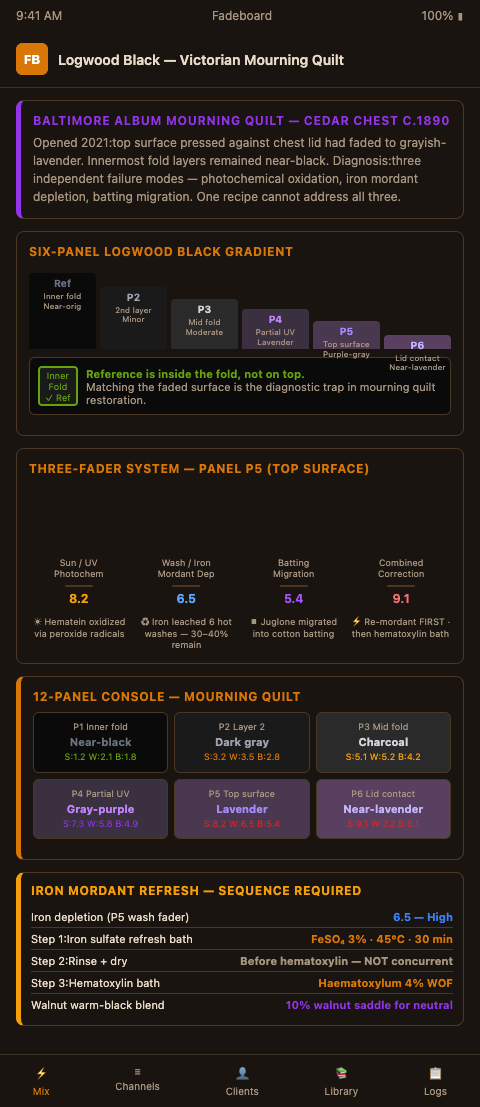
A workshop in rural Pennsylvania opened a cedar chest in 2021 to find a Baltimore Album-style mourning quilt that had been folded since the 1890s. The top surface, pressed tightly against the chest lid, had faded to a dull grayish-lavender. The innermost layers remained closer to the original near-black. The restorer's first instinct — match the faded surface — was exactly wrong. The reference color was inside the fold, not on top of it.
This is the central diagnostic trap in Victorian mourning quilt restoration. Victorian mourning customs mandated dull lusterless black fabrics for textile mourning goods, including quilts that formed part of prescribed grief ritual. The cultural stakes are high: mourning home décor including quilts formed a prescribed material expression of Victorian grief, and families often know exactly what the original should look like from surviving daguerreotypes or written inventory.
The technical problem is that logwood black is not a single chromophore. Hematoxylin, the active compound extracted from the Haematoxylum campechianum tree, oxidizes in air to hematein. When combined with an iron mordant, hematein forms the near-black complex that gave Victorian mourning textiles their distinctive flat, unreflective darkness. Over decades, both the mordant bond and the chromophore itself degrade unevenly — oxidative bleaching removes the deepest wavelengths first, leaving behind the residual purple of partially degraded hematein. A quilt that looks uniformly faded often contains six or seven distinct degradation zones, each requiring a different intervention depth.
The natural dye market's projected ~6% CAGR growth reflects renewed interest in historically accurate restoration methods, but demand for logwood work specifically is being met by practitioners who learned synthetic-dye matching logic and are now confronting a very different chemistry.
The Fadeboard Approach: Separate Faders for Separate Failure Modes
The core problem with applying a single master recipe to a logwood mourning quilt is that no two panels fail the same way. A south-facing corner that received forty years of window light has lost color through photochemical oxidation. A backing panel in batting contact has lost iron mordant into the wadding through wet cycling. A center block that was always folded under has retained most of its hematein-iron complex but carries the off-gassing products of the surrounding wool batting.
Fadeboard treats these as separate channels, each with its own fader.
The sun-exposure fader handles photochemical chromophore loss. Research confirms that hematoxylin oxidizes to hematein via an iron mordant, and the resulting complex degrades further with light exposure — a two-stage failure mode that requires a two-stage compensating recipe. A panel at high sun-exposure has already completed much of the hematein conversion; re-dyeing with fresh hematoxylin without accounting for the residual chromophore produces an over-deep result.
The wash-cycle fader addresses iron mordant depletion. Unlike alum-mordanted dyes where the mordant bond is relatively stable under domestic washing, iron mordant is water-soluble and migrates into both the bath and adjacent batting. A panel that went through six hot washes in the 1930s — common during the Depression era when quilts were laundered aggressively — may retain 30-40% of its original mordant saturation while still showing near-original surface color in low light. The wash-cycle fader accounts for this hidden depletion by adjusting the mordant-refresh component of the recipe independently of the chromophore dose. The Victorian theater context offers a useful parallel: restoring greens in 1890s operetta breeches documents the same problem of mordant-dependent color drift in period garments, and the diagnostic framework for separating dye loss from mordant loss translates directly to mourning quilt work.
The batting-contact fader handles the dye-loss-into-wadding problem. Cotton wadding absorbs iron salts through capillary action during wet processing, pulling mordant out of the face fabric from the back. Lab identification of 19th-century blue/black dyes confirms that logwood loses its visible spectroscopy peak with aging, and that loss pattern correlates directly with batting density and original moisture exposure. Panels over dense cotton wadding show accelerated mordant depletion compared to panels over loosely packed batting.
The operator working a mourning quilt in Fadeboard sets three fader positions per panel rather than writing a single recipe for the whole quilt. Each panel-indexed recipe captures: (1) the sun-exposure value, expressed as years of south-facing window equivalent; (2) the wash-cycle count, drawn from family history or fiber analysis; and (3) the batting-contact rating, assessed by comparing face-side and back-side color under magnification. The resulting recipe set looks like a small mixing console — each panel has its own column of fader positions, and the restorer can scroll across the quilt's geometry to see where the restoration effort is concentrated.
For apprentice handoff situations, this structure has a specific advantage: the incoming practitioner does not need to reconstruct the diagnostic reasoning. The fader positions are the reasoning, encoded as recipe parameters. Shade drift between shift changes — one of the most frequent sources of multi-block inconsistency in heirloom quilt work — is eliminated because the panel-indexed recipe is the same document whether the senior restorer or the apprentice is at the dye bath.
Advanced Tactics for Logwood Black Restoration
Mordant refresh sequencing. When the wash-cycle fader indicates significant iron depletion, the correct repair sequence is mordant refresh before dye bath, not concurrent. Applying a fresh iron sulfate bath to the depleted panel, rinsing, and then proceeding to the hematoxylin bath produces deeper final color than attempting to combine mordant and dye in the same step. The sequence matters because iron and hematein form the color complex at the fiber surface, not in solution; co-bath application reduces contact efficiency.
Progressive depth matching across panels. Because Fadeboard generates a recipe per panel rather than per quilt, the restorer can rank panels by total degradation depth and process them in order from shallowest to deepest. This approach catches recipe calibration errors early — a mild over-depth on a lightly faded panel is visible before the same error is applied to the heavily faded center blocks. Processing light-first is the quilt equivalent of mixing test swatches before committing to a full-scale dye bath.
DART-MS as a pre-treatment diagnostic. For museum-quality mourning quilts where sampling is permitted, DART mass spectrometry identifies hematoxylin derivatives in seconds on historic fibers. A single surface reading per panel tells the restorer whether hematoxylin is still present in measurable quantity or has fully converted to degradation products. This data feeds directly into Fadeboard fader calibration — a panel where hematoxylin is undetectable by DART-MS warrants a higher sun-exposure fader position than one showing a partial residual peak.
The walnut-black blend option. For whole-cloth mourning quilts where logwood alone produces a slightly blue-undertone black, a proportion of walnut brown in the saddle position can shift the final color toward warmer neutral black. Walnut brown mixing for whole-cloth quilt restoration describes the blending ratios; when applied to mourning contexts, walnut's own mordant-independence means it anchors to the cotton fabric regardless of the iron-mordant condition, providing a base layer of warmth under the logwood black.
When comparing the long-term durability of logwood to alternative blacks, restorers working on quilts destined for display should review vat vs. mordant dye comparisons for quilt restoration — the fastness difference is substantial for pieces that will receive any ongoing ambient light exposure. For period-accurate 19th-century mourning pieces, however, logwood with iron mordant is the historically correct choice, and its characteristic tendency toward slight purple undertone in low-light conditions is a marker of authenticity rather than a flaw.
Start With the Fold, Not the Surface
Fadeboard-based logwood restoration begins before the dye bath by building a complete panel map. Photograph the quilt under D65 daylight-balanced lighting. Record a fader position for each panel — sun exposure, wash cycles, batting contact. Note which panels were at the chest surface and which were inner folds. The reference color is always the most protected panel, not the average.
Workshop specialists working through Victorian mourning quilts for the first time often find that two-thirds of their effort goes into the pre-treatment documentation and less than a quarter into the actual dye work. That proportion is correct. A Fadeboard panel map for a 12-block mourning quilt takes two to three hours to build properly. It prevents two to three days of re-dyeing.
If your workshop holds mourning textile pieces — or if a client is about to bring you one — consider starting a Fadeboard panel-indexed session before the next project arrives. The fader positions you set on the first mourning quilt become the calibration reference for every logwood black project that follows.