Workflow for Restoring Greens on 1890s Operetta Breeches
The Problem With Victorian Stage Green
A costume technician cataloguing an 1890s touring company wardrobe documented a set of breeches labeled "garden-fairy green" in the production notes. Under fluorescent examination the garments had shifted to a flat, grayish yellow-brown with no surviving chroma. The period production notes specified a saturated emerald-adjacent hue consistent with what was fashionable in West End operetta of that era.
The culprit, in most cases, was Scheele's green or its successor emerald green — both copper arsenite compounds widely used in Victorian stage costuming before their toxicity forced a gradual shift to synthetic aniline alternatives. Research compiled by Hidden in plain sight: Scheele's and Emerald green confirms these arsenic greens undergo well-documented darkening and surface chalking when exposed to moisture and ambient sulfur compounds — conditions common in any touring company wardrobe trunk.
By the 1880s and into the 1890s, aniline-derived malachite green and later viridian-based formulations began replacing arsenic dyes on stage garments. Aniline greens of that generation were more lightfast than aniline magentas and yellows, but still susceptible to fading along the red-absorbing axis — meaning green fabric shifts toward blue-gray or warm yellow depending on which chromophore degrades first. As The Dyes of Death — Maryland Center for History and Culture notes, costume dyers of the 1880s–1890s routinely blended arsenic and early synthetic colorants in the same bath to hit a wider palette, producing garments with complex mixed degradation profiles that are difficult to assess by eye alone.
For the archivist, this creates a compounding problem: you may be looking at a breeches leg that started as a blend of two or three distinct green colorants, each degrading on its own schedule. Without a systematic approach to decomposing that profile, any restoration attempt is likely to produce a color that looks correct under one light source and wrong under every other.
The Fadeboard Workflow for Operetta Breeches Greens
The soundboard metaphor at the core of Fadeboard treats each independent variable affecting the current state of a fabric's color as a separate fader channel. For 1890s operetta breeches greens, the relevant channels break down as follows.
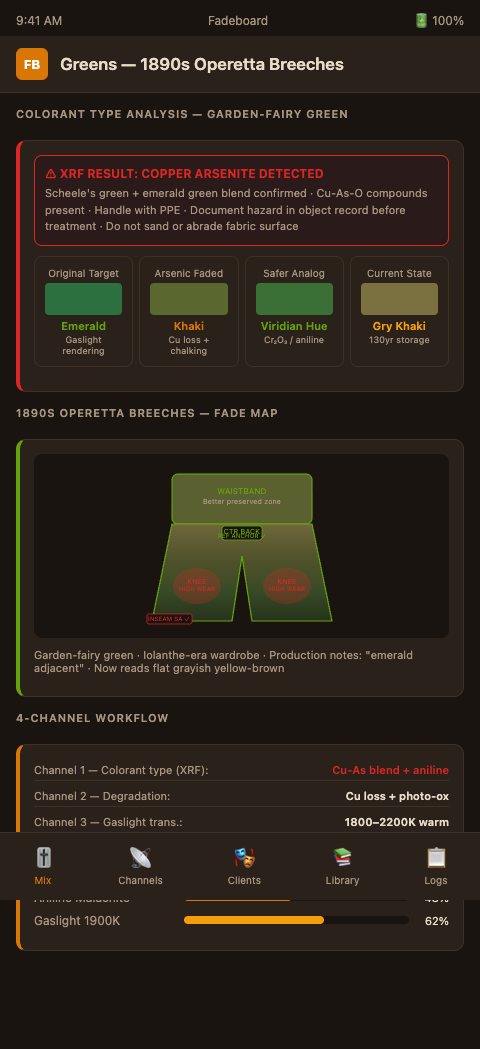
Channel 1 — Colorant type. XRF spectroscopy can distinguish copper-containing arsenic greens from iron-or-chromium-based alternatives without destructive sampling. The Free XRF Spectroscopy Database of Pigments — Cultural Heritage Science Open Source provides a reference database that lets you compare field readings against known period formulations. This fader tells you whether you are dealing with a copper arsenite, a chromium oxide, an aniline malachite, or a blend.
Channel 2 — Degradation mechanism. Arsenic greens fail through copper loss and surface chalking. Aniline greens fail through photo-oxidation of the chromophore. Mordant-based natural greens (over-dyed blue indigo + yellow weld) fail through differential bleaching of the indigo component, leaving a yellow residue. Each mechanism produces a different color endpoint, and each requires a different restoration path. Setting this fader correctly means the difference between a breeches leg that restores to a period emerald and one that restores to a muddy blue-green.
Channel 3 — Lighting-era translation. This is where Fadeboard's channel architecture diverges from standard colorimetric analysis. Gaslight footlights of the 1890s emitted a warm, continuous spectrum peaking in the orange-yellow range — closer to 1800–2200K. Under those conditions, a garden-fairy green that modern eyes perceive as a saturated cool green would have read as a warmer, slightly yellowed green to the period audience. The limelight used for featured performers pushed further into the blue-white range, which would have snapped cool greens into high chroma vibrancy.
When a remount or exhibition requires the breeches to read convincingly under modern 5600K LED rigs, the restoration target must shift. A green calibrated to look correct under gaslight will look undersaturated and warm under LED. This fader — the lighting-era translation channel — lets you model the original designer intent in the original light source, then derive an exhibition-appropriate equivalent.
Channel 4 — Fragmentary loss. Many breeches show fragmentary loss in high-wear zones: the knee panels, waistband lining, and hem edges. The surviving green at the center back panel often retains more original colorant than the seat or knee areas. Pulling a baseline from a protected interior seam and using it as the fader's reference state allows you to set a target that reflects the original, rather than the most faded surviving area.
For a particularly complex case — where all three colorant types are blended — Parameters affecting photodegradation of dyes and pigments — ScienceDirect provides the degradation kinetics for aniline chromophores under UV and visible light, which helps translate spectrophotometric readings of the current faded state back to a plausible original.
Advanced Tactics for Green Restoration on Stage Breeches
Test on a hidden seam allowance first. Victorian breeches frequently have generous seam allowances on the inseam and back rise. This fabric has typically seen little light exposure and zero footlight exposure, so it retains a closer approximation of the original dye bath. Apply any colorant test to a fold of this seam allowance, not to a visible panel.
Account for the aniline-arsenic blend transition. If XRF confirms copper but also reveals organic chromophores, the breeches are likely from the transitional period (late 1880s to mid-1890s) when dyers were blending arsenic greens with early synthetic anilines to extend the arsenic supply or hit a specific hue. The arsenic component will have degraded faster, while the aniline component may have shifted toward blue. Your restoration formulation needs to account for both degradation curves — a single green dye bath will not adequately address a two-component fade.
Model the Gilbert and Sullivan connection. Operetta breeches in the late 1890s often drew from the same sourcing ecosystem as Savoy Opera productions. The garden-fairy green palette associated with Iolanthe-era productions was a specific aesthetic target — a saturated emerald that read as enchanted under gaslight footlights. Comparing your breeches' baseline spectral profile against surviving photographic stills and mourning black comparison records from the same wardrobe period can help anchor the restoration target within the correct production context.
Do not treat arsenic-bearing fabric without proper precautions. If XRF confirms Scheele's green or emerald green, the fabric may carry residual arsenic compounds. Death on the Doorstep: Arsenic in Victorian Wallpaper — Saint Louis Art Museum documents arsenic spread across contemporaneous consumer goods, establishing that costume dyes sourced from the same supply chain are plausible arsenic carriers. Work with appropriate PPE and document the hazard finding in the object record before any treatment.
Stagger the lighting-era channel across performance zones. If the breeches will be worn in an active remount rather than displayed, the restoration target should weight the 5600K LED translation more heavily. If they are going into an exhibit case, the gaslight footlight translation is the correct reference — you want the exhibit viewer to see what the period audience saw. Fadeboard's independent fader architecture allows you to store both profiles simultaneously, so the same assessment can serve both use cases without running a second analysis.
For cases involving complete Gilbert Sullivan yellows in the same production wardrobe, cross-referencing the degradation timelines for yellow and green anilines helps confirm whether both colorants share a common formula origin — a useful provenance indicator.
Theater archivists working through a backlog of 1890s operetta costumes will find that the breeches greens workflow scales efficiently once the fader channels are calibrated for a specific production's colorant era. Open a Fadeboard session with a well-documented reference piece from the same wardrobe, establish the baseline profile for each channel, and apply those settings as starting points for subsequent breeches in the same lot. You can also cross-check your logwood-era reference settings against the logwood mourning workflow developed for a related textile context — mordant chemistry overlaps more than the different substrates might suggest.
If your archive holds a full operetta wardrobe from the 1890s and you have not yet established a colorant reference library for the green channel specifically, start with the best-preserved piece in the collection and build outward. The workflow described here is replicable across a lot of 20–30 breeches once the channel settings are established.