How to Document a Vestment's Original Liturgical Hue
The Documentation Gap
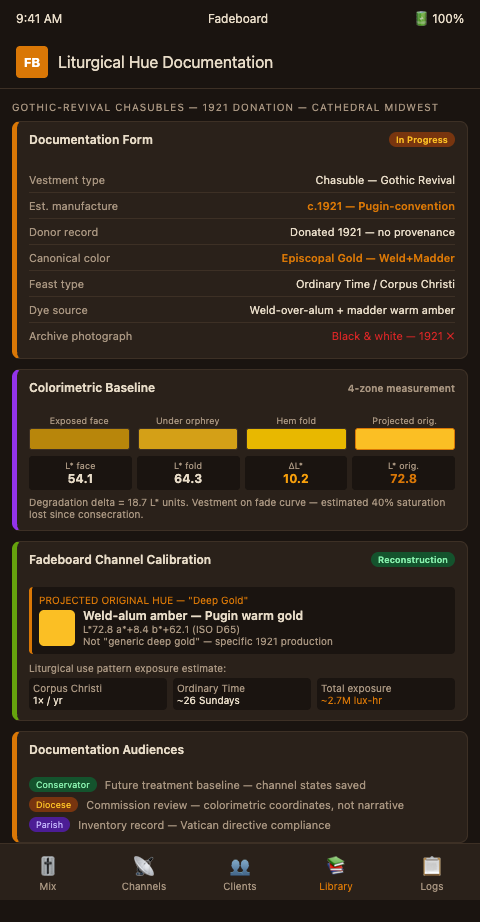
A cathedral archivist in the Midwest discovered the problem during routine accessioning: a set of Gothic-revival chasubles donated in 1921 had no original-condition documentation beyond a dated photograph taken on the altar steps. The photograph was black-and-white. A handwritten note in the vestment chest read "deep gold with red orphrey" — which described approximately forty percent of formal Gothic-revival vestment production from that period. When the conservation committee asked what color the "deep gold" actually was, no one in the building could say.
The 1921 commission would have been produced by a vestment studio familiar with the Gothic Revival conventions established by A.W.N. Pugin and popularized through 19th-century British and American ecclesiastical commissions. "Deep gold" in that context usually meant a weld-over-alum-mordant base on a medium-weight silk damask, sometimes brightened with a small proportion of madder to produce a warm amber rather than a pure yellow-gold. But without colorimetric documentation, "usually" is not the standard that justifies a restoration target — and neither the archivist nor the conservation committee had any way to distinguish the set's specific original from the broader category it fell into.
The ecclesiastical calendar itself accumulates fading exposure per vestment color set in a measurable way — the Determining Treatment Priorities framework for ecclesiastical textiles notes that liturgical use patterns allow conservation-grade estimation of cumulative fading by color (Determining Treatment Priorities for Ecclesiastical Textiles, ScienceDirect). A green chasuble used for twenty-six ordinary Sundays per year accumulates different cumulative exposure than a red chasuble used only for Pentecost, apostle feasts, and martyr days. This pattern-based exposure estimate is one input to the Fadeboard documentation framework.
Textiles function as historical documents, and their conservation documentation is essential to preserving the evidence embedded in the object (Textiles as Historic Documents and Their Conservation, Karen Finch Textiles). A vestment that enters conservation without a pre-treatment color record has lost part of its evidentiary value permanently — the baseline is gone. This is the strongest argument for creating the documentation record before treatment begins, even when treatment is not immediately planned.
Building the Hue Documentation Record
Fadeboard's documentation output is structured to satisfy three distinct audiences: the conservator who will perform future treatments, the diocesan commission reviewing the record, and the parish that needs to understand what it owns.
The documentation session follows a consistent sequence.
Macro photography under ISO D65. Full-garment photographs under calibrated daylight-standard illumination establish the visual baseline. Raking-light photographs capture weave structure and surface texture. UV-fluorescence photographs document dye distribution and prior repairs. Together, these form the photographic record that AIC standards require for examination documentation (PMG Examination and Documentation, AIC Conservation Wiki).
Colorimetric measurements at reference zones. Protected areas — under orphrey bands, in folds, behind lining seams — are measured separately from exposed face areas. The difference between protected and exposed measurements establishes the degradation delta: how much color has been lost, and approximately where on the fade curve the vestment currently sits.
Fadeboard channel calibration. Enter the garment's documented history — manufacture date, liturgical use pattern, storage conditions, known cleaning treatments. The soundboard projects from the current measured state backward through the estimated degradation pathway, arriving at a color reconstruction that represents the most defensible estimate of the original liturgical hue. This reconstruction is expressed as colorimetric coordinates, not a verbal description.
Fragment analysis, if available. When a thread sample or reliquary fragment exists, instrumental analysis of that fragment can confirm or correct the soundboard projection. Fiber and dye analysis on hidden chasuble fragments has demonstrated how FTIR-ATR, SEM-EDX, and HPLC can distinguish original sections and reconstruct original textile hue and provenance (Revealing the Origin: Textile Fragments in 19th-Century Chasuble from Dubrovnik, PMC). When the fragment data is available, the Fadeboard output can be calibrated against it rather than relying solely on exposure-history estimation. For a Gothic-revival chasuble donated in 1921 with no surviving invoices, a thread sample from a seam allowance — inaccessible during active use and therefore better preserved than the face fabric — can provide the analytical anchor that the documentation record lacks.
Provenance cross-reference. Where institutional records survive, they anchor the documentation. Vatican directive requires bishops to commission inventories of church movables — including vestments — with textile-science specialist collaboration (Inventory and Catalogue of the Cultural Heritage of the Church, Catholic Culture). A diocesan inventory that includes Fadeboard-generated colorimetric records satisfies this requirement with a level of precision that narrative descriptions cannot achieve.
The problem of lost provenance before donation is well-documented: systematic pre-accessioning documentation is critical to recording hue history before objects are transferred between custodians (Preserving Provenance: Collaborative Conversation with a Textile Collector, DigitalCommons/UNL). For parish vestments that are being donated to a diocesan museum or cathedral collection, a Fadeboard documentation session before transfer preserves the hue record that would otherwise disappear with the donor.
Advanced Tactics: The Living Record
A single documentation session produces a snapshot. The more valuable product for a parish with a working vestment collection is a living record — one that is updated each time the vestment receives treatment, cleaned, or returned from loan. For a 19th-century Marian chasuble in regular feast-day use, the documentation record produced at intake becomes the reference point against which each subsequent examination measures actual versus predicted fade — a discipline that converts the record from an archival document into an active management tool.
The Fadeboard documentation format exports to a structured file that can be stored alongside the vestment's physical conservation record. When the vestment is examined again in twenty years, the conservator can import the previous session's data and see the degradation progression across the intervening period. This enables proactive treatment decisions: rather than waiting until a vestment's color is obviously wrong, the parish conservation committee can review the projected degradation curve and schedule preventive stabilization before liturgical color identity is lost.
For diocesan collections with multiple vestment sets across multiple parishes, the documentation records become a comparative database. The conservator who has documented ten sets of Ordinary Time green chasubles can identify outliers — vestments that have degraded faster than expected — and flag them for priority treatment. This is exactly the kind of systematic approach that the AIC examination and documentation framework was designed to support.
When the documentation record needs to support a formal treatment proposal for diocesan approval, vestment color decisions for diocesan approval cycles covers how to present Fadeboard's output in the format commissions expect. For conservators building out a full reference system rather than single-vestment records, liturgical color reference from parish collections provides the aggregation methodology. The stage-hue documentation workflow for theatrical costumes in documenting original stage hue for archive costumes offers a parallel approach for secular textile contexts with similar documentation challenges.
Creating the Record Your Diocese Needs
Your vestments are losing their liturgical hue identity at a rate that is measurable, predictable, and — with early intervention — manageable. The documentation session that Fadeboard enables in a single afternoon creates a record that will serve your parish for the next century: a defensible colorimetric baseline that any future conservator can use, any diocesan commission can review, and any successor sacristan can understand.
The documentation record is also the answer to a problem that most parishes do not anticipate until it is too late: the sacristan who knows the vestments retires or moves. The institutional memory of what color the Easter cope was originally — the warm gold-white that reads properly in morning light at the Vigil, as distinct from the ecru-beige that approximates it after twenty years of use — disappears with that person if it was never committed to a colorimetric record. Fadeboard's intake session converts that memory into a documented baseline that survives personnel changes and generational transitions in parish leadership.
For vestments being prepared for a major liturgical event — an episcopal visitation, a centenary Mass, a Marian consecration ceremony — the Fadeboard documentation record can serve as part of the formal presentation to the bishop or the diocesan liturgical commission, demonstrating that the parish's textile heritage has been treated with documented stewardship rather than institutional neglect.
Contact Fadeboard to schedule a vestment documentation intake for your sanctuary collection before the next Ordinary Time season begins — and open a record today that will still be legible to the conservator who examines your chasubles in 2125.