How to Document an Original Stage Hue Before Restoration
The Evidence That Treatment Erases
The Museum of the City of New York holds one of the most significant theater collection archives in North America — tens of thousands of objects documenting New York stage history from the mid-19th century forward. Acquisition of major collections has repeatedly surfaced the same problem: when significant costumes arrive from private estates or closed theater companies, their pre-treatment documentation is fragmentary or absent. Without a color baseline, subsequent treatment decisions are made against a moving target, and provenance claims about original appearance become difficult to substantiate. (Theater Collection — Museum of the City of New York)
This is not a problem unique to large institutions. Any costume archive that loans pieces to touring productions, remount productions, or exhibit venues faces the same exposure: once a garment has been under modern LED stage lighting or treated by a conservator at another institution, the archivist needs a documented baseline to argue for — or against — the treatment's fidelity to original intent.
The American Museum of Natural History's condition-reporting protocol specifies that photographic and written color documentation must be completed before any treatment begins, precisely because treatment changes the object irreversibly and the documentation record is the only baseline available afterward. (Conservation Methodologies: Condition Reporting — AMNH) For historic theater costumes, this standard documentation captures condition, but not always original intent — the two are different things.
A color baseline for a stage costume needs to capture not just the degraded current state, but the evidence needed to reconstruct the original state: the undegraded zones, the period references, the lighting-era context. That is a more demanding standard than a condition report, and it requires a structured method.
Building the Stage-Hue Baseline With Fadeboard
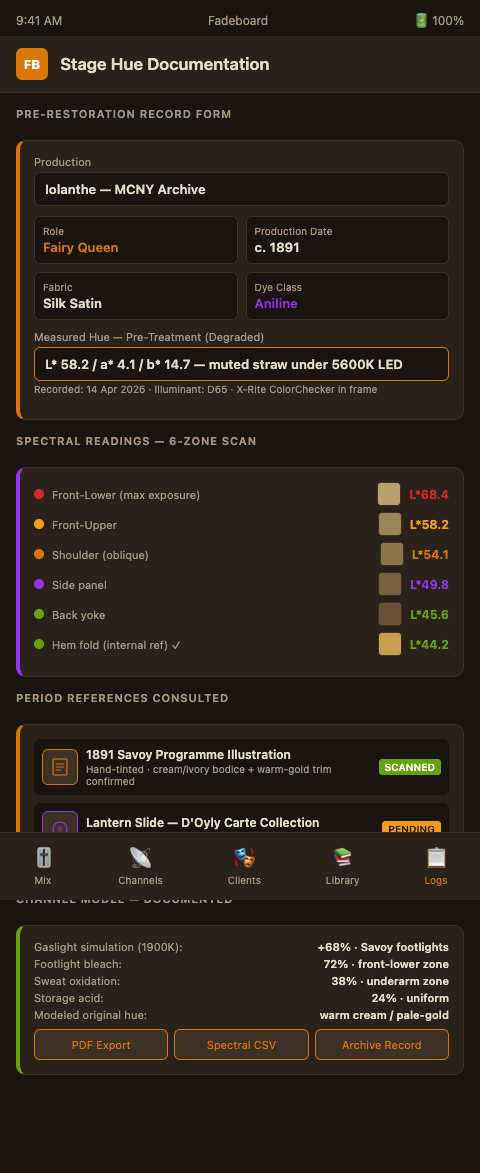
Fadeboard's documentation layer is built around the concept that the session log is itself an archival product. Every fader position, every channel weight, every reference material consulted during the session becomes part of the permanent record. When the session is complete, the archive holds not just photographs of what the garment looks like, but a documented model of what it looked like originally — or, more precisely, what the best-supported reconstruction of original hue indicates.
The practical steps follow a sequence informed by conservation imaging best practice.
Calibrated photography first. FotoWare's professional guidance for museum artifact photography recommends using an X-Rite or equivalent color calibration chart in every image frame, providing a ground-truth reference that makes the photographs metrologically reliable across different viewing environments. (Artifact Photography for Museums — FotoWare) For a stage costume, this means photographing each major panel zone — front lower, front upper, back, sides, internal lining — with a calibration chart in frame, under a standardized D65 or D50 light source, before any handling begins.
Spectral readings at key zones. A Nature Scientific Reports study on improving color reliability in digital textile images found that integrated spectrophotometric readings substantially outperformed uncalibrated digital photography for archival color capture, providing repeatable values that resist the drift of different display environments. (Improving Color Reliability of Digital Textile Images — Nature Scientific Reports) Even a portable handheld spectrophotometer reading at four to six points gives the Fadeboard session log a numerical anchor that photograph review alone cannot provide.
Period reference integration. Any surviving production photographs, program illustrations, design sketches, or hand-tinted lantern slides should be scanned and included in the documentation package before the session begins. These are the external constraints on the reconstruction model — the evidence that limits which interpretations of the original hue are plausible. A Plos One multispectral imaging study demonstrated that pre-intervention imaging provides a constraint map that makes post-treatment validation possible even when the treatment significantly alters surface appearance. (A Multispectral Imaging Approach for Late Antique Textiles — PLOS One)
Channel model as documentation. The Fadeboard session itself produces the third layer of the baseline: the channel model. The degradation channels active on the garment — footlight bleaching, sweat oxidation, gaslight yellowing, storage-acid off-gassing — are documented with fader positions and the reasoning behind each. This is the layer that is absent from conventional condition reports and that makes the Fadeboard record qualitatively different.
For archivists building documentation packages that will support long-term tracking of archive decisions across seasons and production cycles, the archive decision tracking workflow covers the ongoing record-maintenance side of the protocol.
The parallel documentation methodology for objects where pigment-bearing surfaces carry their own evidential weight — specifically pre-restoration documentation for doll collections — is covered in the related documenting original pigment before touchup workflow.
Advanced Tactics for Stage-Hue Baseline Work
Document the documentation environment. The light source used for baseline photography and measurement should be recorded in the session log — illuminant type, color temperature, lux level. A baseline taken under 3200K studio tungsten and another taken under 5600K daylight-balanced LED will produce different readings from the same surface. The documentation environment is part of the record.
Record the degraded baseline separately from the reconstructed model. The session log should contain two distinct states: the measured current condition and the modeled original. These are not the same thing. An archivist reviewing the record in twenty years needs to distinguish what was observed from what was inferred. The Fadeboard session log structure reflects this: the measured readings are fixed inputs; the channel model is a documented interpretation built on those inputs.
Use the film-still archive as a secondary reference layer. For costumes from productions that coincided with early cinema activity — an 1890s tour that was photographed or filmed — early photographic records provide a secondary constraint on the documentation model. A Nature Scientific Reports computational study demonstrates machine-learning-assisted recovery of original color intent from faded photographic film records, and the methodology is directly applicable to using early film stills as color-reference documents. (Digital Restoration and Reconstruction of Heritage Clothing — npj Heritage Science)
Plan for the loan record. When a costume leaves the archive for a touring production or exhibit loan, it should leave with a copy of the pre-loan baseline documentation — not just the condition report, but the full Fadeboard session log and calibrated photographs. If the garment returns in a different state, the baseline makes the delta measurable rather than arguable.
Archive the session log in multiple formats. PDF, structured data export, and calibrated image files each serve different downstream users: the production designer who needs to see color swatches, the conservator who needs numerical readings, the archive management system that needs structured metadata. Building the export into the session workflow means the documentation is usable immediately rather than requiring post-processing.
For archivists whose baseline documentation work intersects with early film costume research — particularly when film stills constitute a primary period color reference — the archive reference from early film costume stills covers that evidence layer in full.
Establish the Record Before Treatment Begins
If your archive holds historic theater costumes that are approaching conservation treatment, a remount production loan, or an exhibit loan, the time to build the stage-hue baseline is now — before any of those processes begins.
The most common error in pre-treatment documentation is treating calibrated photography as sufficient. A well-composed photograph under a D65 light source with a color chart in frame provides a useful visual record, but it does not separate substrate color from dye overlay, does not record fader positions for each degradation channel, and does not produce a restoration target that the next conservator to open the file can act on directly. The photograph documents the state; the Fadeboard session documents the meaning of that state and what would be required to move it.
Two situations make the pre-treatment baseline especially critical. The first is when the garment is approaching a loan. A costume that leaves the archive without a documented baseline gives the institution no quantitative standing if the piece returns in a different condition — the borrowing venue can dispute any damage claim that rests only on photographic comparison. The second is when the garment has been treated before. Prior conservation work from an earlier decade may have altered the surface in ways that complicate current treatment planning; the pre-treatment baseline documents what the current state actually is, distinguishing surviving original colorant from prior restoration layers.
Contact us with your garment inventory and any period references in your collection — we will build the baseline before the first treatment decision is made, and deliver a session log that serves as the permanent color evidence record for the garment through every subsequent production and loan cycle.