How to Match Sarum Red on Medieval Chasuble Fragments
The Sarum Red Problem
The Gothic-revival parish brought in a chasuble fragment identified as c.1325 English embroidered silk — red velvet ground with gold thread and orphrey bands, consistent with documented Opus Anglicanum production. The conservator's task was to match the red well enough that new silk panels woven at a Lyon silk house could be inserted without visible discontinuity. The fragment measured under ISO D65 produced Lab* values that placed it firmly in the pink-orange quadrant. The conservator knew the original was not pink. The question was how far to move, and in which direction.
The Sarum rite dominated England from the 11th through the 16th century, and its liturgical rubrics governed vestment color with enough specificity that "Sarum red" functions as a technical term in the conservation literature (Use of Sarum, Wikipedia). The primary colorant was kermes — kermesic acid extracted from the dried bodies of Kermes vermilio insects found on Mediterranean oak. Kermesic acid gives silk a distinctive red-orange hue that contemporaries identified as "most regal" by the 14th century, and English kermes scarlet was formally distinguished from madder red in medieval trade records (Kermes (dye), Wikipedia).
The surviving corpus is small. The Metropolitan Museum's collection includes a documented c.1325 red velvet chasuble embroidered in gold thread and pearls, consistent with Opus Anglicanum production (Chasuble, Opus Anglicanum, Metropolitan Museum of Art). The Victoria and Albert Museum's holdings of Opus Anglicanum — primary surviving exemplars of English medieval embroidery on silk and velvet — provide additional reference points (Opus Anglicanum, Victoria & Albert Museum). Even together, these objects present faded readings; none are chromatic originals.
Dialing Back the Kermes Fade
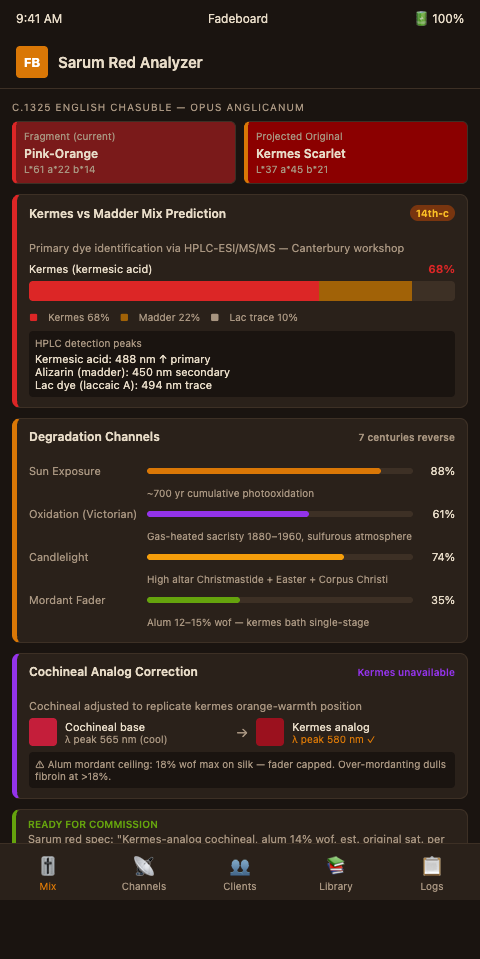
Fadeboard's soundboard framework is built for exactly this kind of backward-projection problem. For a 14th-century English chasuble, the relevant degradation channels are sun exposure (cumulative photooxidation over seven centuries of liturgical use), oxidation (atmospheric degradation accelerated by Victorian sacristy heating), and candlelight (concentrated combustion-product exposure at altar-rail height). For a Sarum-rite chasuble used at Christmastide, Easter, and Corpus Christi over seven centuries — the primary feast cycle in most English cathedral contexts — the candlelight channel carries particular weight because those seasons involve the highest-intensity processional candle use of the liturgical year.
The process begins at the fragment. You measure the fragment's current colorimetric values under ISO D65 — standardized daylight illumination — and enter them as the starting point. You then open the sun-exposure fader and set it to reflect the fragment's estimated light-history: a folded reliquary fragment accumulates far less exposure than a hanging chasuble, so you reduce the sun-exposure channel accordingly, lifting the fragment's apparent red toward a value that represents the shared original rather than the more-faded surviving piece.
HPLC-ESI/MS/MS analysis of 14th and 15th-century liturgical paraments has identified the primary red colorants as orcein, madder, and lac dye in specific proportions, with kermes present in high-status English pieces (Identifying Natural Dyes in 14th–15th Century Liturgical Paraments via HPLC-ESI/MS/MS, ResearchGate). This matters for channel calibration: kermes fades differently from madder under UV, and differently again under combined UV-plus-combustion-product exposure. If the fragment's dye composition has been characterized by HPLC, you can tune the sun-exposure and oxidation faders to match kermes's specific degradation curve rather than a generic red-dye default.
The oxidation fader addresses Victorian-era interventions. Many medieval chasubles spent the late 19th century in storage conditions designed for linen rather than silk — dry, warm sacristies with sulfurous gas heating. Fiber and dye analysis of a 19th-century Dubrovnik chasuble demonstrated how FTIR-ATR, SEM-EDX, and HPLC can distinguish original dyed sections from later repairs and from sections that experienced atypical chemical exposure (Revealing the Origin: Textile Fragments in 19th-Century Chasuble from Dubrovnik, PMC). The same analytical logic informs your oxidation-channel setting: if the sacristy was gas-heated from 1880 to 1960, dial the oxidation fader proportionally.
The candlelight fader is set based on the chasuble's liturgical position. A chasuble worn at the high altar during Solemn Mass at Christmastide accumulates more combustion-product exposure at chest and back than a chasuble reserved for weekday Low Mass. Parish records, if they survive, tell you which this was.
Advanced Tactics for Sarum Red Precision
Once the soundboard output gives you a restoration target, the next question is dye-bath construction. Kermes is commercially unavailable at production scale; the closest accessible analog for modern re-dyeing work is high-quality cochineal, adjusted in mordant ratio to shift the hue from cochineal's slightly bluer-red toward kermes's orange-warm position. HPLC detection peaks for madder (alizarin at 450 nm) and weld (luteolin at 350 nm) provide calibration anchors when cross-referencing your target against analyzed comparanda (HPLC of Natural Dyes: Plant Extracts and Dyed Textiles, ResearchGate).
For conservators working toward a full Sarum cope or chasuble restoration rather than a panel insert, the color relationship between the Sarum red ground and the orphrey gold needs to be established before committing to new silk. Medieval orphrey bands on Opus Anglicanum pieces were embroidered in Cyprus gold — gilt-silver membrane thread — which has its own degradation curve under combined oxidation and sulfur exposure. The gold-ground reading must be stabilized before you finalize the red, since the two chromatic relationships define each other liturgically.
Parishes and dioceses commissioning Sarum-rite revivals for historical or devotional use need this level of precision because the liturgical meaning of the color is inseparable from its chromatic accuracy. A chasuble whose red has drifted toward pink reads, visually, as a penitential garment — which is exactly the opposite of what Sarum red communicated. The soundboard output gives your commission board a defensible colorimetric specification rather than a subjective judgment.
Common Pitfall: Mordant Ratio Overcompensation
The most common error when using cochineal as a kermes analog is over-adjusting the alum mordant concentration in an attempt to push the hue warmer. Beyond approximately 18% alum on weight of fiber, alum mordanting on silk begins to damage the fibroin structure and produces a duller, less saturated red rather than the brighter warmer red intended. The Fadeboard chemistry fader models this ceiling: if your mordant-ratio adjustment produces a projected output that falls outside the physically achievable saturation range for alum-cochineal on medieval silk weights, the channel will flag the discrepancy. Set the mordant fader conservatively and adjust bath concentration upward before adjusting mordant ratio.
For a 14th-century Sarum chasuble produced at a London or Canterbury workshop, the mordant practice was likely a single alum bath at approximately 12–15% wof followed by the kermes bath at high temperature — a process that produces a fast, saturated scarlet-red with excellent light stability relative to later madder-lake reds. When the cochineal analog is prepared to approximate this result, the bath temperature and fiber pre-wetting protocol matter as much as mordant concentration. Log both in the Fadeboard session notes along with the channel output.
If your treatment involves cochineal-dyed panels, cochineal crimson on cope panels covers the mordant-ratio workflow for 16th-century standards. For contexts where the liturgical meaning of the purple range also needs examination, Tyrian purple analog for high feast vestments addresses the related chromatic boundary. The gaslight-era exposure-channel methodology also has direct analogs in gaslight era color intent for costume archives, where combustion-product degradation is analyzed in secular-textile contexts.
Commissioning Fragment-Exact Sarum Red
Your medieval chasuble fragment already encodes the original Sarum red — degraded, but measurable. Fadeboard's channel-by-channel reverse-engineering turns that fragment reading into a restoration target your dyer and weaver can work from. Whether you are inserting a panel into a surviving Opus Anglicanum garment or weaving a complete new vestment for a Sarum-rite parish, the output is a colorimetric specification grounded in seven centuries of documented degradation rather than guesswork.
For High Church Anglican and English Catholic communities commissioning Sarum-rite liturgies for historical devotional use, the colorimetric precision that Fadeboard produces is directly relevant to the commissioning conversation with the dyer. A specification that reads "Sarum red per fragment analysis, kermes-analog at estimated original saturation, verified under 1850 K candlelight preview" is a document a Lyon silk house or a specialist natural-dye supplier can work from. A description that reads "a warm, slightly orange-tinted red" is not.
The Fadeboard waitlist is open to vestment conservators now. Contact the team to discuss how fragment analysis integrates with your diocese's treatment-approval workflow — and join before the next Christmastide commission brings a 14th-century English chasuble fragment to your bench.