How to Predict Gaslight-Era Color Intent on Faded Wardrobe
The Lighting Gap That Fools the Modern Eye
The Royal Enclosure at the Savoy Theatre, London — home to Gilbert and Sullivan premieres from 1881 onward — was lit by a combination of gas footlights and early arc fixtures. The footlights cast upward, casting a warm yellow wash across every performer's costume from knee height. The arc fixtures added a harsher, bluer component from above. The combination was far warmer and more chromatic than the 5600K LED Fresnel rigs that modern remount productions use. (Stage Lighting — Wikipedia)
When a costume from that era arrives at an archive bench under modern work lighting, the archivist is not seeing what the designer saw at final dress rehearsal. A Journal of Victorian Culture study examined precisely this problem, showing that limelight and gaslight pushed Victorian stage dress into a color register that contemporary observers found warm, saturated, and rich — registers that appear muddy or muted under contemporary LED sources. (Costumes in the Limelight — Journal of Victorian Culture Online)
This matters beyond academic interest. When a touring company schedules a remount of Iolanthe or The Mikado and requests historically-faithful costumes from an archive, the production's lighting designer will be working with modern equipment. If the archivist's color restoration targets the current appearance of the garment under LED, the result on stage will be doubly wrong: the dye was matched to a degraded state, and that degraded state was read through the wrong light source.
The goal is not to match what the garment looks like. The goal is to predict what the designer intended the garment to look like under the original light source — and then translate that intent into the current production's lighting context.
Building a Lighting-Era Translation Channel
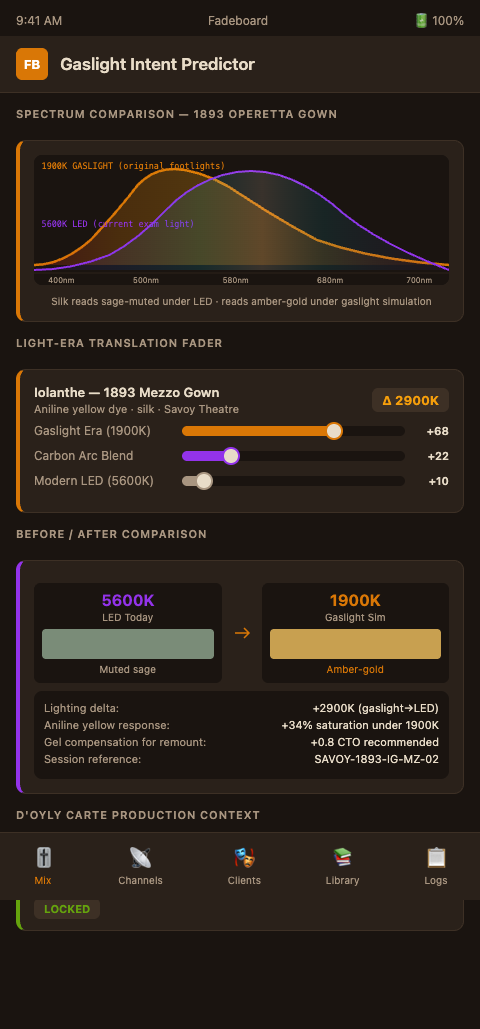
Fadeboard approaches this through what its channel architecture calls a lighting-era translation layer. It sits alongside the standard degradation channels — dye oxidation, footlight bleaching, wash cycles — as an independent fader that simulates the color temperature of the original performance environment.
Think of an audio engineer mixing a vintage recording. The engineer does not simply boost the treble to compensate for tape hiss. They model the frequency response of the original microphone, the room acoustics, and the playback system, then correct for each independently before making any additive decisions. Fadeboard applies the same reasoning to color. The gaslight channel fader represents the color-rendering shift between the performance-space light source and your current work light. Rolling it in does not add yellow to the garment — it reveals what the dye was communicating under the original illuminant.
A garment's original color intent was always a three-way conversation: dye, illuminant, and period audience perception. The aniline dyes introduced from the 1850s onward were typically selected and applied under gaslight conditions, because that was how they would be seen. A HARMAN Professional Solutions industry survey of entertainment lighting history confirms that gaslight sources operated in the 1800–2200K range, producing a heavily warm, amber-tinted rendering that made certain dye types — particularly yellows and reds — appear far more saturated than they do under daylight or LED. (A Brief History of Entertainment Lighting Sources — HARMAN Professional Solutions)
When the Fadeboard gaslight-era channel is engaged, the archivist sees a simulated rendering of the dye under that original illuminant. This is not a cosmetic filter — it is a calibrated color-temperature transformation anchored to photometric data from the original source type. The fader position becomes a documented parameter: "gaslight simulation at 1900K, matching footlight era." That parameter travels with the garment record and can be referenced by any future production team working with the piece.
For archivists working toward a full LED stage calibration for a remount production, the LED stage calibration workflow covers the final translation step in detail.
Advanced Tactics for Gaslight Prediction
Once the gaslight-era channel is established, three additional tactics improve the accuracy of color-intent prediction.
Triangulate against photographic evidence. Early photographic records — including hand-tinted lantern slides used in production promotion — provide qualitative ground truth. A Smithsonian collection documents photographic color evidence from the pre-electric era, including hand-colored promotional materials that record the intended hue rather than the degraded current state. (Photographic History Collection: Early Cinema Color — Smithsonian Institution) If a hand-tinted slide from an 1890 Ballets Russes program shows a specific garden-fairy green, and the gaslight simulation brings the faded silk toward that reading, you have external corroboration for the model.
Use a same-production reference garment as a calibration anchor. Archive collections sometimes hold multiple costumes from the same production in different states of preservation. A chorus costume that spent less time under footlights, or a stand-by garment that was rarely worn, can serve as a high-end anchor — a surface closer to the original dye concentration against which the more degraded principals' costumes can be calibrated.
Document the translation delta explicitly. The difference between the gaslight-simulation reading and the 5600K-LED reading is itself a documented number: the lighting-era translation delta. For a production team planning a remount under modern tungsten Fresnel or LED rigs, that delta tells the lighting designer exactly how much warmth to add through gel filtration to restore the period visual intent. The garment does not have to be re-dyed — the lighting plot can compensate, provided the delta is clearly specified in the archive record.
Account for carbon arc transitional garments. Costumes from the 1890s–1910s may have been designed for carbon arc footlights rather than gas, introducing a cooler, more violet-tinted baseline than pure gaslight. Carbon arc sources produced a light closer to 4200–4500K, which treated aniline magenta and cobalt blue very differently than gas did. Identifying the production decade and venue type determines which translation channel applies.
Common pitfall: applying a single gaslight simulation to a mixed-era collection. Archives that hold costumes from multiple production decades frequently make the error of running a single "gaslight preset" across the whole lot. A gown from the 1882 Iolanthe premiere was designed for the Savoy Theatre's gas footlights; a revival costume from an 1897 D'Oyly Carte tour of the provinces may have played under arc lighting in the larger venues and gas in the smaller halls. The two call for different channel settings even within the same character's costume across different touring seasons.
The practical test is to examine the damage pattern. Gaslight footlights, operating at 1800–2200K, generated more radiant heat per lumen than carbon arc sources, which concentrated UV energy. A bodice exposed primarily to gaslight footlights will show warm-spectrum bleaching — the lower hem and front panel bleach toward a warm cream or straw — while a bodice exposed primarily to carbon arc will show cooler, more neutral bleaching that reads as a flat grey-white under modern examination. The bleaching color is itself evidence of which channel applies.
For 1880s Ballets Russes and Savoy productions where the lighting rig changed mid-run — as it did at several London venues transitioning from gas to arc during this period — the gaslight-era translation fader and the carbon arc channel may both need to be active at partial weight, representing the blended exposure history rather than a single illuminant. The Fadeboard session log documents this blend explicitly, giving future conservators the reasoning behind a mixed-channel setting.
For archivists working with French bisque and other pigment-bearing objects whose degradation model overlaps with theatrical dye chemistry, the analysis of French bisque fade degradation offers parallel channel-building methods.
The footlight exposure reading workflow pairs with this post: once the lighting-era channel is set, reading where footlight bleaching has distorted the garment is the logical next step.
For Your Next Remount or Exhibit Loan
If your archive holds wardrobe from a gaslight-era production and a touring company or remount production is asking for historically-faithful costumes, Fadeboard can build the lighting-era translation model before the garment leaves the archive.
The most useful starting point is a production decade and venue type. A garment from a D'Oyly Carte Iolanthe touring production in 1884 calls for a different gaslight simulation than a Ballets Russes premiere at the Châtelet in 1909 — the Savoy used gas footlights through the 1880s while the major Paris houses were already moving to carbon arc by that decade. The venue determines the light source, and the light source determines which channel to load before the first fader is touched.
If program illustrations or lantern-slide references survive in your collection, bring them to the session. A hand-tinted slide from an 1890s production is not photometrically precise, but it is evidence made by someone who saw the original — and cross-referencing the slide reading against the gaslight simulation output provides external corroboration that no spectrophotometer alone can supply. When the simulation and the slide agree, the model gains confidence. When they diverge, the discrepancy points to an undocumented variable worth investigating before treatment begins.
Reach out with your production records and we will map the gaslight-era color intent, deliver a documented lighting-era delta for the production's lighting designer, and build a session log that travels with the costume to the remount venue.