Reading Footlight Exposure Patterns on Operatic Bodices
What the Footlight Trough Did to Dyed Silk
Stage footlights — the row of oil, gas, or limelight fixtures mounted at the front edge of the stage, facing upward — were the dominant illumination source for opera houses through most of the 19th century. They produced light from below, casting a warm upward wash across the performer's costume from approximately knee height to shoulder level, with maximum intensity at the front panels of whatever garment faced the house.
Britannica's account of footlight technology documents the transition from oil wicks through gas burners to the electric arc lamp during the Victorian era, each generation producing a progressively more intense light source positioned at the same critical distance from the performer's bodice. (Footlights — Britannica) The limelight — calcium oxide heated by a directed oxyhydrogen flame — was particularly powerful, producing a concentrated white light of approximately 4000–5000K that bleached directly-exposed fibers with considerable speed when used at close range.
The Royal Opera House Collections holds the largest active costume collection in the United Kingdom, with 19th-century soprano garments representing some of the most footlight-exposed objects in any performing arts archive. (The Costume Collection — Royal Opera House Collections) The wear patterns on these garments show a consistent signature: maximum bleaching on the lower-front panels (the surface perpendicular to the footlight beam), graduating to much lower degradation at the back panels and interior lining.
A UCL photodegradation study of historic silks documents the mechanism: UV and visible light energy breaks the chromophore bonds in silk-bound dye molecules, reducing color depth progressively from the surface inward. The rate of damage is proportional to both intensity and exposure duration — which is why footlight-facing panels on an opera bodice can show three to four times the saturation loss of the rear panels on the same garment. (Photodegradation and Photostabilization of Historic Silks — UCL Student Journals / PIA)
Mapping the Footlight Channel on a Bodice
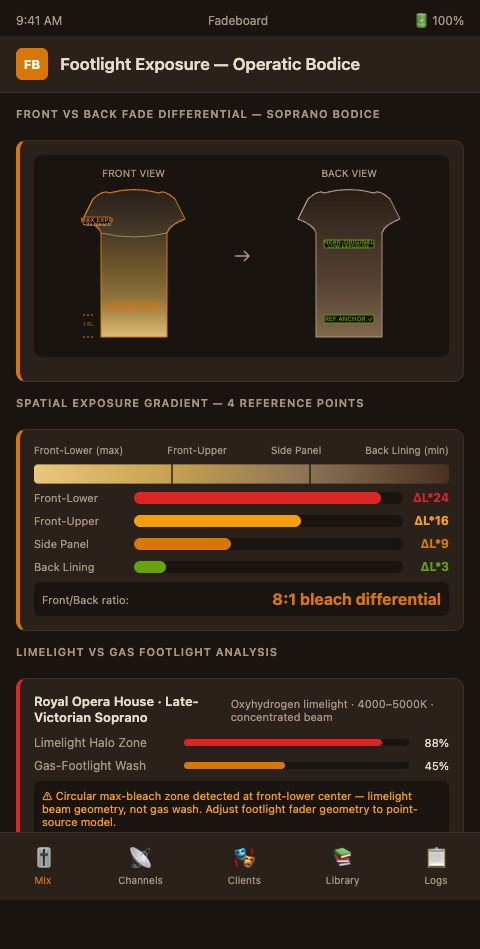
Fadeboard's footlight-exposure channel is spatial as well as quantitative. When you open the footlight fader, you are not applying a uniform correction across the whole garment — you are working with a zone-weighted model that reflects the physical geometry of the exposure.
Think of the footlight trough as a directional audio source in a room: the surfaces facing it receive full-volume signal; surfaces perpendicular to it receive reduced signal; the back of the room receives almost none. An audio engineer applying room-correction in a recording does not apply the same gain to every microphone position — they correct each position for its specific relationship to the source. Fadeboard applies the same logic. The front-lower panel of a soprano bodice needs a different fader position than the shoulder seam, the side panel, or the back yoke, because each received a different dose of footlight exposure.
The V&A's conservation documentation on Diaghilev and the Ballets Russes provides a well-documented case of exactly this differential: the stage-facing surfaces of surviving Ballets Russes costumes show measurably greater photodegradation than the rear-facing surfaces, a pattern the V&A conservation team identified and treated as separate conditions rather than a uniform fading event. (Conservation Stories: Diaghilev and the Ballets Russes — V&A)
In practical terms, mapping the footlight channel on an operatic bodice requires four reference readings: the maximum-exposure zone (front-lower panel center), the mid-exposure zone (front-upper panel above the high-exposure area), a lateral zone (side panel that received oblique exposure), and the minimum-exposure zone (back panel lining or inside hem). The ratio between maximum and minimum readings gives you the footlight-fader range. The spatial gradient between front-lower and front-upper tells you the geometry of the original fixture placement — higher gradients indicate closer or more concentrated footlights, lower gradients indicate diffuse sources.
For archivists whose collections include tulle-overlaid operatic bodices — a common construction on soprano costumes from the 1880s onward — the overlying tulle can complicate footlight-channel readings because it received its own photodegradation dose before light reached the ground fabric. The tulle stage fade workflow addresses this layered analysis in detail.
Advanced Tactics for Footlight Pattern Analysis
Use the APS limelight data to calibrate intensity. For garments from venues known to have used limelight — Covent Garden, the Paris Opéra, the Metropolitan Opera in its early seasons — the physical properties of calcium oxide light are well-documented. The American Physical Society account of Drummond's 1825 public demonstration describes the photometric properties of limelight, which produced sufficient intensity to bleach dyed silk at short range in a matter of weeks at nightly use. (November 9, 1825: Public Demonstration of the Limelight — APS Physics) If the venue used limelight rather than gas footlights, the exposure dose was substantially higher, and the footlight fader range should reflect that.
Look for the limelight halo. On garments worn during limelight-era productions, a characteristic fade pattern sometimes appears as a roughly circular zone of maximum bleaching centered on the panel that faced the concentrated beam. Gas footlights produced a more even wash; limelight produced a more focused effect. If you see a circular or elliptical maximum-bleach zone rather than a horizontal strip across the lower-front panel, you may be looking at limelight damage rather than general gas-footlight exposure.
Check for greasepaint as a partial UV filter. Performers who wore heavy greasepaint on the neck and décolletage may have partially protected the bodice fabric directly behind the greasepaint application zone. If the upper-front panel immediately below the neckline shows unexpectedly low footlight bleaching compared to the lower-front panel, the greasepaint application — which absorbed and scattered UV — may have provided partial protection. This creates a slight anomaly in the footlight spatial model that needs to be flagged rather than corrected.
Account for footlight-era evolution within a single garment. An 1870s opera gown worn into the 1890s would have experienced both gas-footlight and early electric-footlight exposure, because many opera houses transitioned their stage lighting incrementally during this period. The earlier, warmer gas exposure would have affected the lower-front panel; the later, cooler electric exposure would have affected the same zone with a different spectral emphasis. In these transitional cases, the footlight channel is better modeled as two linked faders — gaslight-era dose and electric-era dose — rather than a single unified parameter.
The broader interplay between greasepaint residue and footlight damage in the neck and collar area of tenor and baritone costumes is covered in the greasepaint residue handling workflow.
For archivists whose work includes objects where maker's marks provide chemistry clues — as with certain opera house wardrobe that was supplied by specific London dyers — the parallel analysis of how maker's marks predict pigment chemistry offers a transferable investigative methodology.
For Opera Archives and Touring Productions
If your collection includes operatic bodices from the gaslight or limelight era and you are preparing them for exhibit loan, conservation treatment, or a remount production that will place them under modern Fresnel or LED rigs, Fadeboard can map the footlight exposure pattern on each garment before any decision is made.
The spatial degradation model the session produces is the most immediately useful output for production teams. A remount wardrobe supervisor can see at a glance which panels have suffered maximum footlight bleaching and which retain closer to original saturation — information that determines where reinforcement, re-dyeing, or period-appropriate patching would be most effective. Without the spatial model, treatment decisions default to full-surface approaches that over-correct the less-damaged zones and under-address the maximum-exposure areas.
For opera archives, the same spatial model informs display decisions. A soprano bodice that has lost most of its front-lower panel saturation but retains strong color at the back and shoulders can be displayed in a three-quarter rear view without misrepresenting the restoration state — a straightforward curatorial decision once the spatial map exists. Without the map, the archivist relies on the conservator's verbal description, which rarely captures the spatial precision a display team needs.
Schedule a Fadeboard calibration session before your next remount conversation — we work from calibrated surface readings zone by zone, delivering a spatial degradation model and a documented channel log your conservator and production team can both reference throughout the process.