Pigment Matching for Tulle Layers With Uneven Stage Fade
The Tulle Fade Problem Is a Geometry Problem
When a conservator at La Scala undertook the documentation phase for a set of late-nineteenth-century tulle skirts, she found that standard colorimetric readings of the assembled skirt produced values that were averages of the individual layer profiles — accurate for none of them. The outermost layers, which had received direct footlight exposure during performances and then direct light exposure during storage and display, had faded to near-transparency. The innermost layers, protected by the outer strata and by the opacity of the waistband and underlining, retained 40–60% of their original color depth. Costume Restoration — Teatro alla Scala Association documents the La Scala tulle restoration case, confirming that uneven stage fade across layered structures is a documented challenge that standard single-surface color matching cannot address.
Tulle (netting) — Wikipedia traces the material history of tulle from its silk origins through the nylon transition — a detail that matters for restoration work because silk tulle and nylon tulle take dyes at different rates and with different optical outcomes. An 1890s ballet tulle skirt is almost certainly silk; a 1950s Broadway production tulle skirt may be nylon or a silk-nylon blend. The dye class, fixation chemistry, and achievable chroma differ significantly between fiber types.
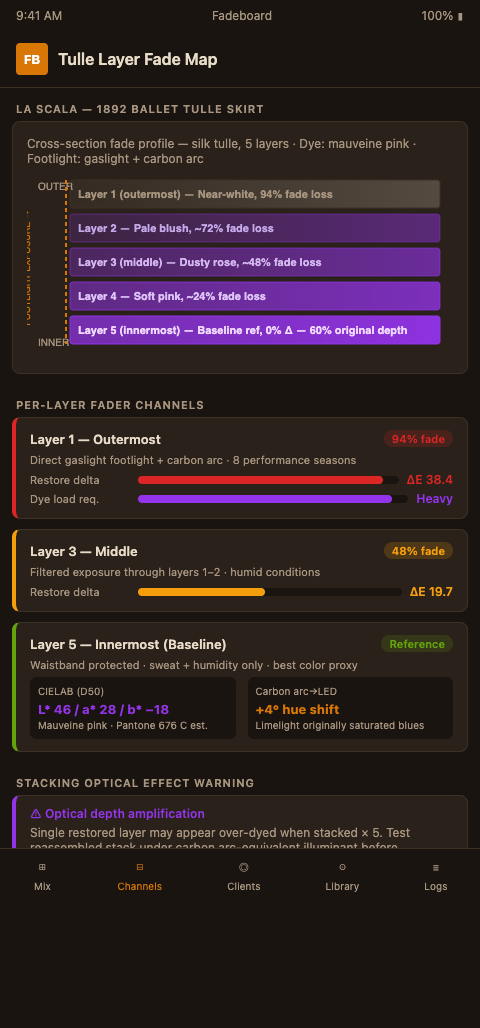
The geometry of the problem is this: a tulle skirt with five layers has five distinct color states. Footlights and overhead carbon arc lights reached the outermost two layers with near-direct exposure. The middle layer received filtered exposure through the outer layers. The inner two layers may have seen relatively little direct stage lighting. Each layer also experienced different sweat and humidity exposure from the dancer's body — the innermost layers receiving the most.
The cumulative result is a color gradient running from the outside in, with each layer sitting at a different point on the fade curve. Parameters affecting photodegradation of dyes and pigments — ScienceDirect explains the degradation kinetics that drive this layered fade profile: photon flux, oxygen availability, and temperature all decrease with depth in a layered textile stack, producing precisely the gradient observed in multi-layer stage costumes.
Study on Photodegradation of Thermal-Aged Silk — npj Heritage Science provides directly relevant data on combined heat and light degradation in silk — the mechanism that drove outermost-layer fading in ballet tutus kept in warm storage conditions.
The Fadeboard Layer-by-Layer Analysis Approach
Fadeboard's independent fader architecture maps naturally onto the layer problem in tulle. Each layer is treated as a separate channel with its own baseline spectral reading, its own degradation depth, and its own restoration target.
Step 1 — Disaggregate the layers for individual measurement. Where the construction of the skirt permits, carefully separate each tulle layer and take individual spectrophotometric readings. If the layers cannot be separated without risk to the seam construction, take readings at exposed layer edges and use microspectrophotometry to distinguish overlapping layer profiles from a single-point reading.
Photofading in Cotton Fibers Examined by Microspectrophotometry — PMC demonstrates how MSP isolates distinct fading zones at microscopic scale — the same technique applied to tulle edges can distinguish the spectral profile of individual layers even when physical separation is not possible.
Step 2 — Establish the innermost layer as the baseline reference. The innermost layer holds the closest approximation of the original dye bath color, modified only by sweat and humidity exposure rather than direct light. Set the innermost layer reading as the Fadeboard baseline channel — the target that all other layers need to reach after restoration. This is not necessarily the exact original color (it has degraded too), but it is the best available approximation within the object itself.
Step 3 — Calculate the restoration delta for each layer. The restoration delta channel calculates the difference between each layer's current spectral reading and the innermost-layer baseline. Layer 1 (outermost) will show the largest delta; layer 5 (innermost) shows zero delta by definition. Each intermediate layer shows a proportional delta corresponding to its cumulative light exposure.
Step 4 — Apply the lighting-era translation. For an 1890s ballet production, the lighting context includes both gaslight footlights (the warm floor sources that hit the outermost skirt panels most directly) and carbon arc or limelight followspots from above. Limelight produced an intensely blue-white illumination that made saturated colors pop — a visual effect that the original dye formulation was optimized for. The lighting-era translation channel converts the restoration target from the innermost-layer baseline to the equivalent color performance under the original stage lighting conditions.
Step 5 — Formulate by layer. Each layer requires a different dye formulation to reach the same visual result, because each starts from a different current state. The outermost layer requires the heaviest application to close a large restoration delta; the next layer requires slightly less; and so on. Running a uniform dye bath across all layers will produce a correctly colored innermost layer and an over-dyed outermost layer. Spectrophotometric Color Matching for Damaged Goods — HunterLab describes instrument-guided formulation for precisely this kind of multi-zone differential restoration.
Advanced Tactics for Tulle Layer Pigment Matching
Address the optical stacking effect in your formulation. Individual tulle layers look more saturated when stacked because each layer adds depth. A single layer of tulle restored to the target color value may appear correctly saturated when stacked with four others — or it may appear over-dyed. Test the individual layer colorant application by reassembling the stack and viewing under the intended stage light before treating all layers. Adjust the formulation based on the assembled appearance, not the individual layer.
Protect the seam allowances from the dye bath. The seam allowances on tulle skirts often retain the original fabric color in fold areas sheltered from light — the same principle as interior seam readings on breeches. Protect these zones with a resist coating before any dye bath treatment so they remain available as reference readings for future conservators.
Flag the differential fade gradient as an archival feature. The layer-by-layer fade gradient is itself an authentic historical record of how the costume was used and stored. Where possible, document this gradient in the final treatment record rather than fully erasing it. A tulle skirt that has been brought back to uniform color across all layers may look more "correct" to the exhibition viewer but has lost information about the performance history of the piece. Consider whether partial restoration — bringing the outermost layers to within visible range of the innermost layers without achieving complete uniformity — better serves the archival purpose.
Compare against LED incandescent shift data for the specific tulle dye class before finalizing the exhibition-lighting restoration target. The visual difference between a carbon arc-calibrated tulle and a 5600K LED-calibrated tulle is more pronounced in sheer layered fabrics than in opaque textiles, because the depth effect amplifies the hue shift with each additional layer.
Test colorfastness of the planned dye against the original fiber. Colorfastness Test Methods for Textiles — QIMA covers the ISO and AATCC test standards applicable to characterizing the existing fade level and to qualifying the lightfastness of the proposed restoration dye. For exhibit-safe restoration of a tulle skirt, the dye applied to the outermost (most exposed) layer must carry a higher lightfastness rating than the dye applied to inner layers, because the outermost layer will continue to receive the most direct light exposure after restoration.
For archives holding layered ballet or operetta tulle costumes, spectrophotometer stage work provides the measurement framework for establishing consistent layer readings across a larger tulle collection — particularly useful when a single production wardrobe includes multiple skirts that need to read as ensemble rather than as individual pieces.
The tulle layer analysis approach in Fadeboard also has direct application to fugitive dye matching methods from quilt restoration work: the differential fade analysis across layered or stacked textile structures is structurally the same problem whether the substrate is ballet tulle or chintz applique, and the K/S measurement bridge applies in both contexts.
Archivists encountering tulle restoration for the first time should resist the impulse to treat the assembled skirt as a single object. The layered structure requires layer-by-layer analysis, layer-by-layer formulation, and layer-by-layer testing before the skirt is reassembled for evaluation. The additional time investment at the analysis stage pays back in a final result that holds up under the assembled lighting conditions — which is the only test that matters.
If your archive is preparing layered tulle costumes for a ballet remount or museum loan, the Fadeboard waitlist is open to theater archivists now. Get started with the layer-by-layer session protocol before the production schedule locks in the restoration deadline.