Pigment Matching for Chintz Appliqué With Fugitive Dyes
The Yellow That Disappeared
A Metropolitan Museum record documents an 18th-century Indian chintz quilt from the Coromandel Coast — an archival record of original mordant-dyed color schemes in historic chintz production. In that piece, the yellow ground dye survives because the museum piece was stored under conservation conditions almost from acquisition. In the hands of a workshop restorer, the typical chintz appliqué quilt from the first half of the 19th century arrives with the yellow entirely gone — not faded, but absent, replaced by the uncolored base fabric of the cotton or linen ground.
Chintz appliqué is among the most vibrantly colored 19th-century American quilt styles, and fugitive yellow dyes are commonly absent in surviving examples. The pattern is consistent enough that "chintz without yellow" is now a recognized artifact condition, not an anomaly. The dyes responsible — typically weld (Reseda luteola), quercitron, or early synthetic aniline yellows in later pieces — were the most UV-sensitive component of the mordant-printed design. Yellow plant dyes are the most UV-sensitive and most vulnerable to disappearance in faded antique chintz.
What makes chintz restoration difficult is that the yellow was not decorative — it was structural to the color system. Indian mordant-printed cotton used yellow dyes as the base for secondary color mixing: yellow under blue mordant produced green; yellow under red produced orange. When the yellow disappears, the greens become flat blue, the oranges become flat red, and the printed design loses the dimensional color relationships that made it read as representational rather than abstract. Matching the chintz is not just replacing a missing yellow — it is reconstructing the lost foundation of the entire color system.
Reconstruction From the Surviving Evidence
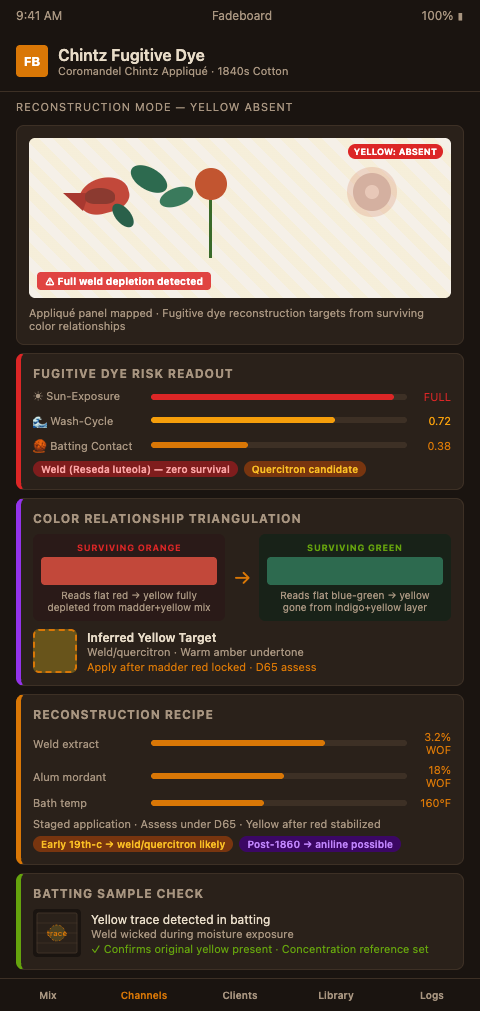
Fadeboard approaches chintz appliqué fugitive dye work as a reconstruction problem rather than a standard color-matching problem. The faders are not set to the current visible color — they are set to a target color inferred from the surrounding evidence.
The sun-exposure fader provides the first inference layer. A panel with very high sun exposure has likely lost its yellow entirely while retaining some red and blue (which are more lightfast in mordant-dyed chintz). The degree of yellow loss can be estimated by comparing the current appearance of the surviving orange and green areas — if the oranges read as bright red and the greens read as flat indigo blue, the yellow component has been fully depleted. The sun-exposure fader is set to "full depletion" for those areas. If the oranges still read with a warm undertone, partial yellow remains, and the fader is set to a lower depletion value.
The wash-cycle fader provides the second layer. Chintz is an Indian mordant-printed cotton with yellow dyes that are notoriously fugitive and rarely survive intact in historic samples. Washing accelerates yellow loss through both mechanical extraction and alkaline saponification of the dye-mordant bond. A piece with six documented hot washes before 1940 has a predictably different yellow survival rate than a piece that was never wet-washed. The wash-cycle fader position for chintz yellow reconstruction adjusts the reconstruction depth based on this estimated loss pathway.
The batting-contact fader rounds out the diagnosis. Chintz appliqué quilts are typically cotton face fabric over cotton wadding. Yellow fugitive dyes can migrate into the cotton batting through moisture exposure; a careful examination of the batting in a permission-to-sample area can sometimes reveal traces of yellow dye that wicked downward, which confirms the original dye was present and provides a rough concentration reference for the reconstruction target.
HPLC analysis methods can identify surviving dye markers in degraded historic textiles and guide pigment reconstruction — for museum-grade chintz work, this analytical confirmation of residual yellow dye markers is the most reliable way to set the Fadeboard reconstruction target. For workshop-level work without laboratory access, the inference from surviving orange and green color relationships is the practical alternative.
For long-term color stability of the reconstructed yellow, restoration dye stability in cotton context provides the framework for selecting a replacement dye that matches the original lightfastness profile rather than exceeding it — a reconstructed yellow that outlasts its original context will eventually read too saturated relative to the further-fading surrounding design.
Advanced Tactics for Fugitive Dye Reconstruction
Color relationship triangulation. When the yellow is fully absent, the restorer can bracket the reconstruction target by identifying the most orange-tending red and the most yellow-tending green in the surviving pattern. The orange-tending red reveals how much yellow was originally overlying the madder or cochineal red layer. The yellow-tending green reveals how much yellow was mixed with the indigo or woad blue. From these two data points, Fadeboard's reconstruction fader can be set to a target that produces a yellow at the correct saturation to restore both the orange and the green relationships.
Weld versus quercitron versus synthetic aniline. The reconstruction target varies significantly based on the original yellow dye identity. Weld produces a clear, slightly green-leaning yellow. Quercitron produces a warmer, more amber yellow. Aniline yellows used in mid-to-late 19th century chintz are more saturated and flat. Conservation dye selection criteria include reversibility, lightfastness match, and spectral compatibility. For early 19th-century chintz, the most likely candidate is weld or quercitron; for later feedsack-era chintz revivals, the aniline yellow family is more probable.
Staged application under natural light. Chintz yellow reconstruction should be applied and assessed under D65 daylight-equivalent lighting, not under tungsten or LED, because yellow dyes are among the most sensitive to illuminant metamerism. A reconstruction that matches under studio light may read significantly different under window daylight, where the UV component of natural light activates subtle undertone differences in the dye. Natural dye fade prediction methodology describes how to model the future lightfastness trajectory of a reconstructed dye — critical information when deciding between a matched-lightfastness reconstruction and a higher-lightfastness stabilization approach.
Tulle stage fade parallel. The problem of reconstructing a missing color layer from surrounding evidence is not unique to quilt work: pigment matching for tulle stage fade describes an identical inference problem in theater archive contexts, where the original translucent overlay color must be reconstructed from the surviving base color relationships. The triangulation method used for chintz yellow translates directly.
Layered application sequencing. Because chintz yellows were applied as mordant-printed layers over, under, and between other dye layers, reconstruction cannot be done in a single surface application. The yellow layer must be placed in the correct sequence relative to any other corrective dye work. If the restorer is also correcting the madder red layer (which may have faded separately), the yellow should be applied after the red is stabilized, so the final orange relationship can be assessed correctly.
Infer the Target, Then Test It
Chintz appliqué fugitive dye reconstruction cannot start from observation alone. The restorer who looks at a de-yellowed chintz panel and tries to match the "current" color is solving the wrong problem — the current color is the damaged state, not the target.
Fadeboard's reconstruction mode forces the correct framing: the fader positions are set to a target that is inferred from indirect evidence, not observed directly. The sun-exposure history sets the depletion depth. The surviving orange and green relationships triangulate the original yellow saturation. The wash-cycle history adjusts the mordant bond strength. The resulting recipe is the restorer's best reconstruction hypothesis, applied first to a test swatch, assessed under D65 lighting, and revised before full-panel application.
Workshops that have moved from matching-what-you-see to inferring-what-was-there report a significant improvement in the long-term visual accuracy of their chintz work. The piece looks coherent rather than patched — the reconstructed yellow restores the color relationships rather than simply filling a gap with the nearest available yellow.