Handling Greasepaint Residue on Tenor Collar Linings
What Leichner's Formula Did to Collar Fabrics
Commercial theatrical greasepaint entered the stage market in the 1870s when Ludwig Leichner, a German opera singer turned chemist, began selling tallow-based pigmented sticks formulated to survive stage lighting and remain workable during performance. A Wikipedia account of theatrical makeup history records that Leichner's 1873 formula combined tallow, lanolin, and zinc oxide with pigments — a composition that proved remarkably adhesive to protein and cellulose fibers. (Theatrical Makeup — Wikipedia)
For a tenor performing nightly in an opera house, the collar and neckline of his tailored coat or period frock received greasepaint transfer every performance. The makeup migrated from jaw and neck during singing — movement, perspiration, and heat all contributed to transfer. By the end of a run, the inside collar lining of an active tenor's costume carried a complex deposit: greasepaint lipid layer, pigment particles from the makeup itself, perspiration salts layered over and under the greasepaint, and the laundering residue of whatever partial cleaning had been attempted between productions.
The Britannica entry on greasepaint documents the composition and history of these compounds, noting that tallow-based makeup was specifically chosen because it adhered to skin and fabric under hot stage lighting — properties that also made it particularly resistant to removal from historic textiles. (Greasepaint — Britannica) The cosmetics history resource cosmeticsandskin.com adds that early Leichner-era greasepaint brands used lard, spermaceti wax, or tallow depending on the application type, each with different penetration depth and fiber adhesion characteristics. (Cosmetics and Skin: Greasepaint — cosmeticsandskin.com)
UAL Special Collections notes in their conservation documentation of Ballets Russes costumes that surviving garments from active performance bear visible greasepaint marks at precisely these zones — collar, neckline, cuff — and that these marks were considered archival evidence of performance rather than contamination to be removed. (Ballets Russes Costumes Marks of Performance — UAL Special Collections) This creates an important conservation tension: the greasepaint is both evidence of authentic use and an interference layer that prevents accurate color reading.
The Greasepaint Channel in Fadeboard
The approach Fadeboard takes to greasepaint-contaminated collar zones begins with treating the greasepaint deposit as its own channel — not as noise to be removed, but as a known layer with known optical properties that can be accounted for in the degradation model.
Think of it as an audio engineer dealing with a vocal track that has been recorded through a telephone EQ filter. The engineer does not discard the track — they apply the inverse of the telephone response to recover the original frequency content. Fadeboard applies the same logic: the greasepaint layer has known spectral absorption properties (lipids absorb at specific near-infrared wavelengths; zinc oxide and titanium dioxide in theatrical makeup produce characteristic reflectance peaks), and accounting for those properties allows the underlying dye signal to be extracted from the composite surface reading.
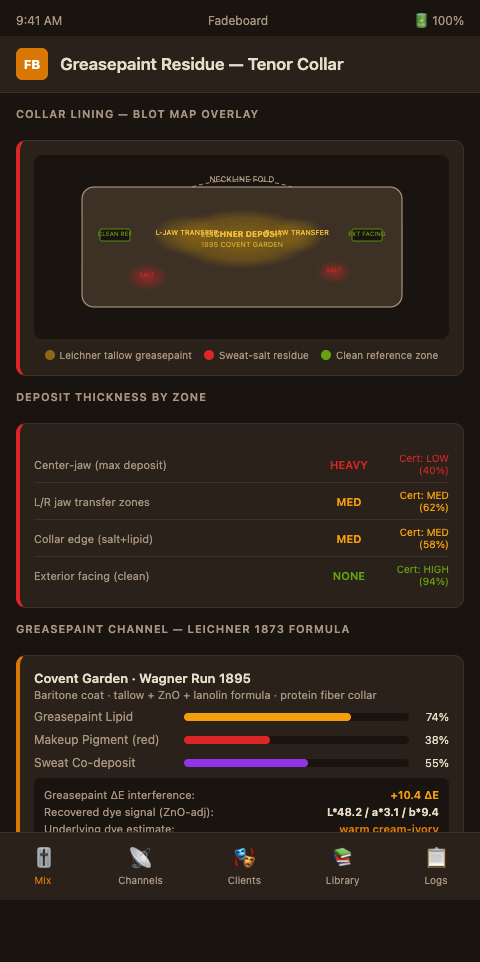
In practical terms, this means taking readings at three types of zones on the collar: heavily contaminated zones (direct greasepaint deposit), partially contaminated zones (transfer areas at the edge of the deposit), and clean zones (if any exist — often the back-neck lining below the collar fold). The ratio between these zones gives you the deposit's optical contribution, which becomes the greasepaint channel fader. Rolling back the greasepaint fader in the model isolates the underlying dye reading.
The AIC Technical Studies Group's protocols for stain removal in textile conservation specify that identification of stain chemistry must precede any removal attempt, because some stain treatments interact destructively with certain dye types. (TSG Chapter VI: Stain Removal or Reduction — AIC Conservation Wiki) Building the greasepaint channel in Fadeboard before any physical treatment begins ensures that the color-analysis phase informs the treatment decision rather than the reverse.
For archivists whose collections include costumes with significant sweat damage layered beneath greasepaint contamination — a combination that concentrates in the same collar zone — the sweat stain preservation workflow covers the interaction between the two damage types.
Advanced Tactics for Greasepaint-Contaminated Collars
Do not treat the collar in isolation. The interior collar lining and the exterior facing of the collar are usually cut from the same cloth and share an original dye lot. If the exterior facing has been less contaminated — either because the production's cleaning regime targeted visible greasepaint or because the exterior was made from a different material — use the exterior facing as the color reference for the greasepaint-channel calibration. The exterior gives you an estimate of what the interior would read without the lipid deposit.
Map the deposit thickness. Not all zones of a greasepaint deposit have the same thickness or penetration depth. Areas of heaviest deposit — where the jaw contacted the collar edge — show deeper lipid penetration than areas of light transfer. The Smithsonian's Museum Conservation Institute guidance on stain chemistry distinguishes between surface stains and penetrating stains, with fundamentally different correction approaches. (Stain Removal — Museum Conservation Institute, Smithsonian) In a Fadeboard model, zones of heavy deposit need a higher greasepaint-fader contribution than zones of light transfer — use the deposit-map to weight the channel spatially.
Account for the greasepaint's own pigment contribution. Victorian-era greasepaint was available in skin-tone, red-shadow, and blue-shadow varieties, and the specific pigments used had their own reflectance signatures. If the greasepaint deposit contains red pigment (from lip rouge applied to the jaw during broad character makeup), that red signal will be present in the surface reading of the collar zone and will mislead the dye-channel calibration if not accounted for as a separate layer. A supercritical CO₂ cleaning approach, explored in a ScienceDirect study, allows lipid removal from fragile textiles without solvent contact — potentially enabling surface reading before and after lipid removal to isolate the pigment contribution. (A Novel Approach for Textile Cleaning Based on Supercritical CO2 — ScienceDirect)
Flag greasepaint zones in the export record. When the session log is exported for the archive management system or for a production team, collar zones with residual greasepaint contamination should be explicitly flagged, with a note on what the greasepaint-channel subtraction produced and how confident the underlying dye reading is. A high-contamination zone will produce a less certain dye reconstruction than a clean zone, and the production team or conservator working downstream needs to know that.
For archivists whose greasepaint analysis work extends to the question of how contamination behaves differently on different period textile substrates — specifically the comparison between protein-fiber collars (silk, wool) and cellulose-fiber linings (cotton, linen) — the related analysis of composition versus bisque fade differences offers a comparable framework for modeling contamination behavior across substrate types.
The tulle stage fade workflow is a relevant next step for archivists whose tenor costumes include tulle-stock collars or overlay elements where the greasepaint analysis must be extended through a semi-transparent layer.
Working With Heavily Used Performance Costumes
If your archive holds tenor, baritone, or character costumes with significant collar contamination from active performance runs, Fadeboard can build the greasepaint channel model before any physical treatment is decided.
The most useful pre-session information is production era and cleaning regime. A Covent Garden baritone costume from an 1895 Wagner run will carry Leichner's tallow-based greasepaint at its most adhesive — the formula that remained standard well into the early twentieth century. A 1920s vaudeville character costume may carry a later greasepaint generation with different lipid composition and different penetration depth. The production era narrows the greasepaint chemistry; the cleaning regime (how frequently the costume was spot-treated or laundered between performances) determines how deeply the lipid layer penetrated the collar fabric.
For costumes with both greasepaint and sweat residue in the collar zone — which describes most actively-worn tenor collars — the two damage types need independent channel assignments. The greasepaint channel accounts for the spectral contribution of the lipid and pigment deposit; the sweat channel accounts for the acid-driven mordant disruption and salt crystallization beneath it. Treating the combined reading as a single contamination layer produces a restoration target that either under-corrects the greasepaint contribution or over-corrects the underlying dye reading.
Contact us with garment type, approximate production era, and any information on the production's cleaning practices — we can map the greasepaint contribution, isolate the underlying dye reading, and give you a documented baseline that drives the treatment decision rather than guessing around the contamination.