Composition Doll Fade vs Bisque Fade: Key Differences
The Surface Similarity That Misleads
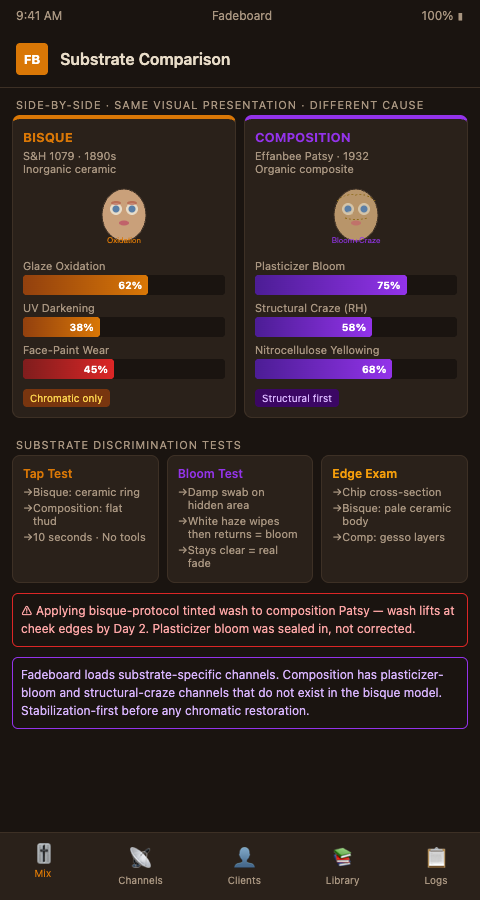
An Effanbee Patsy from the 1930s and a Simon & Halbig 1079 from the 1890s sit side by side on your workbench. Both show an amber warm shift on the face, both have faded cheek color, both look like they need a similar tinted wash to restore. You apply the bisque protocol to the composition Patsy and by day two the wash is lifting at the cheek edges because the gesso undercoat has already begun to separate.
The surface similarity is deceptive. Composition and bisque fail through fundamentally different mechanisms, and those mechanisms demand fundamentally different channel configurations in Fadeboard.
Wikipedia's article on composition dolls establishes the material difference clearly: composition is a mixture of sawdust, glue, bran, and plaster of Paris. Surfaces crack, flake, and darken with humidity and age. This is an organic composite substrate, not ceramic — and every degradation mechanism it undergoes is distinct from fired bisque.
The Bisque Degradation Profile
Bisque is inorganic ceramic. Its primary failure modes are:
Glaze oxidation, producing uniform warm yellowing concentrated on exposed surfaces. The kiln-fired underglaze pigments are sealed below the glaze layer and essentially stable. Over-glaze face paints are vulnerable but their failure mode is surface wear or UV-driven chemistry, not structural separation from the substrate.
UV darkening of specific colorants — particularly cinnabar and manganese-containing pigments — producing localized darkening on cheeks and nose. This is irreversible in the fired layer but does not compromise the structural integrity of the surface.
Glaze crazing from thermal cycling, which visually separates the face into a network of fine cracks but does not cause paint lifting because the glaze layer and bisque body expand and contract together.
The Wikipedia article on ceramic conservation notes that underglaze ceramic colorants resist fading, placing them in contrast with surface paints. For restoration purposes, the bisque channel model assumes a stable substrate with predictable color shift — oxidation yellowing and UV darkening — without structural failure of the paint surface itself.
The Composition Degradation Profile
Composition degrades structurally, not just chromatically. Research on 20th-century composition dolls in the PMC archive documents widespread paint cracking and nitrocellulose discoloration in composition surfaces, with plasticizers affecting flexibility. The face paint on a composition doll sits on a gesso or primed surface that is itself subject to moisture-driven expansion, shrinkage, and delamination.
Research on plasticizer loss in heritage objects identifies plasticizer migration as causing surface bloom, brittleness, and shrinkage — all of which appear in composition dolls as a white haze over darkened paint, or as paint edges that have pulled away from underlying gesso. This bloom is often misread as pale fade, but it is a surface chemical phenomenon, not pigment loss.
Research on craquelure patterns in panel paintings is directly applicable to composition: RH cycles cause gesso and paint layer cracking on organic substrates in patterns determined by the substrate's response to humidity change. Composition doll craze patterns follow the same physics as panel paintings — they are humidity-driven structural cracks, not aesthetic aging.
The practical consequence is that the composition face paint degradation visible on your bench is frequently not fade at all. The warmth shift is usually plasticizer yellowing of the gesso or primer layer, not the face paint itself. The cheek paleness may be surface bloom over intact paint, not actual pigment loss. Applying a tinted wash to address what looks like fade when the actual mechanism is plasticizer bloom results in sealed bloom and deeper overall darkening when the wash dries.
Fadeboard's channel model handles this by separating composition-specific channels from bisque channels. The composition face has a plasticizer-bloom channel and a structural-craze channel that do not exist in the bisque model, because bisque does not have those failure modes. The visual similarity between the two surfaces — both warm, both pale at cheeks — maps to completely different channel configurations, and the restoration response to each is different. Understanding gesso loss in composition arms and bodies extends this channel logic beyond the face: gesso loss in limbs presents the same structural-first restoration priority, and the channel settings for arm and body work follow the same composition-specific configuration rather than bisque defaults.
Research on technical and ethical issues in doll conservation notes that conservation must balance scholarly preservation and emotional significance, and that composition and bisque dolls differ fundamentally in what that balance requires. For composition, the ethical restoration is stabilization-first: address the structural failure before any chromatic restoration.
Advanced Tactics for Substrate Discrimination
Three practical tests distinguish composition from bisque-origin fade on your workbench.
Tap test. Bisque produces a distinct ceramic ring. Composition produces a duller, flatter sound. Under an 11-day deadline with no markings visible, the tap test takes ten seconds and eliminates substrate confusion.
Bloom test. Apply a clean cotton swab dampened with distilled water to a hidden area. If a white haze wipes clear briefly then reappears as it dries, you have plasticizer bloom, not pigment fade. If the surface remains uniformly colored after the swab dries, the issue is genuine chromatic change rather than surface contamination.
Edge examination. At any chip or edge loss, examine the cross-section. Bisque shows a pale ceramic body below the glaze. Composition shows layered gesso and paint with no ceramic core. The cross-section view confirms substrate within seconds.
Common pitfall: applying a bisque-optimized consolidant to a composition surface. Some restorers use dilute Paraloid B-72 — the standard bisque consolidant — on composition surfaces because it is technically reversible and widely recommended in ceramic conservation literature. On composition, however, the acrylic film that Paraloid B-72 creates at the surface can prevent the traditional rabbit-skin-glue gesso repair from bonding correctly, because the two systems have different expansion coefficients under humidity cycling. The correct consolidant for a composition surface with active gesso delamination is either dilute hide glue or a specialized conservation adhesive tested for organic substrate compatibility.
For comparative reference on binder behavior, egg tempera versus casein comparison in doll restoration covers how the choice of restoration medium interacts differently with composition and bisque surfaces — an important consideration when the substrate discrimination above confirms you are working on composition. On composition, casein's structural brittleness is more pronounced than on bisque because the organic substrate is itself dimensionally unstable, compounding the cracking risk that casein introduces at its film boundaries.
An Effanbee "Patsy" composition doll from the 1932 production run — the peak year for that mold before the war-era reformulation changed the composition compound — presents the bloom and darkening profile described above in textbook form: the nitrocellulose in the original factory enamel has yellowed to a warm amber cast while the surface paint has faded to a desaturated tan, and the combination looks like bisque oxidation to an eye not trained to distinguish between the two. Fadeboard's substrate-specific channel selection forces the correct identification at the first step rather than letting the visual similarity drive the wrong treatment path.
The sun-bleached chintz applique corner challenge in quilt restoration presents an analogous substrate-discrimination problem: printed cotton and woven silk in the same panel degrade at different rates and require different channel configurations even when they arrive presenting similar fade.
Same Surface, Different Cause, Different Solution
Composition and bisque dolls fail through mechanisms that look similar on the surface but require entirely different restoration responses. Applying bisque channel settings to a composition head produces physically incorrect restoration because the degradation physics do not match. Fadeboard's substrate-specific channel model ensures your starting configuration matches the actual material, not just the visual impression.
If you currently use a single tinted-wash protocol across both bisque and composition heads and find yourself losing sessions to lifting edges or sealed bloom, the channel distinction is the missing piece. The Fadeboard waitlist is open for restorers working across substrate types — join with a note on whether your client mix is predominantly bisque, composition, or mixed, and the early-access build will prioritize the channel configurations that match your studio's actual workload.