Handling Sun-Bleached Chintz Appliqué Corners
The Corner Bleaching Pattern and Its Cause
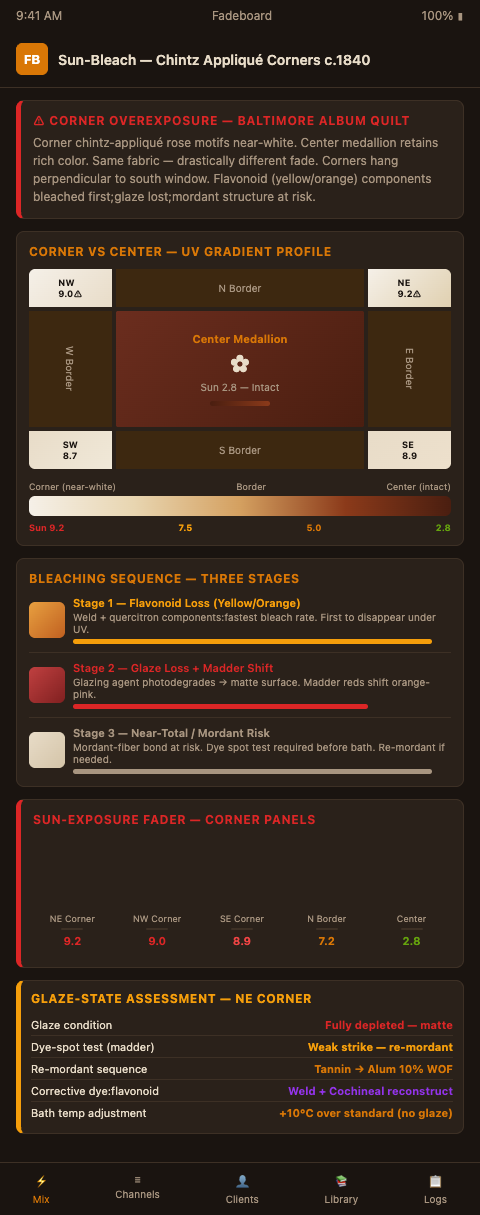
A workshop specialist unfolded a circa-1840 Baltimore Album quilt and saw immediately that something was wrong with the proportions. The center appliqué medallion retained good color — rich indigo blues, madder reds, and traces of weld yellow in the small floral details. The corner blocks, each featuring large chintz-appliqué rose motifs, were nearly white. The same printed chintz fabric had survived in deep color at the center of the quilt and been bleached to near-transparency at the four corners.
Corners are geometrically the most exposed areas on a quilt draped over a bed. The center panels fall at an angle that partially reflects incoming window light; the corners hang at a perpendicular angle to the quilt face and present themselves more directly to a south-facing window's UV flux. AIC guidance on light damage to textiles confirms that direct sunlight destroys textile colorants irreversibly, and that corners near windows receive a disproportionately high UV dose over a quilt's working life.
Library of Congress guidance on limiting light damage specifies a maximum of 50 lux for sensitive textiles, and notes that UV causes embrittlement, yellowing, and rapid fading — particularly pronounced in corner areas. For a quilt that has been in a sunny bedroom for 60 or 80 years, those corner panels may have received several orders of magnitude more UV exposure than the center medallion.
Chintz Chemistry: Why Corners Bleach Faster Than Piecework
Original printed chintz — as produced in India and later in England and France for the European and American markets — was mordant-dyed on handwoven cotton with a characteristic combination of iron, aluminum, and tannin mordants that produced the dense, contrasting color palette of traditional chintz design. Chintz production history documents this original manufacturing process: the glazed finish was applied over the mordant-dyed surface as a separate treatment, stiffening the cotton and giving chintz its characteristic sheen.
The glaze layer is the first thing lost to UV exposure. As the glazing agent (typically starch or a natural resin) photodegrades, the surface becomes matte and the underlying mordant-dyed cotton is exposed to more direct UV without the protective optical effect of the glaze. AMNH's documentation of UV effects on collections confirms that UV breaks chemical bonds in dye molecules, and that damage to corner areas is cumulative and chemically irreversible.
Flavonoid dyes — which include the yellow and orange components of many chintz prints — are particularly photolabile. Research on flavonoid dye photodegradation in cultural heritage shows that the flavonoid chromophore structure determines bleaching rate, and that these dyes bleach significantly faster than anthraquinone reds or indigotin blues under equivalent UV exposure. The yellow and orange areas of a chintz appliqué panel vanish first; then the reds shift toward orange-pink; finally the blues lighten and the overall print loses contrast and detail before fading to white.
Caring for antique glazed cottons notes that UV bleaching of these textiles causes irreversible glaze loss and color shift, with corners identified as the most vulnerable location. This is exactly what the Fadeboard sun-exposure fader is calibrated to capture: the specific degradation pattern of flavonoid-dominant chintz under high-intensity directional UV exposure.
Assessing Chintz Corner Damage: What Can Be Recovered
Not all chintz corner damage is equal. The critical assessment question is whether the mordant-fiber structure remains intact or whether the bleaching has extended to the chemical bond between the mordant and the cellulose. If the mordant is intact, the fiber can accept fresh dye. If the mordant has also degraded under the combination of UV and mechanical stress, the fiber will not hold dye reliably without re-mordanting.
The practical test is a small dye spot: apply a single drop of a dilute madder or cochineal solution to an inconspicuous area of the bleached chintz and allow it to dry. If the dye strikes and holds with reasonable intensity, the mordant structure is sufficiently intact to support restoration dyeing. If the dye does not strike — if it washes off cleanly — re-mordanting is required before any color application.
UV-absorber treatment research for faded textiles documents that UV-absorber applications can reduce further photodegradation of restored areas, providing protective value after color restoration has been completed. For chintz corners that have been restored and are returning to display, a UV-absorber treatment is a worthwhile final step.
In Fadeboard, the sun-exposure fader for a severely bleached chintz corner will sit at position 8 or 9 — indicating both the extreme color deficit that needs to be corrected and the risk that the fiber's dye-reception capacity has been partially compromised. At these high fader settings, the workspace flags the panel for mordant pre-treatment assessment before bath mixing.
Reconstructing the Original Chintz Palette
Because chintz appliqué corners often show total or near-total loss of the most fugitive colors, restoration of these panels is frequently reconstructive rather than corrective. The yellow-orange and pink components of a chintz floral print may have bleached so completely that no visible trace remains. The restoration specialist is inferring the original palette rather than measuring it.
Reference sources for chintz palette reconstruction include: the protected underside of the appliqué patches (the back of a chintz rose appliquéd to the ground fabric often retains original color on the underside face); similar chintz fabrics from the same period in museum collections or antique textile archives; and the remaining color balance in the center panels of the same quilt, which provides evidence of the colorist's palette choices even if the chintz itself is different fabric.
For fugitive dye matching in chintz appliqué, the parallel post on chintz appliqué fugitive dye matching covers the reconstruction methodology for cases where the original print colors can no longer be directly measured. The sun-exposure fader calibration for reconstructive work follows the same logic as corrective work but uses a reconstructed reference rather than a measured one.
Working With Glazed Cotton: Dye Application Challenges
Original chintz appliqué was glazed — the surface had a characteristic stiffness and sheen that affects how it accepts dye in restoration. Even where the glaze has been partially lost to UV and age, the remaining glaze chemistry creates a barrier to dye penetration that is not present in unglazed cotton.
For glazed chintz restoration, adjust the dye bath temperature and contact time upward relative to standard cotton mordant-dye applications. The glaze does not need to be removed before dyeing — attempting to strip it would cause further damage — but the bath needs longer contact time to penetrate through the remaining glaze to the underlying mordant-fixed fiber. Test on a period chintz swatch (not modern quilter's cotton, which has no glaze chemistry) before committing to the full panel bath.
For accent borders on Baltimore Album quilts, where chintz appliqué often appears in the border and corner accent panels as well as the central design blocks, the same glaze-adjusted dye application approach applies across all the chintz-containing areas of the quilt.
For conservators working on silver thread and faded silk in ecclesiastical settings — a different substrate but a related problem of UV damage to complex mordant-dyed materials — tarnished silver thread and faded silk restoration addresses the substrate-specific dye application challenges in parallel textile contexts.
Setting the Sun-Exposure Fader for Chintz Corner Panels
The sun-exposure fader calibration for a chintz corner panel requires accounting for both the colorant loss and the glaze loss. A panel that has lost glaze but retains most of its color sits at a lower fader position than a panel that has lost both glaze and color. The glaze loss matters not just cosmetically but functionally: it affects dye uptake, and a recipe calibrated for intact-glaze chintz will over-penetrate the surface of glaze-depleted fabric.
Assess glaze state by touch and by the specular reflection of light from the fabric surface. Intact glaze shows a distinct sheen and feels stiff. Partially depleted glaze shows reduced sheen and some softening of the hand. Fully depleted glaze looks matte and feels like ordinary cotton. Record the glaze state in the condition documentation alongside the color state — both inputs are needed to calibrate the sun-exposure fader accurately and to specify the correct dye bath application parameters for the panel.
This level of precision — tracking not just how faded a panel is but what specific physical changes have accompanied the fading — is what makes Fadeboard's panel-indexed recipe system more reliable than a simple target-color match. The recipe accounts for where the panel is chemically, not just where it is colorimetrically.
If your workshop handles Baltimore Album quilts or any Victorian appliqué piece with chintz corner panels, try Fadeboard's glaze-state annotation in the sun-exposure fader before your next corrective bath. Reach out to schedule a demonstration using a chintz appliqué piece from your current intake — bring the glaze condition assessment and the seam-allowance reference colors, and we will calibrate the corner channels from the first session.