Handling Tarnished Silver Thread Adjacent to Faded Silk
The Compound Degradation Problem
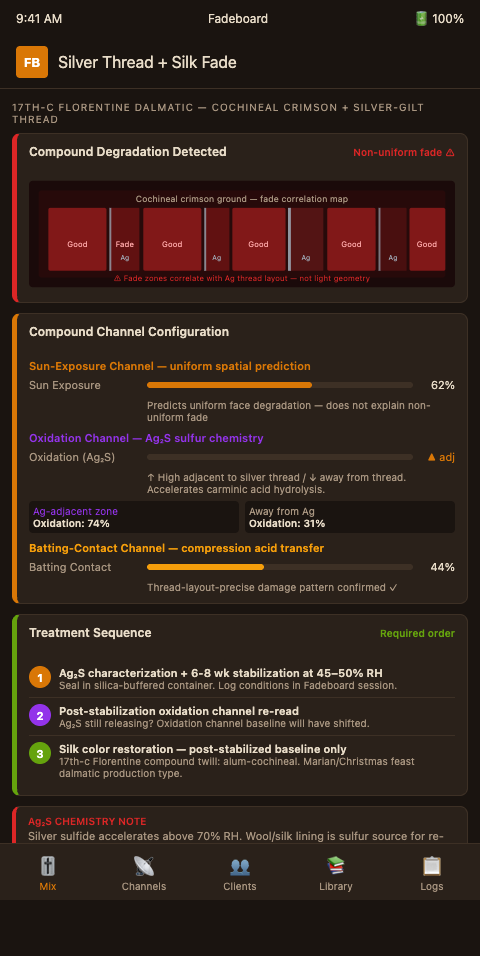
A 17th-century dalmatic arrived with what looked like standard light-fading on the crimson silk ground: even bleaching across the face, slightly deeper color where the orphrey bands had shielded the silk. The conservator's first Fadeboard session set the sun-exposure channel for three centuries of sanctuary use and projected a restoration target. Before accepting that target, she cross-checked it against the silver thread distribution — and the numbers did not reconcile. The faded zones did not correlate with light-exposure geometry. They correlated with the silver thread layout.
The crimson silk ground was alum-mordanted cochineal on a compound twill — a 17th-century Florentine production type used for high-quality Marian and Christmas feast dalmatics. Cochineal's carminic acid is moderately vulnerable to acid-catalyzed dye-bond hydrolysis; the Ag₂S corrosion products releasing sulfur compounds in the areas immediately adjacent to the silver thread were creating exactly the pH conditions for accelerated carminic acid loss independent of the photodegradation pathway. The conservator who had assumed a uniform light-fade model was working with the wrong causal framework.
Gilt-silver thread develops two distinct corrosion products: black silver sulfide (Ag₂S), which is the characteristic tarnish, and reddish copper corrosion from the copper alloy core sometimes present in historic metallic threads. Cleaning metal thread is widely acknowledged as the hardest single challenge in textile conservation because the corrosion products are physically and chemically bonded to both the metal and the adjacent silk (Gilded Silver Threads: Corrosion and Cleaning, Academia.edu). What is less commonly discussed is the secondary effect: as the silver sulfidizes, it releases sulfur compounds into the adjacent silk fiber. Those compounds attack the dye's mordant bond, accelerating local fade in a pattern that mimics light-induced fading but has a different spatial distribution.
Ag₂S formation accelerates above 70% relative humidity, and the degrading wool and silk fibers that often form the lining or padding of historic brocade vestments are themselves sulfur sources that accelerate silver sulfide corrosion (Sulfidation of Sterling Silver in Corrosive Environments, npj Heritage Science). A vestment stored in a humid sacristy — or wrapped in tissue that retained moisture — has its silver thread corroding from both the ambient sulfur environment and the off-gassing of its own interior fibers.
Separating the Fade Pathways in Fadeboard
Fadeboard's channel framework is built to handle compound degradation. For a vestment with both light-induced fading and silver-sulfide-accelerated local fade, you open two independent causal channels and calibrate them separately.
The sun-exposure channel is set to model the aggregate light dose the vestment received over its documented life. For a 17th-century dalmatic in continuous liturgical use, this is a large number — but it produces a spatially uniform degradation pattern across the exposed face. If your actual fade pattern is not uniform — and on the Florentine dalmatic, it was distinctly non-uniform — the sun-exposure channel alone does not explain the data. The spatial mismatch between predicted and observed fade is the diagnostic signal that points toward compound degradation.
The oxidation channel is where silver-sulfide chemistry registers. Sulfur sources in historic sanctuaries include degrading wool and silk padding, stored vestment bags made of sulfur-releasing materials, and even the wood of vestment chests (Managing Silver Tarnish — ICOM-CC 2021 Beijing, English Heritage PDF). You dial the oxidation channel up in areas adjacent to high-density silver thread, and down in areas away from metal. The resulting projected original will show a more spatially variable degradation history than the sun-exposure channel alone would produce.
The batting-contact channel addresses compression effects: silver thread pressed against silk under the weight of the vestment during storage creates localized acid transfer from corrosion products into the fiber. The spatial pattern of this damage tracks the thread layout precisely, which is how the conservator identified it on the dalmatic.
A 266-nanometer laser can clean silver without damaging adjacent silk, while 1064-nanometer laser treatment melts and burns the substrate — instrument selection for metal thread cleaning has direct consequences for the silk that must be color-restored afterward (Laser Cleaning of Tarnished Silver and Copper Threads in Museum Textiles, ScienceDirect). The channel settings in Fadeboard need to reflect the cleaning treatment history: a dalmatic whose silver has been laser-cleaned retains the silk in better condition than one that received abrasive or chemical treatment, and the oxidation channel should be calibrated accordingly.
Case study evidence confirms the risk: post-treatment stability assessment of metal thread cleaning found that mechanical cleaning damaged securing silk thread in a documented instance — the silk that survives may carry different physical properties depending on what treatment the metal received (International Journal of Conservation Science — Metal Thread Cleaning, IJCS).
Advanced Tactics: Sequencing Metal and Silk Treatment
The critical sequencing question for vestments with both tarnished silver and faded silk is which treatment comes first. The general answer is: stabilize the metal thread before addressing the silk color, because ongoing sulfur release will continue to degrade the silk during and after any dye restoration if the metal source is not controlled.
Evaluating mechanical, electrochemical, and chemical cleaning methods for metallic embroidery threads consistently identifies incompatibility with adjacent silk as the key risk in metallic thread conservation (A New Approach to Conservation of Metallic Embroidery Threads, ResearchGate). If the cleaning method introduces moisture, chemical residue, or mechanical abrasion to the surrounding silk, the silk will be in worse condition for the color restoration phase than it was before treatment began.
Fadeboard's documentation output supports this sequencing decision. The oxidation-channel reading before silver treatment and after silver treatment will differ — the post-treatment reading should show lower projected chemical degradation in the zones adjacent to cleaned thread. Documenting both states creates a before/after record that demonstrates the intervention's effect on silk condition, not just on metal appearance. This is the kind of evidence that diocesan conservation review boards increasingly expect when approving multi-phase treatments.
Environmental Control After Metal Stabilization
Once the silver-gilt thread has been cleaned and the sulfur-release source has been addressed, the vestment's storage environment must be managed to prevent re-tarnishing during the silk color restoration phase. If the dalmatic is returned to an uncontrolled sacristy environment between treatment sessions, the silver will begin to re-tarnish within weeks at relative humidity above 70%, and the oxidation-channel baseline for the silk work will have shifted before the dye bath is prepared. Store the vestment in a sealed container with silica gel buffered to 45–50% RH between treatment sessions, and log the storage conditions in the Fadeboard session notes so that any re-tarnishing detected at subsequent visits can be attributed to a specific environmental event rather than an unexplained channel discrepancy.
For a 17th-century Florentine dalmatic with silver-gilt couching and crimson silk ground — the most common configuration for high-quality Italian liturgical production of that period — the typical treatment sequence runs: environmental assessment and Ag₂S characterization, followed by a 6–8 week stabilization period under controlled humidity, then the Fadeboard silk channel calibration with the post-stabilization oxidation reading, then the dye bath preparation for the silk ground zones. The stabilization period is not dead time — it is when the Fadeboard session's substrate channel should be set, using the controlled-environment reading as the baseline rather than the intake reading made in the sacristy.
For brocade vestments where the couching threads that secure the silver embroidery are themselves silk and subject to both light fade and metal-adjacent chemical damage, couching preservation and brocade color restoration addresses the specific challenges of couched metal on silk grounds. For vestments where Raman spectroscopy data is available to inform the metal-thread analysis, Raman soundboard adjustments for metallic grounds covers how that analytical data feeds into channel calibration. The handling challenge of greasepaint residue adjacent to degrading silk in theatrical costume contexts — a chemically analogous contamination problem — is addressed in greasepaint residue on theatrical textiles.
Treating the Whole Problem, Not Just the Visible One
The tarnished silver thread and the faded silk on your brocade vestment are not two separate problems — they are one compound degradation system, and treating only the visible symptoms without addressing the chemical interaction will produce a restoration that fails faster than the original degradation did. Fadeboard's multi-channel framework gives you the diagnostic precision to understand the full system before you intervene.
Schedule a channel-analysis session for your silver-and-silk brocade treatment before committing to a dye bath — the oxidation-channel reading alone may change your sequencing plan. Apply to join the Fadeboard waitlist now, and have the compound degradation framework configured before the next Candlemas or Epiphany season brings another 17th-century silver-ground dalmatic to your studio.
The most expensive failure mode in silver-and-silk brocade work is treating the silk and the metal as independent restoration projects on the same garment, scheduling them weeks apart, and missing the chemical interaction that connects them. The single Fadeboard session that documents the joint degradation is also the document that prevents that scheduling error — by making the dependency visible, it forces the sequencing decision to the front of the project rather than the middle.