Reading Maker's Marks to Predict Original Pigment Chemistry
The Mark as a Chemistry Document
A bisque head arrives with a mark you half-recognize: "S H 1039 DEP." You know it is Simon & Halbig, you know the mold number, but you treat it the same as every other S&H you have handled. Three tinted washes later the flesh tone is plausible but slightly off — and you cannot identify why, because you set your Fadeboard channels to generic "German bisque 1890s" defaults rather than S&H-specific settings for the mold 1039 era.
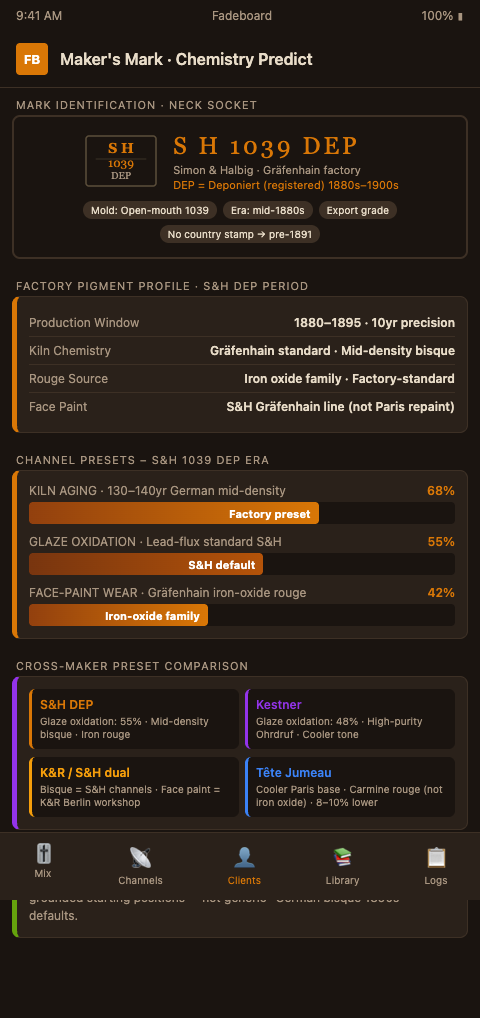
The mark tells you more than you used the. According to Simon & Halbig manufacturer history, the Gräfenhain factory was founded in 1869 and used SH initials early, shifting to the "S&H" marking after 1901 — which means mark format alone narrows the production decade. The DEP suffix indicates a Deponiert (registered) mark used in the 1880s–1900s. The mold number 1039 corresponds to a specific open-mouth style introduced in the mid-1880s. That three-part mark places this head within a ten-year production window, which is precise enough to identify the dominant pigment sourcing period for S&H.
Research on German bisque mark identification from Dr. Lori establishes that German bisque mark identification is directly tied to factory era, quality grade, and firing chemistry differences — meaning the mark is not just a provenance label but a chemistry indicator.
What Different Marks Tell You About Pigment Channels
Simon & Halbig. The SH mold number reference at DollReference documents mid-1880s open-mouth molds and 1893 ethnic doll head introductions. S&H supplied bisque heads to Jumeau, Kämmer & Reinhardt, and others — which means an S&H head may carry the bisque firing chemistry of the Gräfenhain factory but the face-painting chemistry of a French or Berlin assembly house. When you see a dual mark (S&H on the bisque, Jumeau red stamp on the body), set your base-tone channel to S&H German bisque standards but your face-paint-wear channel to the Jumeau Paris workshop's known pigment preferences, which tended toward cooler, more pastel flesh tones than S&H's own production heads.
Kestner. General mark identification reference confirms that Kestner began mold numbering in 1892; pre-1892 marks carry size information only. The factory acquired the Ohrdruf porcelain works around 1860, which gave it a higher-purity bisque body than most competitors by the 1870s. Higher-purity bisque oxidizes slightly differently over a century — the glaze-oxidation channel on a pre-1892 Kestner should typically sit a half-position lower than on a contemporary S&H, because Kestner's tighter clay body shows less yellowing from oxidation.
Kämmer & Reinhardt. The K&R manufacturer reference at DollReference documents that K&R sourced bisque heads from Simon & Halbig and stamped both marks on assembled dolls. A K&R/S&H dual-stamp head has the same bisque body chemistry as a standard S&H, but K&R's in-house face painting from 1886 onward used different rouge formulations than S&H's own production. The dual stamp tells you to set bisque channels to S&H defaults and face-painting channels to K&R-specific settings.
Jumeau. By 1885, all Jumeau dolls carried the trademarked name, and the historical account of French fashion dolls confirms that French and German makers used distinct pigment sourcing methods. Jumeau heads made entirely in Paris (as opposed to Jumeau-marked S&H heads) used French atelier pigment suppliers with a characteristic cooler flesh-tone base and carmine-family cheek rouge rather than the iron-oxide-family rouge common in German production. Your cheek-rouge channel should sit at a different starting position for a genuine Tête Jumeau versus a Jumeau-assembled S&H head.
Fadeboard's approach here is to treat each maker/era combination as a factory pigment profile — a predefined starting configuration for kiln-age, glaze-oxidation, and face-paint-wear channels based on the documented pigment chemistry of that factory in that decade. Reading the mark before setting any fader means your starting configuration is historically grounded rather than intuition-based. Understanding how composition doll bodies differ from bisque heads in their degradation chemistry is the natural complement: most bisque heads from the major German and French makers were assembled onto bodies of different materials, and the body's degradation may visually influence how you read the head's mark-based channel preset.
Advanced Tactics for Mark-Based Channel Setting
Three practical adjustments improve mark-based prediction in edge cases.
Account for assembly houses that repainted. Many bisque heads were painted at the assembly house, not at the bisque factory. A Simon & Halbig mold with a French retailer label may have been painted in Paris by a workshop that used different pigments than the Gräfenhain production line. When you see evidence of retailer marking or export stamps, treat the face-paint-wear channel as assembly-house specific rather than bisque-factory specific.
Use condition asymmetry to confirm or override factory defaults. If the mark suggests S&H mid-1880s but the glaze oxidation reads much higher than your channel preset expects, something in the storage history differs from the typical provenance for that era. The mark sets the prior; the condition tells you whether the prior holds.
Log mark-to-channel mappings in your dated recipe log. Over twenty or thirty clients, your own observed correlations between specific marks and channel settings will outperform generic factory profiles for the regional and storage variations that appear in your actual client base. An S&H 1039 head that spent ninety years in an Illinois textile chest may show less UV darkening than the factory preset predicts; your logged observation from that client overrides the preset for the next S&H 1039 in similar provenance.
Common pitfall: ignoring country-of-origin stamps added after 1891. The McKinley Tariff Act of 1890 required imported goods to be marked with country of origin beginning in 1891. A bisque head marked "Germany" was made after 1891; one marked "Made in Germany" was made after 1914. These stamps don't change the mark-based channel presets for the bisque chemistry, but they do narrow the production window — which affects how many years of kiln-aging to dial into the channel. An S&H 1039 marked "Germany" (1891–1914) needs a narrower kiln-age range than one with no country stamp, which could be as early as the mid-1880s.
For work on partial repaints of heirloom Jumeau dolls, accurate mark reading is doubly important: a partial repaint that uses S&H German factory defaults on a genuine Tête Jumeau head will read as anachronistic to any future conservator who examines the pigment chemistry.
When a client's doll has suffered wash cycle damage to feedsack-era textiles in associated textile items, the same mark-reading logic applies to the fabric: manufacturer weave codes and dye lot markings on period feedsack carry the same function as a bisque head stamp — they index the original colorant chemistry to a specific production era and source.
The Mark Is the First Fader
Independent restorers who handle individual client heirlooms in solo studios cannot afford to set degradation channels from generic defaults when specific factory chemistry information is sitting on the back of every head. Reading maker's marks before setting any Fadeboard channel converts a provenance detail into a chemistry prediction — and that prediction changes how many sittings it takes to match any bisque patina.
If you currently ignore marks beyond basic maker identification, the Fadeboard waitlist is open for independent restorers now. Join and note which manufacturer-era combinations you handle most often — Kestner pre-1892, S&H DEP period, or Jumeau Tête — and those factory profiles will be the first channel presets built into the early-access release.
Pull the next three bisque heads off your bench and photograph each mark under consistent raking light before you run your first Fadeboard session. That three-head sample is enough to confirm which two or three factory profiles dominate your actual client base, which is the information the early-access team uses to prioritize calibration sequencing for solo studio restorers entering the beta.