How to Handle Partial Repaints on Heirloom Jumeau Dolls
What Makes Jumeau Partial Repaints Different
A Doll Reference overview of Jumeau Bébés documents that Jumeau's 1878 bisque bébés became the industry standard for French doll manufacture, and that finest-condition Jumeaus reach $5,000–$300,000 at auction depending on size, mold, and original paint integrity. That range tells you what's at stake in a partial repaint: a single session that mismatches the touch-up zone to the original paint can shift a doll from the upper end of its condition tier to the lower end.
The challenge specific to Jumeau dolls is the quality of the original paint. Jumeau painters were skilled specialists applying consistent, well-controlled layers of high-grade bisque paint in a factory environment with dedicated lighting. The original factory application is thinner and more even than most restoration work — a 140-year-old Jumeau face has a surface film so controlled that the applied paint reads almost as integral to the bisque, not as a separate layer on top of it. Matching this quality requires not just color accuracy but film thickness accuracy.
According to AIC's Code of Ethics, conservators must use reversible treatments and document all procedures with minimal intervention required. For a Jumeau partial repaint, "minimal intervention" is literal: touch only the verified loss zone, leave all original paint undisturbed, and ensure the new application can be removed without affecting surrounding original layers.
Diagnosing the Repaint Zone
Before mixing anything, you need to know exactly what you're working with. Historic paint analysis methods — cross-section microscopy, FTIR, and optical microscopy — can distinguish original bisque paint layers from later repaints via layer stratigraphy: original factory paint sits directly on bisque, while later repaints show a distinct boundary layer, often including a dust or wax accumulation from decades of surface aging between the original and the added paint.
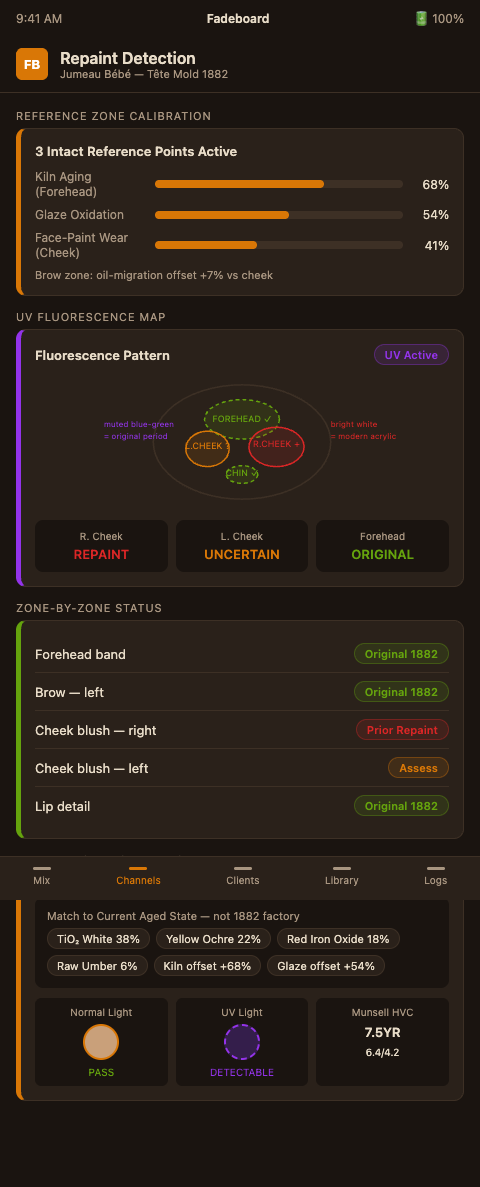
For a kitchen-workbench restorer without microscopy access, UV light is the practical field tool. Genuine period bisque paint fluoresces differently under UV than modern pigments — original paint typically shows a muted blue-green fluorescence from the period binder, while modern acrylic or oil-based repaints fluoresce bright white or yellow. Mapping the fluorescence pattern before treatment identifies every zone of prior restoration and confirms which areas are original and require matching. When partial repaint work must be evaluated against a scenario where water damage has expanded the loss zone across multiple features, the 1865 Bru Jeune water-damage restoration case study covers the threshold decisions between partial and full facial reconstruction — the UV mapping step is the same diagnostic tool in both cases.
AIC inpainting philosophical standards require that all retouching be detectable under UV while invisible to the unaided eye in normal viewing. This principle defines the success criterion for the partial repaint: pass the UV test (detectable as retouching) and pass the normal-light test (invisible as retouching). Those two requirements are not contradictory — they define the acceptable detection threshold.
The Fadeboard Formula for Jumeau Matching
Opening a Fadeboard session for a Jumeau partial repaint starts with calibrating against the intact original zones, not the damaged zone. Identify three reference points on the original face paint: forehead (no applied color, shows base bisque tone), cheek (original rouge application), and brow area (often shows different oxidation than cheek due to oil migration from hairpiece wigs). Set the kiln-aging baseline from the forehead reference. Set the glaze-oxidation fader by comparing the forehead tone against a clean white chip — the differential tells you how much ambient yellowing has accumulated. Set the face-paint-wear channel by assessing the cheek rouge density relative to a reference photograph of comparable unrestored examples.
Think of these three reference calibrations as setting three fader channels on the soundboard: you're not guessing what the degradation levels are — you're reading them directly from the original surface and entering them as fader positions. The repaint-zone formula output then represents what the original paint should look like at those degradation levels, not what the raw original bisque factory formula looked like in 1882. That distinction is what makes Fadeboard matching converge on the current aged state rather than on the historical original.
Porcelain and bisque doll identification from Dr. Lori's appraiser notes confirms that bisque heads are made of unglazed china paste fired at high temperature and that the surface can be repainted over original layers — but that this history is detectable, which is why calibrating against the original paint zones matters so much. You're measuring the current state of the original to extrapolate the formula for the repaint, not working from a theoretical original.
Application Discipline for Partial Repaints
Film thickness control is the variable that most restorers underestimate. An original Jumeau application is so thin that you can feel the bisque texture through it under a fingernail. Restoration work that builds up even half a paper-thickness over original is detectable by touch, and that detection undermines the "invisible under normal light" criterion.
Work in three ultra-dilute passes rather than one medium-opacity application. Each pass uses the Fadeboard formula diluted to approximately 1:5 pigment-to-water, applied with the smallest sable that still covers the zone. Let each pass dry completely before evaluating whether a second is needed. In most Jumeau partial repaint cases, three passes bring the loss zone to within matching range of the original; a fourth may be needed for the center of deeper losses.
Munsell Color System notation gives you the objective record you need between sessions: record the HVC of the original reference zones and the HVC of your repaint zone after each pass. The dated recipe log with Munsell readings documents exactly what was done and allows a future conservator to pick up the work accurately.
Antique doll valuation data from Appraisily is unambiguous: improper restoration destroys value. The partial repaint discipline described here is not excessive caution — it is the professional standard that preserves the economic integrity of what may be the most valuable object your client owns.
When partial repaint work generates client disputes about what constitutes "original color" versus "restored color" — an increasingly common issue as Jumeau values rise and clients become more color-particular — the handling client disputes about original vs. restored color addresses those conversations directly.
Ecclesiastical conservators dealing with canonical disputes about liturgical red shades — where a vestment's historical red must be matched against a regulated color standard while also matching surrounding original material — face a structurally parallel challenge. The canonical disputes about liturgical red shades documents those adjudication processes and the fader logic that resolves them, with useful parallels for Jumeau partial repaint decisions.
The Case for Getting It Right Once
A Jumeau partial repaint done correctly — invisible under normal light, detectable under UV, reversible, documented — adds value and prolongs the authenticity window of a doll that might otherwise require a full repaint within a decade. A partial repaint done incorrectly either destroys value or, at best, requires removal and repetition.
If you have a Jumeau bébé on your bench with a specific loss zone — a cheek abrasion, a lip chip, a nose-tip rub — run the Fadeboard calibration against the three intact reference zones before mixing anything. The formula that comes out of that session will converge on the current aged surface in a way that no amount of eye-matching can achieve. One correct application, documented in your dated recipe log, with a Munsell reading at completion.
Independent restorers handling high-value Jumeau and Bru partial repaints can sign up for the Fadeboard waitlist now and get early access to the Tête Jumeau factory calibration presets before the next bébé arrives on your bench.