How to Handle Canonical Disputes on Liturgical Red Shades
The Canonical Red Problem Has Institutional Roots
A parish in a high-church Anglican diocese commissioned the restoration of a seventeenth-century red silk stole. The restorer matched the restored crimson carefully against surviving unexfaded areas under ISO D65 illuminant, achieving ΔE* < 1.8 — a technically excellent result. The parish's incumbent accepted the restoration. The area dean, reviewing the completed vestment, declared the red too warm and "distinctly Sarum rather than Roman" and requested the work be redone.
The dispute was not about the conservation outcome. It was about which canonical standard the red should target: the incumbent read the stole's pre-Reformation origins as authorizing the warmer Sarum red; the area dean read the diocese's modern rubrics as requiring compliance with the General Instruction of the Roman Missal's five-color system. Both were correct within their own interpretive frame.
General Instruction of the Roman Missal (USCCB) specifies red vestments for certain feast days (nos. 346–347) but does not define the shade of red beyond "fire" or "blood," leaving the specific chromaticity unresolved. General Instruction of the Roman Missal — Vatican full text confirms the same openness. The GIRM provides normative intent, not a spectrophotometric specification.
On the Anglican side, The Strange Story of the Ornaments Rubric (North American Anglican) traces how the legal interpretation of the Ornaments Rubric from 1550 through the nineteenth century left vestment color standards genuinely contested, which is why the area dean's objection carried some institutional weight despite the incumbent's authorization.
Liturgical Colors in the Sarum Rite (Taylor Marshall) documents the specific Sarum red as a warm crimson closer to kermes scarlet than the cooler Roman rite red, which tends toward a slightly bluer hue under modern rubrical guidance. The stole's pre-Reformation origin made the warm Sarum reading historically defensible — but the diocese's current practice did not honor that reading.
The conservator needed documentation that separated what was done (accurate restoration to original dye character) from what was disputed (which canonical standard the original dye character satisfies). Fadeboard's channel record provided exactly that.
How Channel Records Separate Facts From Norms
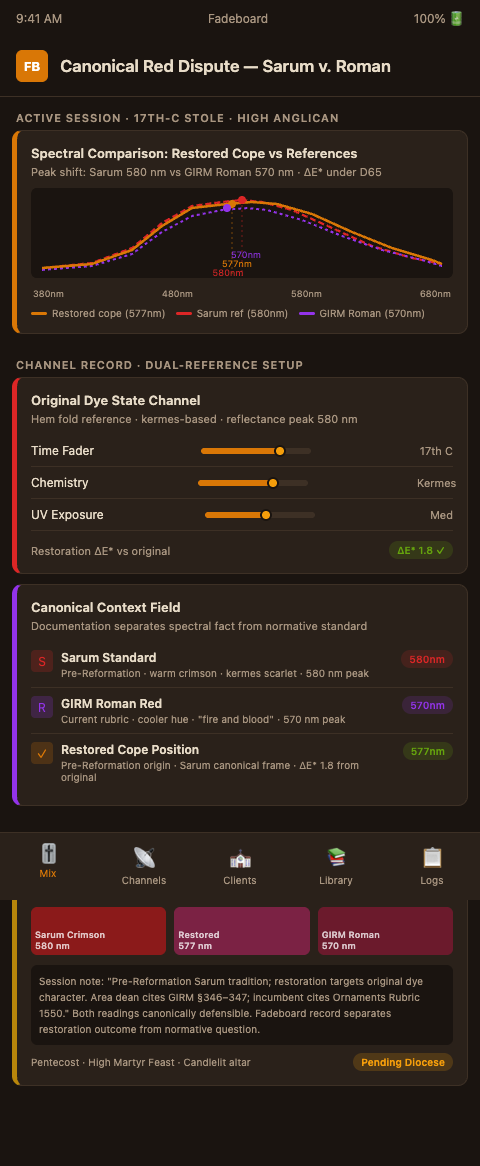
The conservator's Fadeboard session recorded two channels: the original dye state channel (set from measured reflectance on unfaded hem areas) and the restoration target channel (set to match the measured baseline with time and chemistry faders applied).
The session output included a spectral curve for the restored red, locating it at reflectance peak 580 nm with a half-width typical of kermes-based dyes — a warm crimson, documented spectrally, not just described verbally. The conservator added a note in the session's canonical context field: "Pre-Reformation Sarum tradition; restoration targets original dye character, not GIRM-compliant modern Roman red."
When the area dean's objection arrived, the conservator provided the Fadeboard session report and two comparison curves: the restored cope at peak 580 nm, and a reference curve for a modern GIRM-compliant red vestment measured at the same diocese, peaking at 570 nm with a narrower warm shoulder. The documentation showed, unambiguously, that the restored cope's red was spectrally distinct from the GIRM-target red — not because the restoration was poor, but because the original vestment had been made to a different canonical standard.
This reframing allowed the diocese to make a genuine institutional decision: either accept the historically accurate restoration on canonical grounds, or commission a new red overlayer in GIRM-compliant crimson while preserving the historical piece in the vestry collection. The Color of Liturgical Vestments (EWTN) was cited in the decision document as the accessible summary of the Roman rite color system, confirming that both choices were canonically defensible positions.
The key was that Fadeboard's channel record had separated the technical restoration outcome from the canonical norm question. The conservator was not asked to adjudicate the institutional dispute; the spectral documentation made clear the restoration was correct relative to its historical reference, and the canonical dispute was the diocese's to resolve.
For the Florentine vestment case study extending this analysis across a high-profile historical attribution dispute, the Florentine orphrey case study covers how similar documentation enabled a museum attribution revision.
Advanced Tactics for Canonical Red Documentation
Document the Rubrical Basis Before Restoration Begins
Before setting any Fadeboard channel target, obtain written confirmation from the commissioning parish or diocese about which canonical standard applies. If the vestment predates the rubric cited by one party, record this explicitly in the Fadeboard session's canonical context field. This prevents the documentation dispute that followed the case above, where the area dean's objection arrived after the work was complete.
Use Two Canonical Reference Curves
Load at least two reference spectral curves into the Fadeboard session: one for the authenticated original red shade (Sarum, Roman, Anglican, Byzantine, as appropriate) and one for the current canonical standard of the commissioning diocese. Display both curves alongside the restoration target on the output report. This ensures reviewers can see exactly where the restored dye sits relative to each standard without relying on verbal descriptions.
The Jumeau Partial Repaint Parallel
Canonical disputes about color standards are structurally analogous to the challenge of partial repaints on Jumeau heirloom dolls, where the question of whether a repaint "matches" depends entirely on which era's color standard is used as the reference. The same dual-reference channel logic applies: document both the historical reference and the current-use standard, and let the owner decide which governs.
Prepare for the Diocesan Commission Proofs Requirement
High-church Anglican and Roman Catholic dioceses increasingly require color proof documentation before accepting restored vestments for sanctuary use. Diocesan commission proofs and soundboard records covers the specific format that diocesan fabric committees expect. The Fadeboard session export should be accompanied by a physical swatch under two illuminants — D65 and the sanctuary's measured illuminant — attached to the submitted report. For a Pentecost red stole or an Ascension cope, the relevant sanctuary illuminant is whatever the parish actually burns at the high feast: beeswax candles at approximately 1850 K for traditional high-church settings, or the mixed candlelight-and-spot-LED profile increasingly common in renovated naves. Specify which illuminant the proof swatch was evaluated under in the submission documentation.
Sarum Blue Parallel as a Methodological Caution
Sarum Blue: The Great Untruth (Pray Tell Blog) models how a color-canonical dispute is adjudicated when documentary evidence does not support the assumed tradition. The article's methodology — check the primary sources before accepting the received color standard — is the same verification step the conservator should apply before setting a Fadeboard canonical reference channel. Assumed traditions are not documented ones.
Final Note for Canonical Red Work
A liturgical red dispute is not a technical problem with a technical solution. Fadeboard cannot decide whether Sarum crimson or GIRM-compliant red is theologically authoritative in a given diocese. What Fadeboard's channel records do is separate the factual restoration outcome from the normative canonical question with enough precision that the institutional parties can debate the right question rather than blaming the conservator for a judgment call they never authorized.
The distinction matters especially at high-feast transitions. A cope used for both Pentecost and martyr feast days in a high-church context carries a specific red requirement that the GIRM describes as "fire and blood" but leaves spectrally undefined. When the diocesan commission and the commissioning incumbent hold different inherited color expectations for what "Pentecost red" looks like at the high altar under candlelight, the Fadeboard session record is the neutral evidence base from which both parties can reason. The conservator who has run two reference curves — documented Sarum red and documented GIRM-adjacent red — and placed the restored cope's spectral position in relation to both has transformed an incipient canonical dispute into a resolvable institutional question.
For your next red vestment project where canonical ambiguity exists, open Fadeboard with a dual-reference channel setup — original historical standard and current diocesan standard — document both curves in the session before touching the silk, and submit the output report with your commission letter. The spectral record will protect your professional standing regardless of how the canonical question eventually resolves. Apply to join the Fadeboard waitlist and have this dual-reference framework ready before the next Pentecost or high martyr feast commission requires it.