Reading Wash-Cycle Damage on Depression Feedsack Prints
Why Feedsack Prints Fade Differently
A workshop specialist examining a Depression-era Nine-Patch quilt built from 1930s feedsack fabrics found that the fading pattern bore no resemblance to the UV-gradient fade she regularly saw on 19th-century natural-dye quilts. The entire surface was uniformly paler, with almost no gradient from edge to center. The original printed detail — tiny floral sprigs on the yellow blocks, geometric grid lines on the blue blocks — was nearly invisible on the most-washed sections. The colors had not shifted in hue; they had simply lifted uniformly, like watercolor thinned with too much water.
This is the signature of wash-cycle damage on printed cotton: global color lift with preferential loss of fine print detail, caused by repeated alkaline detergent exposure stripping the surface dye rather than photochemically degrading the chromophore.
Feedsack history documentation records that women removing ink labels from cotton feed bags in the 1920s and 1930s often used household chemicals — lye, bleach, or washing soda — that were harsh enough to strip surface colorants. The printed fashion fabrics introduced commercially around 1937 used dye formulations that were economical rather than lightfast or wash-resistant. These were utility textiles, made to look attractive in the store and used until they fell apart.
Percy Kent Bag Company and similar manufacturers began printing fashion designs on cotton bags around 1937, deliberately targeting quilters and garment makers. The dyes used were not the mordant-fixed natural dyes of 19th-century textile production — they were early synthetic print dyes applied by roller printing with minimal fixation chemistry. The result was vibrant color that faded rapidly under home laundering conditions.
The Chemistry of Wash-Cycle Color Lift
Research on industrial washing conditions and cotton cellulose shows that alkaline detergents and mechanical agitation in repeated wash cycles degrade cellulose bonds and strip surface dye systematically. The damage is not random — it follows the mechanics of agitation washing, which subjects every part of the fabric surface to approximately equal mechanical stress. Unlike UV fading, which creates gradients, wash-cycle damage creates uniform overall lightening.
Cotton Incorporated's colorfastness research documents that red and blue print dyes show the highest wash-loss rates, with pattern detail fading faster than overall color. This is because printed pattern detail is built up as thin layers of colorant on the fabric surface, while the background color penetrates deeper into the fiber. As surface layers strip away, the detail lines disappear before the background becomes noticeably pale.
Repeated laundering causes measurable structural changes to the cotton cellulose itself: degree-of-polymerization reduction in the cellulose chain means the fibers become increasingly unable to hold dye even if the original dye molecules are chemically intact. After 50 or more cycles, the surface fiber layer may be half as thick as it was originally, and the remaining fiber structure is less reactive to dye-fixation chemistry.
For feedsack quilts that were used as everyday utility quilts and washed in household conditions through the 1940s and 1950s — before cold-water washing became standard — six hot washes per year over 15 years represents 90 wash cycles or more. Natural dye chromophore breakdown under water exposure confirms that repeated wetting cycles hasten chromophore degradation beyond UV effects alone. For printed synthetic dyes with even lower initial stability, 90+ cycles in hot alkaline water is sufficient to reduce a vibrant 1938 floral print to a pastel suggestion of its original pattern.
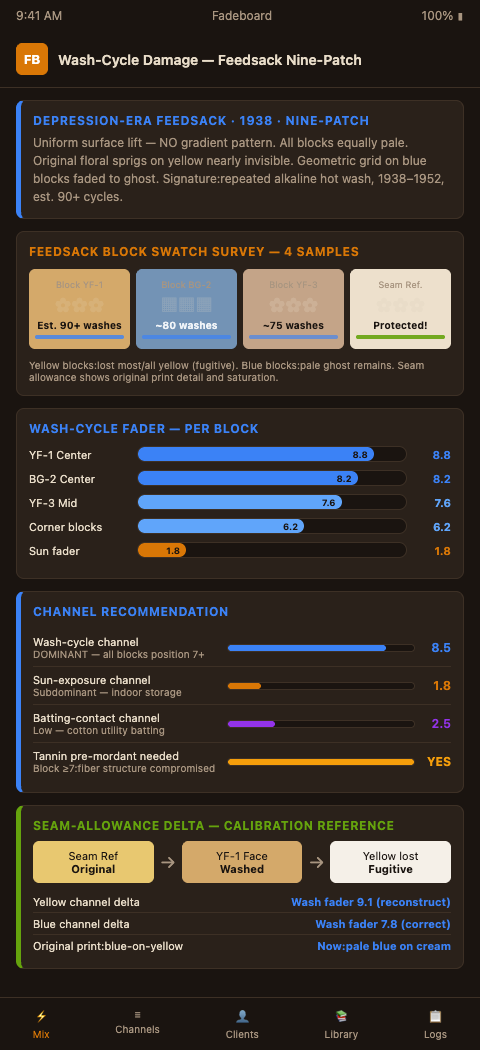
In Fadeboard's channel system, the wash-cycle fader for a Depression feedsack quilt block is almost always the dominant elevated channel — often sitting at position 7–9 — while the sun-exposure fader may be comparatively low if the quilt spent its life in indoor storage between washings.
Identifying the Original Colors: What Survives in Protected Areas
The diagnostic technique for feedsack wash-cycle damage is the same as for natural-dye quilts: compare exposed areas with protected areas. For a feedsack quilt, the most useful protected areas are the seam allowances (tucked inside the piecing and never agitated directly), the binding fold (the fabric is doubled and the inner surface is partially protected), and, if present, any blocks that were covered by additional quilts in storage for extended periods.
On feedsack quilts, the underside of appliquéd patches (if the quilt has appliqué elements) and the back of reversible blocks can also preserve original color. Examine every protected area you can find and compare the color saturation with the exposed face.
One complication specific to feedsack fabrics: many feedsack prints used two or more colors in combination, and those colors did not fade at equal rates. A print that originally showed a bright blue-on-yellow floral may read today as a faint blue on cream — the yellow has been completely lost while the blue retains a pale shadow. Restoring this print requires recognizing that the "cream" background was originally yellow (or possibly orange, or pink) and that the fader calibration for the yellow channel needs to be set much higher than for the blue channel, even though visually both appear equally pale.
Professional condition reporting standards for wash-damaged textiles describe wash-cycle damage as presenting as even overall color lift with pattern-detail loss — exactly the presentation of Depression feedsack quilts that have been heavily laundered. Using this characterization in your Fadeboard documentation creates a clear record for any future practitioner who works with the quilt.
Calibrating the Wash-Cycle Fader for Feedsack Blocks
Unlike UV-faded blocks where the sun-exposure fader position can be inferred from the quilt's placement history (window-adjacent, outdoor use, etc.), the wash-cycle fader for feedsack quilts needs to be calibrated from the color delta between protected and exposed areas, because household washing histories are rarely documented.
Find the best-protected area on the quilt — typically a seam allowance from a rarely-opened seam, or the innermost fold of the binding. Measure or visually assess the color saturation in that area. Compare it with the most-washed area (usually the center panels of the top surface). The delta between these two readings gives you the approximate wash-cycle fader position for the most-damaged block.
For blocks in intermediate states — not as washed-out as the most-damaged but not as protected as the seam allowances — interpolate the fader position proportionally. A block that reads halfway between the reference color and the most-washed state gets a fader position roughly halfway up the scale.
When mixing the corrective baths, the wash-cycle fader position does not just set the dye concentration — it also flags whether a mordant pre-treatment is needed. Severely wash-damaged feedsack cotton has compromised fiber structure, and a standard direct-dye application without mordant support may produce uneven uptake or premature re-fading. For blocks at position 7 or above on the wash-cycle fader, a tannin pre-mordant bath before the color bath significantly improves dye adhesion and longevity.
For in-dyeing cotton calico, the mordant pre-treatment decision follows the same logic — cotton with compromised surface chemistry requires mordant support before color application, regardless of whether the original fabric was mordant-dyed or direct-dyed.
The Reconstruction Challenge: Fugitive Dyes and Missing Colors
The hardest feedsack restoration case is the block where the original color has completely disappeared. Some Depression-era print dyes were so low in lightfastness and wash-resistance that they leave no recoverable trace — the fabric reads as undyed cream or white muslin. Restoring these blocks is reconstructive rather than corrective: you are inferring the original color from design context rather than measuring it.
Design context clues include: the visible surviving colors in the print (if three of four colors survive, the fourth can sometimes be inferred from period feedsack color palette conventions), the color choices in adjacent blocks made from the same feedsack fabric cut, and, occasionally, intact examples of the same print in other quilts or historical feedsack fabric collections.
Chintz appliqué corners with fugitive dye loss addresses the parallel challenge of reconstructive color work on 19th-century printed cottons where original colors have been entirely lost — the color inference logic is similar even though the dye chemistry differs.
For vestment conservators who encounter the equivalent problem with faded orphrey UV readings on aged liturgical textiles, orphrey gold-ground UV light reading covers the spectroscopic approach to identifying what is no longer visible to the naked eye.
Documenting Feedsack Work for Future Restorers
Feedsack quilts are increasingly recognized as historically significant — documents of Depression-era domestic economy and women's creative work under material constraint. A restoration record that documents the wash-cycle fader positions, the protected-area reference colors, the original print reconstruction decisions, and the dye bath formulations for each block is a contribution to the historical record of these pieces, not just a technical worksheet.
Fadeboard's panel-indexed recipe format exports naturally into a documentation format that future restorers, family members, or historical society archives can read and act on. Building that record into every feedsack restoration is standard professional practice — and increasingly, it is what clients bringing Depression-era family quilts expect.
Open a Fadeboard account and bring your next Depression-era feedsack piece to the first session — include the block construction (Nine-Patch, Grandmother's Flower Garden, or similar), the client's laundering history, and any surviving fabric scraps from the same run. The wash-cycle fader calibration for feedsack prints will be the immediate focus.