Reading Orphrey Gold-Ground Pigments Under UV Light
What Orphrey Gold Hides
The 13th-century episcopal textile arrived with what appeared to be straightforward orphrey restoration: some gold thread had tarnished, some ground silk had faded. Under visible light, the orphrey bands showed consistent gold-on-red embroidery with isolated dark areas at the margins. Under UV examination, the picture changed entirely. The apparently consistent red ground fluoresced unevenly — some sections glowing with the characteristic orange-yellow response of alum-mordanted madder, others showing near-dead black that indicated either iron-mordanted areas, applied organic pigment layers, or both.
Conservation of a medieval cross-orphrey depicting the Crucifixion documented the challenge precisely: the orphrey's Cyprus gold (gilt-silver membrane thread) and relief embroidery on padded grounds involve multiple material types whose degradation profiles do not correlate with each other (Diversity of Materials: Conservation of the Medieval Cross-Orphrey, CeROArt). The conservator working from visible light alone misses the distinction between materials that happen to look similar at a given fading stage but are degrading at completely different rates.
UV fluorescence is the non-invasive method for separating these layers. It identifies dyes, optical brighteners, repairs, and coatings without sampling — the authoritative review of UV examination techniques for conservation confirms it as the primary first-pass diagnostic for textile surfaces with complex layering (Review of UV Light Examination Techniques for Conservation, Cultural Heritage Resources). The limitation is that surface contamination — beeswax deposits from altar candles, incense resin, accumulated handling oils — can mask underlying fluorescence and produce false negatives for areas that are actually in better condition than they appear.
Mapping the UV Reading Into Fadeboard Channels
UV fluorescence examination produces observations — this area fluoresces orange, this area is dead, this thread responds to 365 nm differently than adjacent threads — that need translation into colorimetric targets before they can drive a restoration decision. Fadeboard provides that translation layer.
The process begins with UV documentation: photograph the orphrey bands under UV illumination at the same scale and registration as your ISO D65 visible-light images. The MA-XRF technique for mapping heritage textiles identifies gilded-silver thread distribution, iron-based dye concentrations, and copper and lead pigment deposits on 13th-century episcopal textiles with spatial resolution that UV photography approximates at low cost (Non-Invasive Analysis of Heritage Textiles with MA-XRF Mapping — Bishop Jacques de Vitry Mitres, npj Heritage Science). If your commission budget includes MA-XRF or micro-Raman analysis, that data feeds directly into Fadeboard's channel calibration. If it does not, UV fluorescence combined with careful visual-light mapping provides a workable substitute.
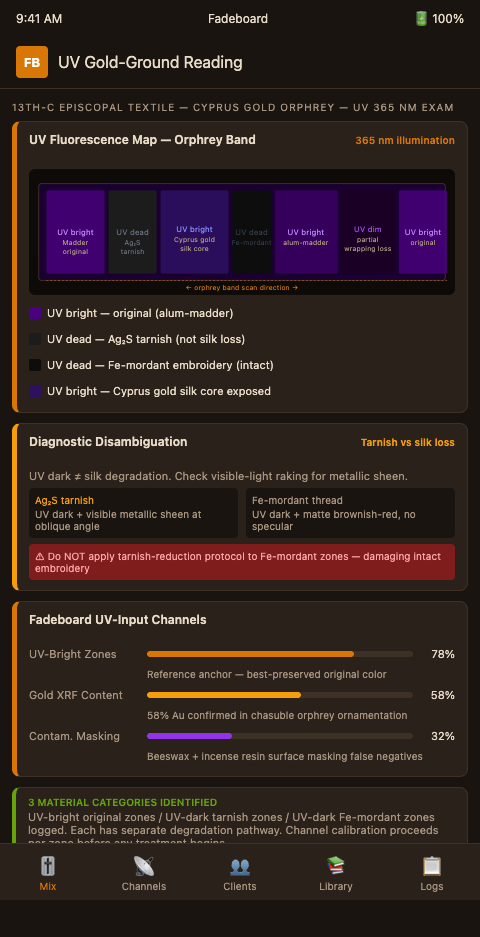
For the gold thread specifically, Cyprus gold (gilt-silver membrane thread over silk core) used from the 12th through the 16th century carries a distinctive UV fluorescence signature from the silk core — the metal wrapping blocks most UV response, but damaged or missing areas of metallic wrapping expose the silk and produce a brighter fluorescence signal. The UV map of the orphrey therefore doubles as a damage map for the gold thread: bright areas in zones that should be metal-wrapped indicate areas where the wrapping has been lost.
XRF analysis of Andalusian liturgical vestments detected approximately 58% gold content in the chasuble orphrey ornamentation, with identifiable concentrations that shifted at the boundaries between original and restored sections (Analysis of Fabrics and Metal Threads from Andalusian Liturgical Vestments, European Physical Journal Plus). This concentration boundary is often visible under UV as an abrupt fluorescence transition — which means the UV examination can distinguish original orphrey from 19th-century repairs without chemical sampling.
Fadeboard's UV-input channel accepts this mapped data. You designate the UV-bright areas as "original, less-degraded" reference zones and the UV-dark or anomalous areas as "treatment-required" zones. The sun-exposure fader is then calibrated against the UV-bright reference zones — since those zones represent the best-preserved surviving color, they anchor the backward projection toward the original gold-ground.
The underlying principles of UV-induced luminescence — including its documented limitations with surface contamination masking — are essential reading before relying on UV data for channel calibration (Ultraviolet Radiation Imaging, AIC Conservation Wiki).
Advanced Tactics: Separating Gold Tarnish From Silk Fade
The most common misreading in orphrey UV examination is attributing the "darkening" of a gold-ground area to silk degradation when the darkening is actually tarnished metal wrapping blocking the underlying silk's UV response. The Ag₂S tarnish that forms on gilt-silver thread absorbs UV at 365 nm and prevents the underlying silk from fluorescing — so a tarnished gold-ground area looks like degraded silk in the UV image, when the silk may actually be in reasonable condition.
The corrective is to compare the UV image with the visible-light photograph at the same registration. If an area appears dark in UV but has visible metallic sheen in visible light, the dark UV response is tarnish, not silk degradation. If the area appears dark in both UV and visible light, you may be looking at iron-mordanted embroidery grounds that genuinely absorb across both spectra.
Advanced analytical techniques for heritage textiles — including fiber-optic reflectance spectroscopy (FORS), XRF, and FTIR — provide definitive separation of these ambiguities when the budget allows (Advanced Analytical Techniques for Heritage Textiles, npj Heritage Science). For most parish commissions, UV examination plus careful visual-light mapping resolves enough of the ambiguity to proceed with channel calibration.
The orphrey's gold thread and silk ground must both be characterized before the Fadeboard target is finalized, because the restoration target for the silk ground must be validated against the gold thread's reference points. The two materials define each other chromatically in the finished work.
Iron-Mordanted Areas and the UV Diagnostic Trap
Iron-mordanted embroidery on orphrey grounds — used in English medieval work from the 14th century onward to produce dark red-browns and purples directly on the thread surface — creates a specific UV diagnostic trap. Iron mordant, particularly when combined with tannic acid as a dye-mordant co-process, produces a near-total UV absorber that reads identically to heavy tarnish in UV fluorescence images. A conservator who flags this area for silver-thread tarnish treatment will damage a genuinely intact iron-mordanted embroidery zone by applying a tarnish-reduction protocol to a substrate that does not require it.
The discriminant is the visible-light image again: iron-mordanted silk thread shows a specific matte brownish-red or brownish-purple surface color under visible light with no metallic sheen at all. Tarnished silver under visible light still shows some residual specular reflection at oblique angles. Under raking light, the surface geometry of a metal thread — however tarnished — reads differently from a flat-dyed silk thread. Log this visible-light raking comparison in the Fadeboard session notes alongside the UV documentation, so that any future conservator who reviews the record can reconstruct the diagnostic reasoning without re-examining the piece from scratch.
For a Pentecost-season orphrey in red silk ground with gold couching, the Fadeboard session should document UV-bright zones, UV-dark tarnish zones, and UV-dark iron-mordant zones as three distinct material categories before any channel calibration begins. Each category has a different degradation pathway and a different treatment implication.
For treatment decisions about the silver thread itself — when tarnish is present and cleaning is being considered — tarnished silver thread adjacent to faded silk covers the chemical interaction between silver sulfide formation and adjacent silk degradation. For orphrey bands where fragmentary loss makes color reference reconstruction more complex, orphrey fragmentary loss and pigment matching addresses partial-data reconstruction. The footlight-exposure channel logic used in stage textile analysis provides a useful analogy for altar-candle exposure modeling in footlight exposure reading for operatic bodices.
Taking the UV Data Further
If your orphrey examination produces UV maps that reveal a complex material history — earlier restorations, applied pigment layers, metal wrapping loss — Fadeboard's channel framework lets you address each zone separately rather than applying a single global restoration target to the entire band.
A well-documented UV examination from a 13th-century episcopal mitre or a 15th-century English cope orphrey can anchor the channel calibration with more precision than any amount of visual inspection. The UV diagnostic work is the foundation of the channel logic; the channel logic is what makes the UV data actionable. Schedule a demonstration session with UV-documentation images from your current orphrey project and see how the channel inputs translate into zone-specific restoration targets — and subscribe to the Fadeboard waitlist to secure access before your next high-feast commission arrives.
For diocesan studios that examine multiple orphreys per liturgical year, the cumulative payoff of building a UV-anchored channel record is significant: the second Easter Vigil cope you process inherits calibration insights from the first, the fifth from the previous four, and within a single liturgical cycle the studio has assembled a working reference library that no individual examination could produce on its own. The same UV-to-channel translation that took 90 minutes on the first orphrey takes 20 minutes on the tenth — and produces a more defensible result.