Best Practices for In-Dyeing Cotton Calico Patches
The Patch That Wouldn't Match
A conservation workshop in Ohio was repairing a double-wedding-ring quilt with four damaged sections, all requiring replacement calico patches. The restorer matched the color of the surviving panels under tungsten light, mixed a bath accordingly, and dyed the patches. Under the same tungsten light after rinsing, the match was close. Under daylight two weeks later, the new patches had faded two shades while the originals held. The problem was not the dye concentration — it was the mordant foundation.
Victorian-era calico used dense small-scale prints common in American quilts from 1840 to 1890, and the fabrics that survived into the modern era did so because their mordant bonds — tannin pre-bath followed by alum — were set under conditions no longer replicable with modern water chemistry. Modern cotton, even 100% unbleached calico, starts from a mordant-zero baseline. Calico's plain-weave cotton structure makes it receptive to dye but prone to fading with sun and washing; that receptiveness cuts both ways — it takes dye quickly in the bath but releases it just as quickly without adequate mordant foundation.
The quilting market was valued at $6.2 billion in 2024 with heirloom and sustainable fabric demand growing as a key segment. More restoration work is entering workshops, and the mismatch between modern patch stock and 150-year-old original fabric is one of the most consistent failure modes in calico patch work.
Building Mordant Foundation Before the Dye Bath
In-dyeing calico patches correctly starts with recognizing that the mordant history of the original fabric is not a variable you can ignore. Cellulose fibers have lower natural-dye affinity than protein fibers; tannin pre-treatment bridges the gap. A new calico patch needs a full tannin-then-alum mordant sequence before any dye bath, and the concentration of that mordant sequence must be calibrated against the estimated mordant saturation of the original fabric.
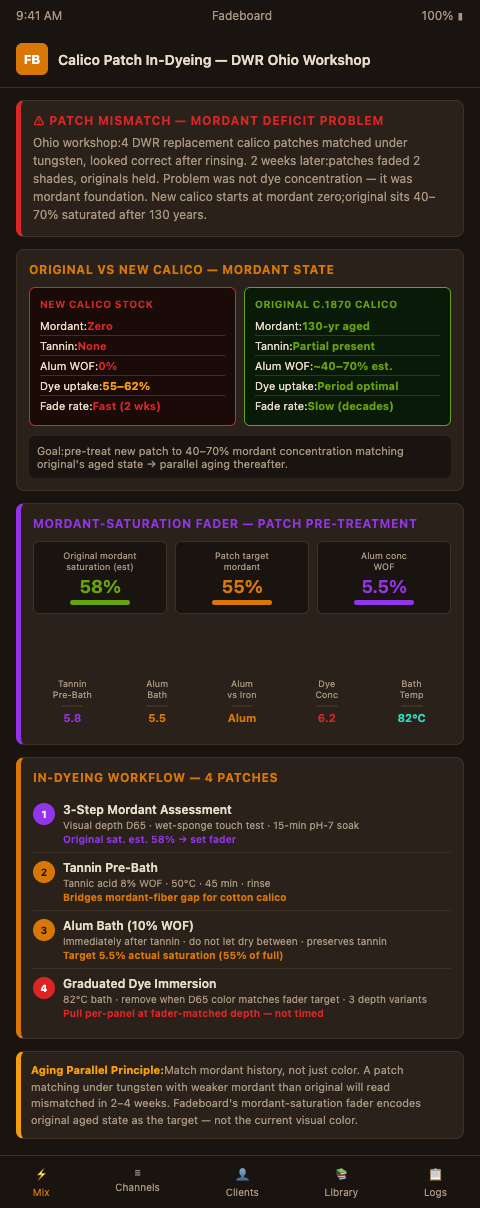
Fadeboard addresses this directly through its mordant-saturation fader. The operator assesses the original surrounding fabric — examining color depth under magnification, testing wash-fastness on a small hidden area, reviewing any available laundry history from the client — and sets a mordant-saturation fader position that represents how deeply the original was mordanted. The patch's mordant treatment is then targeted to match that fader position rather than being applied at a generic standard rate.
Alum at 10% weight-on-fiber applied immediately after tannin bath maximizes dye bond without losing tannin; on original 19th-century calico that has been in use for 130 years, the effective mordant saturation is typically between 40% and 70% of a fresh full-treatment value, depending on wash history. Setting the patch's mordant treatment to 40-70% of full concentration — matching the estimated original mordant state — produces a patch that will age in parallel with its neighbors rather than fading faster.
Mordant dye uptake on cotton ranges 55–62% under standard alum mordanting; using iron mordant instead of alum can improve exhaustion rate, but iron also shifts color toward gray-green on many dye baths, which is rarely the correct direction for calico color matching. The choice of mordant metal is a separate fader position in Fadeboard — the alum-vs-iron fader — and it is set independently of the mordant concentration fader.
For quilts where hand-quilting preservation during color repair is also a concern, the in-dyeing process for patches must account for the risk that immersion baths, if applied to already-installed patches rather than pre-cut patch stock, will stress the stitching around the repair area. The standard practice is to dye patch stock before cutting and installing, so the mordant and dye baths can be managed without the existing stitch lines being exposed to thermal or chemical stress.
Advanced Tactics for Calico Patch Dyeing
Multi-step mordant assessment. Before mixing the mordant bath for new patch stock, the restorer runs a three-step assessment on the original fabric: visual depth comparison under D65 lighting, a wet-sponge touch test to assess mordant stability (severely depleted fabric loses color on the sponge), and a 15-minute soak in plain pH-7 water to observe rinse-out rate. These three data points together allow a more precise mordant-saturation fader setting than visual comparison alone.
Graduated immersion for depth matching. When a single mordant concentration and dye bath formula must produce patches at three slightly different final depths (because the surrounding panels are not all at the same fade state), graduated immersion is more reliable than multiple bath concentrations. The patch is immersed for a short period, removed and assessed, then returned for additional time. The Fadeboard sun-exposure fader position for each target panel provides the reference depth — the operator pulls each patch from the bath when its color matches the fader target under D65 lighting.
Fugitive yellow in calico prints. Many 19th-century calico patterns included weld yellow or quercitron yellow that has completely disappeared from surviving examples. When replacing a patch in a calico area that originally had yellow-ground printing, the restorer must decide whether to dye the replacement patch at the current (yellow-absent) depth or attempt to reconstruct the original yellow-ground layer. Exhibit-safe costume restoration provides a useful framework: the standard for exhibition-grade work is that new material should be reversible and visually consistent with the artifact's current state, not its original state, unless a documented original color exists.
Temperature control for cotton calico. Best-practice immersion dyeing parameters for natural dyes on cotton include temperature, time, pH, and fiber-weight ratios. Cotton calico dyed above 85°C with alum mordant often exhibits uneven exhaustion — the dye bonds unevenly across the weave because the mordant begins to hydrolyze at high temperature. Fadeboard's bath-temperature annotation in the recipe log helps the restorer track which patches were dyed at which temperature, so any color discrepancy after drying can be traced back to thermal variation rather than dye concentration error.
Amish solid comparison context. The mordant-depletion problem in calico patches is closely related to the partial fade problem in Amish solid-color quilt fade repair, where the original fabric is solid-colored wool rather than printed cotton but the diagnostic question is the same: how much of the original mordant bond remains, and how do you match a new treatment to an aged original? The Fadeboard fader logic is portable between the two contexts.
Match Mordant History, Not Just Color
The core principle in calico patch in-dyeing is that color matching under studio lighting is not the same as mordant matching. A patch that matches under tungsten will fade faster than its neighbors if its mordant foundation is weaker than the original's. A patch dyed with a stronger mordant than the original will hold color longer and eventually look too saturated relative to its neighbors.
Fadeboard's mordant-saturation fader makes this principle operational: the restorer sets a target that represents the original fabric's mordant state, not the original fabric's current color, and builds the patch to that target. The color that results from that mordant target, combined with the correct dye bath concentration, is the color that will age in parallel with the original.
Workshops that have moved to this approach consistently report fewer re-dyeing sessions per project. The diagnostic work takes longer — typically one to two hours per project for mordant assessment — but the bath-and-rinse sequence produces a match that holds through subsequent care.
Contact us to schedule a Fadeboard demonstration focused on calico patch in-dyeing — bring the replacement stock, the surrounding original fabric, and any available laundering history for the quilt. We will walk through the mordant-saturation fader calibration from the first test swatch to the finished panel.