How to Handle Partial Fade on Amish Solid-Color Quilts
When Every Block Is a Different Color and All of Them Have Faded
A Lancaster County bar quilt brought to a Philadelphia workshop showed a pattern familiar to anyone who handles Pennsylvania Amish wool: the deep indigo blocks on the east-facing side had retained most of their saturation; the burgundy border on the south-facing side had faded to a dusty rose; the green corner blocks had shifted toward olive; and the black sashing, which by rights should have been the most stable element, had gone purple-gray. All four degradation patterns were occurring simultaneously on the same piece.
Lancaster County Amish quilts use deep blue, purple, red, and green wool; solid colors date from the late 19th century. The color palette is culturally prescribed, which means the restorer cannot simply match what is visible — they must know what the original indigo, the original burgundy, and the original green were supposed to look like, then determine how far each has drifted.
Conservation treatment of Smithsonian Amish quilts documents partial fade patterns in 19th-century wool fabrics, and the consistent finding is that the fade patterns are neither uniform nor random: they follow the quilt's use history, the geometry of light exposure, and the specific dye chemistry of each color family. Indigo — a vat dye — fades differently from madder red, which fades differently from logwood-modified blacks. Each color family needs its own fader calibration.
Many 19th-century black and dark wool fabrics were fugitive; partial fade is common in Amish pieces. The conventional response — mix a recipe for each color and apply it — fails because partial fade is not uniform. The south-facing burgundy border has not faded uniformly to dusty rose: the center of the border has faded more than the edges (which were partially shaded by the bed frame), and the areas over batting seams have faded differently from areas over solid batting. A single recipe for the burgundy border will be wrong for two-thirds of it.
Panel-Indexed Faders for Multi-Color Solids
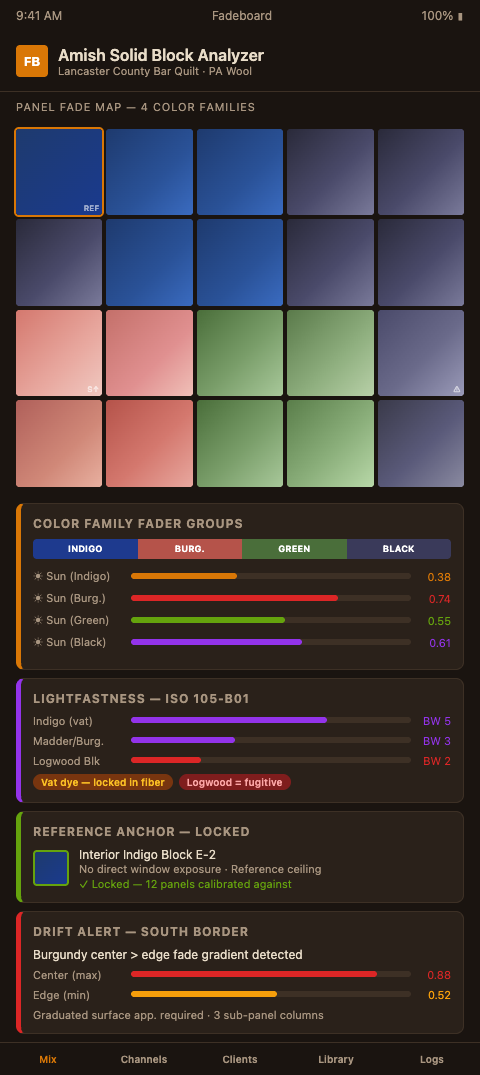
Fadeboard's panel-indexed approach handles the multi-color solid fade problem by treating each color family as a separate fader group. The indigo blocks get their own sun-exposure and wash-cycle faders. The burgundy border gets separate faders. The green blocks and the black sashing get theirs. Within each color family, the faders vary by panel to reflect within-color fade variation.
This sounds like more complexity than a traditional recipe approach, but it is less — because the traditional approach collapses the complexity into the dye bath, where it is invisible until the result is wrong. Fadeboard makes the complexity explicit in the fader map, where it can be checked, adjusted, and handed to an apprentice with a clear explanation of what each setting means.
The sun-exposure fader for each Amish solid panel reflects two variables: how much light the panel received (assessed from the quilt's known placement — south-facing bed, east-facing, stored) and how photosensitive the dye chemistry is. UV-driven chromophore breakdown causes uneven fade across partially shaded solid-colored fabric. Indigo is a vat dye with relatively high lightfastness; madder red is a mordant dye with moderate lightfastness; logwood black is a mordant dye with low lightfastness. The same sun-exposure fader position produces different restoration depth requirements for each color because the underlying chemistry degrades at different rates.
ISO 105-B01/B02 blue wool scale rates lightfastness 1–8; many 19th-century natural dyes test at 2–3. That low lightfastness rating means that even modest light exposure over 120 years produces significant chromophore loss. The fader position for a south-facing Amish burgundy panel should be set higher than for a comparable indigo panel with the same light history, because the madder-family dye has lost a greater proportion of its chromophore for the same UV dose.
The wash-cycle fader is equally important for wool Amish quilts. Wool takes dye differently from cotton — mordant bonds on wool are generally stronger and more resistant to washing, but repeated hot washing with alkaline soaps can strip iron mordant from dark colors and partially open the wool fiber, accelerating subsequent dye loss. A piece that was laundered quarterly in the 1920s and 1930s has a different wash-cycle fader history than one that was dry-cleaned from 1950 onward.
For multi-month restoration work on Amish quilts where the documentation will eventually need to meet museum lending standards, the Fadeboard session records function as the provenance documentation for the color treatment. The 1862 sampler quilt case provides a detailed parallel for building that documentation structure on a complex multi-color piece.
Advanced Tactics for Amish Solid Partial-Fade Work
Reference anchor selection. On an Amish solid quilt, the reference anchor for each color family is the least-faded panel in that family — not an average. For the burgundy border, the reference is the corner section that was most consistently shaded. For the indigo blocks, it is the interior block that had no direct window exposure. These reference anchors establish the fader ceiling: no corrective bath should exceed the depth represented by the reference anchor.
Wool fiber preparation before dye. Wool at 19th-century mordant saturation behaves differently from new wool. Before applying a corrective bath to aged Amish wool, the restorer should assess whether the fiber has felted, become brittle, or lost significant lanolin. A brief warm-water conditioning bath before mordant refresh can restore enough fiber flexibility to allow adequate dye uptake without mechanical damage. Fadeboard's pre-treatment annotation field captures this step so the session record reflects the actual treatment sequence.
The partial-fade zone as a calibration problem. On the south-facing burgundy border, the center fades more than the edges. This gradient within a single panel is the hardest part of partial-fade Amish work to handle. Fadeboard addresses it by allowing the restorer to set sub-panel fader positions — a left, center, and right column for a long border segment — and then run a graduated surface application rather than a full-immersion bath for that segment. The surface application is built up in coats from lightest (center) to deepest (edges), matching the reverse of the observed fade gradient.
Chemical model documentation for museum loan requests — when an Amish quilt is being prepared for a museum loan or exhibition, the Fadeboard session record provides the chemical treatment documentation that loan institutions require. The fader positions, bath recipes, and mordant records translate directly into the condition report format used by museum textile conservators.
Broadway loan comparison. The administrative challenge of managing partial-fade documentation for institutional loans parallels Broadway costume loan handling: both require chemical treatment records, before/after photographic documentation, and a statement about the reversibility of any dye intervention. Fadeboard's session export provides the technical content for that documentation.
Calibrate the Reference Before Mixing the Bath
The single most costly mistake in Amish solid partial-fade work is selecting the wrong reference anchor. If the restorer chooses an average of visible panel depths rather than the least-faded panel, the restoration target will be lower than the original, and the piece will look uniformly faded rather than genuinely restored.
Fadeboard enforces reference anchor selection by requiring the operator to identify and lock the reference panel before any fader positions are set. The reference panel's color depth is the ceiling. Everything else is measured relative to it. This sequencing — reference first, then targets, then bath recipes — is what prevents the gradual drift toward the average that plagues manual multi-panel restoration work.
Workshops handling Amish quilts for the first time should plan for two to three hours of fader mapping per piece before the first bath. The mapping session will reveal two things: how far each panel has drifted from the reference anchor, and which panels are close enough to each other that they can share a bath. That second finding typically reduces the number of distinct bath recipes from eight to three or four, making the actual restoration work far more manageable.
Start your next Amish solid-color project with Fadeboard's multi-color-family fader groups — apply to the waitlist and bring the quilt's construction type (bar, bars-and-stars, center diamond), its color families, and any known wool fiber treatment history. The reference anchor selection session is where every Amish restoration begins.