How to Handle Loan Requests for Faded Broadway Costumes
When a Faded Costume Comes Back Worse
The Museum of the City of New York's theater collection — one of the primary repositories for Broadway wardrobe material — receives loan requests for iconic stage costumes from regional theaters, university productions, and international exhibitions. Theater Collection — Museum of the City of New York contextualizes the lending responsibility: these garments are not just historical objects but active documents of American theatrical culture, and their loan carries obligations that extend well beyond a standard museum outgoing loan.
The particular challenge with faded Broadway costumes is that fading damage is cumulative and non-reversible. A costume that arrives from a 6-month loan with a 3% spectrophotometric shift in its primary color has lost that 3% permanently. If the pre-loan condition report described the garment only in visual terms — "faded aniline magenta, condition fair" — there is no quantified baseline to calculate what the borrowing institution caused. The borrowing institution can dispute the claim, and the archive is left without recourse.
Guidelines for Requesting Loans — The Metropolitan Museum of Art sets out the Met's standard loan framework, which includes detailed condition reporting and environmental requirements. The NMAH Outgoing Loan Agreement — Smithsonian National Museum of American History goes further, specifying the condition verification and lux limit requirements that govern the nation's most active costume lending program. Both frameworks assume a baseline condition record robust enough to support post-return comparison.
For a faded Broadway costume, "robust enough" means a spectrophotometric record — not a written description, not a photograph, and not a conservator's visual assessment. Color photographs are notoriously unreliable for documenting subtle color change: the camera's white balance and the shooting light source introduce variation that makes pre-loan and post-return photographs nearly impossible to compare objectively.
The Fadeboard Loan Preparation Workflow
Fadeboard's documentation architecture is designed precisely for the pre-loan baseline problem. Running a Fadeboard session on each outgoing loan item produces a quantified spectral record that is defensible, reproducible, and independent of the light source used during assessment.
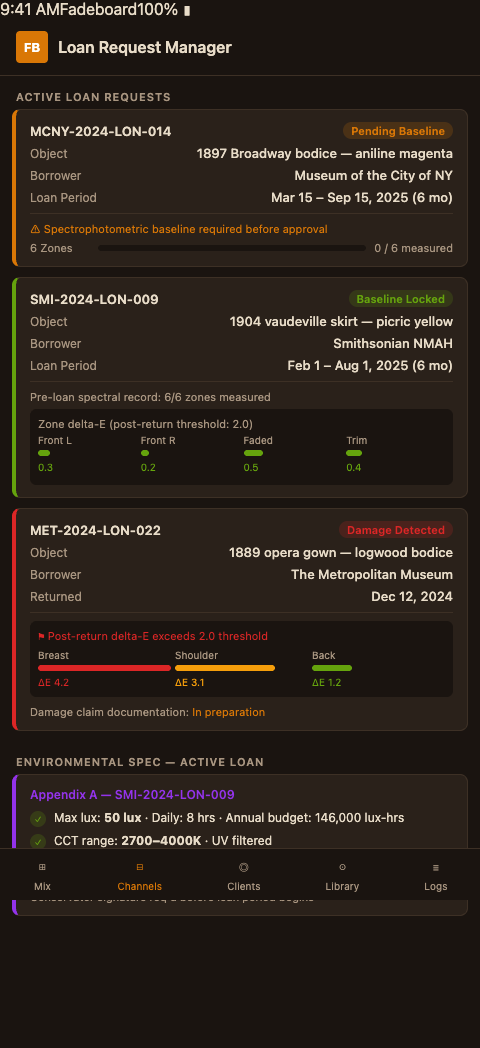
Step 1 — Spectrophotometric baseline capture. Before a loan request is approved, take spectrophotometric readings at minimum six measurement zones on the costume: the primary color field in two locations, the most faded zone, the least faded zone, and any area of particular archival significance (a performer's signature patch, a surviving original trim element). These readings become the Fadeboard session baseline — the "zero" state against which all future readings will be compared.
Step 2 — Channel configuration for the loan context. Open a Fadeboard session and configure the lighting-era translation channel for the borrowing venue's stated light source. If the borrowing institution uses LED at 5600K, the translation channel maps the pre-loan spectral baseline to what that garment should look like under those conditions — establishing not just the current color but the expected appearance under the borrowing venue's actual fixtures. If the post-return reading diverges from that expected appearance beyond the tolerance band, the session calculates the magnitude of the discrepancy. The exhibit loan evidence documentation workflow describes how to structure these session outputs as the formal color evidence record that travels with the garment to the borrowing institution and returns with it.
Step 3 — Environmental specification generation. From the session output, Fadeboard generates a display specification: maximum lux level, maximum daily exposure hours, UV filtration requirement, minimum distance from heat sources, and acceptable CCT range for the display fixtures. This specification is written in quantified, measurable terms — not "low light" but "50 lux maximum, 2700–4000K, UV filtered, maximum 8 hours daily, annual lux-hour budget not to exceed 146,000 lux-hours."
This specification becomes Appendix A to the outgoing loan agreement. NPS Museum Handbook, Part II, Chapter 5: Outgoing Loans establishes the federal policy framework for how outgoing loan environmental specs are incorporated into loan agreements — a useful reference for archives whose staff may not be familiar with the legal enforceability of these requirements.
Step 4 — Condition agreement signature. Require the borrowing institution's conservation staff (not curatorial staff) to sign the environmental specification as a technically binding exhibit condition, separate from the standard loan agreement. This separates the conservation obligation from the administrative agreement and puts a trained conservator on record as responsible for meeting the specification.
Step 5 — Post-return spectrophotometric verification. Within two weeks of the costume's return, repeat the spectrophotometric readings at the same six measurement zones. Load the post-return readings into the Fadeboard session alongside the pre-loan baseline. The session calculates delta-E values for each zone — a standardized color difference metric. Any zone showing delta-E greater than 2.0 represents a perceptible color change that occurred during the loan.
If delta-E exceeds 2.0 at any zone, you have a documented, quantified claim. If it stays below 2.0 at all zones, the loan was completed within acceptable tolerance. Either outcome is professionally useful: the first supports a damage claim; the second supports future lending decisions, demonstrating that the borrowing institution met its obligations. Archives building a long-term lending history can reference the Amish solid fade documentation approach from quilt conservation as a model for how incremental spectral records accumulate into a useful long-term collection condition profile — the same methodology scales directly to a Broadway costume lending program.
Advanced Tactics for Faded Costume Loan Management
Negotiate a pre-installation fixture measurement requirement. The environmental specification means nothing if the borrowing venue installs the costume under fixtures that do not match the agreed specification. Requiring a post-installation measurement certificate — submitted before the loan period officially begins — catches configuration errors before they cause cumulative damage.
Distinguish between pre-existing fading and loan-attributable fading in the condition report. The pre-loan condition report should clearly identify all zones of existing fading and their spectral values, so that any post-return claim relates only to additional fading that occurred during the loan period. A costume that was already significantly faded before the loan requires a pre-loan notation to that effect; otherwise, post-return discussions about "who faded it" become unnecessarily contentious.
Use the Fadeboard baseline as the loan insurance valuation support. ACRL/RBMS Guidelines for Loans of Special Collections Materials — ALA notes that quantified condition documentation strengthens insurance valuation for outgoing loans. A spectrophotometric record that documents the specific degree of existing fading — and establishes a threshold for damage that would trigger an insurance claim — is more useful to an insurance adjuster than a written condition description.
For Ballets Russes and early-run Broadway costumes, consult Ballets Russes case documentation before processing any loan request. The dye chemistry used in early-twentieth-century ballet and Broadway costuming includes particularly fragile aniline compounds that may not survive even compliant loan conditions. Some costumes should not be loaned at all; the loan request process should include an initial viability screen before any negotiation with the borrowing institution begins.
Require return condition photographs under controlled lighting. Even with spectrophotometric records, controlled-condition photographs at return provide a visual complement to the numerical data. Shoot under the same lighting setup as the pre-loan photographs, using a calibrated color reference chart in the frame. If a delta-E discrepancy is later disputed, having both the spectrophotometric data and the comparative photographs from controlled conditions makes the case more straightforward to resolve.
For archives managing an ongoing lending program alongside active collection development, maintaining a running Fadeboard session archive — one session per outgoing loan, preserved in the object record — builds an institutional lending history that is invaluable for setting future loan terms.
Theater archives accepting loan requests for their most significant Broadway wardrobe should treat the Fadeboard session as the first step in the loan approval process, not an afterthought. The spectral baseline is what makes every subsequent decision — negotiation, installation oversight, post-return verification — defensible and documentable.
If your archive is receiving loan requests for faded Broadway costumes without a spectrophotometric baseline in place, join the Fadeboard waitlist today. Theater archivists who get started before the next request arrives have the baseline ready before the loan agreement is drafted — which is the only position from which the documentation can actually protect the collection.