Best Practices for Exhibit-Safe Costume Color Restoration
The Lux Budget Problem Nobody Tracks
A 2016 loan of an 1890s Savoy Opera bodice to a regional theater archive produced a condition discrepancy that took three months to resolve. The borrowing institution had agreed to 50-lux maximum display lighting — the standard recommended by the Caring for Textiles and Costumes — Canadian Conservation Institute for sensitive historic garments — but the actual fixture output at the case face was measured at 80 lux because the LED modules had not been dimmed down from their production-lighting preset.
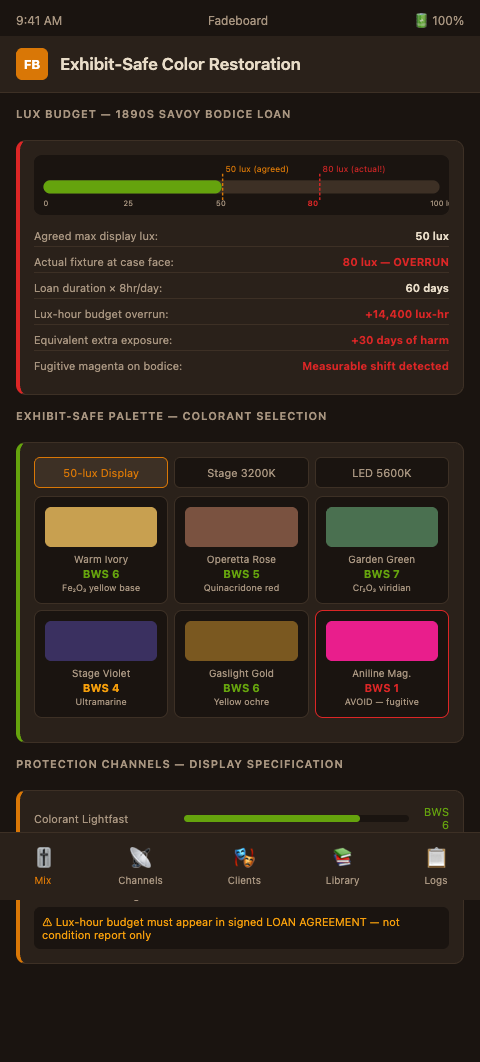
The bodice fabric contained a fugitive aniline magenta that had survived in relatively stable condition before the loan. After two months at 80 lux under a 5600K LED source, the magenta showed measurable shift. The difference between 50 lux and 80 lux sounds trivial; over a 60-day loan with 8-hour daily exposure, the cumulative lux-hour budget overrun was roughly 14,400 lux-hours — comparable to adding another full month of exhibition.
This is the core risk of exhibit-safe restoration work: the conservation treatment can be done perfectly, and the garment can still sustain avoidable damage through inadequate environmental control at the borrowing venue. Light Exposure for Artifacts on Exhibition — CCAHA documents cumulative lux-hour budgets as the correct framework for sensitive textile management, yet most theater archives and many regional museum venues still set loan conditions in peak-lux terms rather than lux-hour terms.
The TSG: Environmental Concerns for Textiles — AIC Conservation Wiki establishes the AIC textile specialty group's standard as 50 lux maximum for sensitive dyed textiles, with UV filtration, and recommends annual lux-hour rotation limits. For a costume that already carries fading or prior damage, the applicable limit should be tighter.
Archives that routinely generate exhibit loan color evidence packages — spectrophotometric baselines attached to loan agreements as an exhibit-condition appendix — have a structural advantage here. The exhibit loan color evidence workflow describes how Fadeboard session exports become the contractual color record for each outgoing loan, making lux-hour overruns documentable and disputable rather than merely regrettable.
Building Exhibit-Safe Restoration Into the Fadeboard Workflow
Exhibit-safe color restoration has two distinct phases: the treatment phase (what colorant you apply, how you apply it, and what reversibility standard you meet) and the protection phase (what light environment the restored garment can safely tolerate, and for how long). Fadeboard supports both.
Treatment phase — colorant selection channel. The colorant selection fader prioritizes materials with documented lightfastness ratings. For a restored bodice that will go into a 50-lux LED case, the colorant must carry at least a Blue Wool Scale rating of 5 or higher — ideally 6+. This is more restrictive than the colorant choices available for a remount costume that will only be worn for a 12-performance run and then returned to storage. The channel setting here reflects the intended use case: display permanence rather than performance accuracy.
Treatment phase — reversibility channel. The Code of Ethics and Guidelines for Practice — American Institute for Conservation mandates that restoration treatments be reversible to the greatest extent possible. For color restoration on stage costumes, this means preferring surface consolidants and inpainting over full immersion dye baths where the substrate condition permits, and documenting the removal protocol alongside the application method. The reversibility fader in Fadeboard tracks whether the chosen approach meets this standard — not as a checkbox, but as a constraint that shapes the formulation options available in the colorant channel. The same reversibility discipline that governs exhibit-safe work applies when dealing with performance-residue zones — the sweat stain preservation workflow addresses what happens when archival evidence and color restoration goals overlap in the same panel.
Treatment phase — previous intervention channel. Many costumes in active theater archives carry prior restoration work from earlier decades — work that may not have met current conservation standards. TSG: Treatment of Textiles — Addressing Previous Interventions (AIC Conservation Wiki) covers the ethical and technical considerations for evaluating earlier repairs before proceeding with new treatment. The previous intervention channel in Fadeboard captures this layer: what prior work is present, how it affects the current color profile, and whether it needs to be addressed before the new restoration can proceed.
Protection phase — display environment specification. Once treatment is complete, Fadeboard's documentation output generates a display specification tied to the colorant lightfastness ratings applied. For a garment restored with a colorant rated at Blue Wool 5, the specification will calculate a maximum annual lux-hour budget based on the target longevity period (typically 5–10 years before reassessment). This becomes the exhibit loan agreement attachment — a specific, quantified light budget rather than a vague "low lux" requirement.
Protection phase — LED spectral profile channel. The Smithsonian's study LED Lighting in Museums: Conservation and Color of Textiles documents that different LED color temperatures cause measurably different rates of apparent color shift in historic textiles — even at the same lux level. A 5600K LED causes more perceptible shift in warm-hued aniline dyes than a 2700K LED at the same lux-hour exposure. The LED spectral profile channel in Fadeboard lets you specify the expected exhibit lighting CCT and adjust the lux-hour budget accordingly.
Advanced Tactics for Exhibit-Safe Restoration
Write the lux-hour budget into the loan agreement, not the condition report. Condition reports describe current state. Loan agreements govern future conditions. The lux-hour budget number — calculated from the restored colorant's lightfastness rating and the intended display duration — belongs in the loan agreement's environmental spec section, where the borrowing institution is contractually bound to it.
Require a fixture measurement certificate at installation. A loan agreement specifying 50 lux means nothing if the borrowing venue installs the costume and never measures the actual fixture output. Requiring a post-installation measurement certificate — submitted before the loan period begins — catches the configuration errors that cause the most damage.
Flag fragile original colorants in the object record before treatment. If spectral analysis reveals surviving original aniline colorant that should be preserved rather than overcoated, that finding shapes the treatment approach before the archivist picks up a brush. Original colorant that reads as faded under modern LED may still carry significant historical information, and overcoating it with a lightfast restoration pigment may permanently obscure that information. Some evidence of original performance should be protected, not corrected.
Cross-reference with calico patch methods for adjacent repairs. When a bodice requires both color restoration and structural repair on adjacent panels, the dye approach used for the structural repair material must be exhibit-safe by the same standard as the restoration colorant. A patch dyed with a fugitive colorant next to a restored panel treated with a stable pigment will show differential fading over a 5-year display period. Coordinating the colorant selection across treatment areas prevents this. Calico patch dyeing techniques developed for quilt restoration offer relevant transfer methods for cotton-ground stage costume panels.
Archivists preparing a costume for its first major loan after a full restoration should treat the pre-loan review as a final Fadeboard audit: check that the display specification matches the receiving venue's actual fixture configuration, verify that the lux-hour budget has been correctly inserted into the loan agreement, and confirm that any prior restoration layers flagged in the previous-intervention channel have been disclosed to the borrowing conservator. These three steps take under an hour and prevent the kind of irreversible cumulative damage that took the Savoy bodice example three months to negotiate.
The exhibit-safe restoration workflow described here is not more conservative than necessary — it is the minimum that the material evidence and the professional standards require.
Common pitfall — confusing the display specification with the loan agreement. Archives regularly write lux limits into condition reports rather than loan agreements. A condition report describes the object's state; it does not bind the borrowing institution to anything. The quantified lux-hour budget must appear as a signed exhibit condition in the loan agreement itself — with the borrowing institution's conservation staff signature on record as technically responsible for compliance. When it appears only in the condition report, the borrowing venue's exhibition team may never see it, and the configuration error that caused the Savoy bodice overrun will repeat.
A second pitfall is calculating lux-hours from peak lux rather than from average fixture output at the case face. A fixture rated at 50 lux at 1 meter may deliver 65 lux at the distance of the case face due to the inverse-square relationship between distance and illuminance. Post-installation measurement at the object position is the only reliable figure; the fixture specification sheet is not. For LED fixtures with adjustable CCT, also confirm whether the CCT setting at installation matches the agreed specification — a 5600K fixture running at 3200K has a different spectral damage profile at the same lux level, and the Fadeboard display specification should specify both values rather than lux alone.
If your archive is preparing for an upcoming exhibit loan of a fully restored stage costume, the Fadeboard waitlist is open to theater archivists now. Join before the loan agreement is signed — building the display specification into the loan terms at the outset is far simpler than renegotiating it after installation.