Preserving Hand-Quilting Stitches During Color Repair
The Stitch Line That Broke
A Baltimore Album quilt arrived at a Maryland conservation studio for indigo ground restoration. The piece had passed through three previous workshops over forty years. The hand-quilting thread — fine cotton running in an elaborate feather cable — had survived. The restorer chose a standard warm-immersion indigo dye bath to restore the ground color. After the bath and a gentle press, two of the feather cable sections had broken stitch lines where the thread had swollen, tightened against the batting, and snapped at the pull.
The International Quilt Museum protocol flags this exact failure mode: sleeve-hanging distributes weight, but immersion baths apply stress at the fiber level, at every stitch, simultaneously. The thread is not just decoration — in a quilted piece, it is the structural connection between face fabric, batting, and backing. Break enough stitch lines and the quilt loses dimensional integrity.
Professional conservation standards prioritize stabilization of stitching before any color treatment or dye work. That sequencing — stitch-integrity assessment first, color intervention second — is the principle that separates workshop color repair from conservation-grade treatment. When the two are conflated, the color can be improved while the artifact is damaged.
Mapping Stitch Vulnerability Before Planning Color
Fadeboard's role in hand-quilting preservation is not to model the stitching directly — it is to provide a color-intervention plan that the restorer can check against a separate stitch-integrity map before committing to any bath.
The process begins with the stitch-integrity assessment. NPS textile documentation records thread count, yarn diameter, twist, and ply before any treatment begins. For workshop-level assessment without lab equipment, the equivalent is a visual and tactile pass across the full quilt surface: note every section where the quilting thread is brittle, discolored, or shows tension failure (puckers, pulled loops, breaks). Mark these on the panel map.
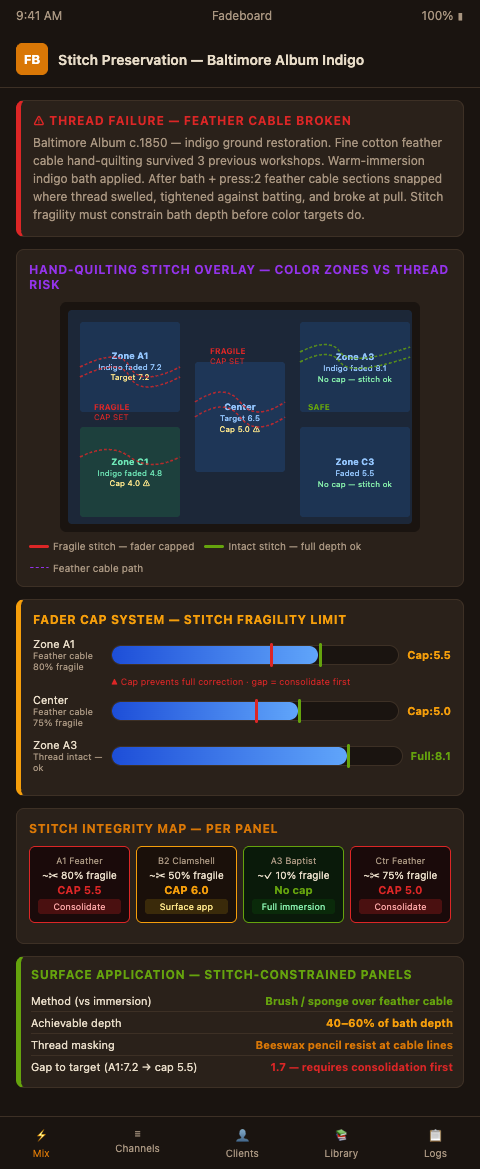
The panel map then becomes the constraint document for the Fadeboard session. Each panel that carries significant hand-quilting thread stress is flagged with a reduced-intervention marker. The color faders for those panels are capped — the restorer sets a maximum immersion depth that is lower than what the color alone would require, because the stitch condition limits how aggressive the bath can be.
Needle-and-thread consolidation and adhesive lining can stabilize historic quilt stitching before treatment. For panels where stitch fragility is severe, Fadeboard will show a lower maximum sun-exposure fader position (indicating a shallower correction bath) alongside a notation that consolidation work should precede any dye intervention. This is not an automatic calculation — the restorer sets these limits based on the stitch assessment — but the fader cap makes the constraint visible to any collaborator or apprentice who picks up the project.
The wash-cycle fader takes on additional significance in stitch-context work. Temperature of 62–72°F and 45–55% relative humidity preserves thread integrity; fold stress breaks quilting stitches over time. Every wash cycle the quilt underwent in its history stressed both the dye mordant and the stitch thread simultaneously. A panel that received six hot washes has not only depleted mordant — it also has thread that is 60-100% more brittle than a panel with two gentle washes. The wash-cycle fader indirectly indexes stitch fragility, which is why setting it accurately matters beyond just the color chemistry.
For stereomicroscope fiber work in stitch-critical repair contexts, magnified assessment of thread condition before bath can distinguish a thread that is superficially discolored from one that has lost structural fiber integrity — the two require different intervention limits.
Advanced Tactics for Stitch-Preserving Color Repair
Surface application over immersion. For panels where stitch fragility prevents full immersion, surface dye application — brush or sponge — is the alternative color intervention. Stitch type for conservation is chosen by fabric condition; overstitching risks breaking historic threads. Surface application avoids the swelling stress of immersion while still delivering pigment to the face fabric. The depth achievable by surface application is lower than by immersion — typically 40-60% of bath depth — and Fadeboard's fader positions must be adjusted to reflect the surface application limit rather than bath limit.
Thread-adjacent masking. In areas where the hand-quilting thread runs close to a heavily faded zone, masking the thread with a temporary resist material (fine beeswax pencil or removable conservation wax) before surface application prevents the colorant from wicking into the thread fibers. The masking is removed after the surface application dries. This is a technique borrowed from textile conservation practice; the principle is that the thread and the face fabric respond differently to the same dye, and the thread's response is usually undesirable.
Consolidation sequencing with Fadeboard. When a section requires both stitch consolidation and color restoration, Fadeboard's project timeline function allows the restorer to record consolidation sessions as pre-treatment steps tied to specific panels. The color fader positions for those panels remain at their pre-treatment (uncapped) targets, but they are marked as locked until the consolidation status is updated to complete. An apprentice picking up the project sees not just what the target color is but what must happen before that color work can proceed.
Fugitive dye matching under stitch constraint. Fugitive dye color matching for chintz appliqué panels describes a scenario where the color target itself is uncertain because the original dye has completely disappeared. When that uncertainty is combined with stitch-fragility constraints, the correct approach is to start with a conservative surface application at 30-40% of the estimated original depth, assess the result after drying, and build depth in additional passes rather than committing to a single bath that may be both the wrong color and too stressful for the stitching.
Sweat-stain preservation parallel. The tension between preserving structural evidence in fibers while restoring color appearance appears in other textile conservation contexts: preserving sweat stains documents the same conflict between what the artifact currently shows and what the color treatment would overwrite. The resolution in both cases is to set the restoration target at the fabric level, not the thread level — restore color to the ground fabric, leave the thread in its current condition, and document the distinction.
The Constraint Is the Plan
The most common mistake in stitch-concurrent color repair is treating the stitch-fragility assessment as a separate checklist item rather than an active constraint on the color plan. Fadeboard makes the stitch fragility explicit by encoding it as an intervention cap — a maximum fader position that the color repair cannot exceed regardless of how far the color has faded.
A quilt where the indigo ground has faded to pale blue but the feather cable is at 80% fragility will not receive a full indigo restoration in one pass. Fadeboard will show the color target, show the stitch-limited maximum, and show the gap — which is the work that requires stitch stabilization before color can proceed. That is not a limitation of the tool; it is the correct framing for conservation-grade quilt work.
Workshops starting hand-quilting preservation work should build a stitch-condition map for every piece that comes through before opening Fadeboard. The fader session will take fifteen minutes. The stitch assessment will take an hour. That proportion is correct, and workshops that get it backward consistently produce color repairs that compromise the structural integrity of the very object they are restoring.
Email us to learn more about the stitch-fragility intervention cap system before your next color repair on a heavily hand-quilted piece. Bring the quilting pattern type (feather cable, Baptist Fan, clamshell), the thread condition rating, and the faded zone locations — the constraint map is the first thing we build in Fadeboard together.