How to Read Flesh Tone Degradation on 1880s French Bisque
Why French Bisque Fails the Simple Color Match
A Bru Jeune bébé from 1885 lands on your bench with a flesh tone that reads amber-warm under your workbench lamp. You mix to match, apply two washes, and the result is orange by the time it dries. You have not made a mixing error — you have made a reading error. The amber you matched was not the original color; it was the original color plus 140 years of specific chemical degradation that your mix cannot reproduce from the outside in.
According to research on bisque doll construction, high-quality Bru bébés (1879–1889) were fired in multiple layers, sometimes up to seven times, to achieve nuanced skin tone gradients. Each firing layer sits at a different depth relative to the glaze surface, which means each layer has different oxygen exposure, different UV penetration, and different moisture contact history. The color you see today is the sum of those independent processes, not a single aged pigment.
The Antique Dolls Value Guide from Appraisily confirms that condition of bisque face and color integrity are the primary drivers of valuation. Misreading degradation direction and mixing to the wrong endpoint is the most common cause of value loss in independent studio work — and the most avoidable one.
Reading Degradation Direction Before You Mix
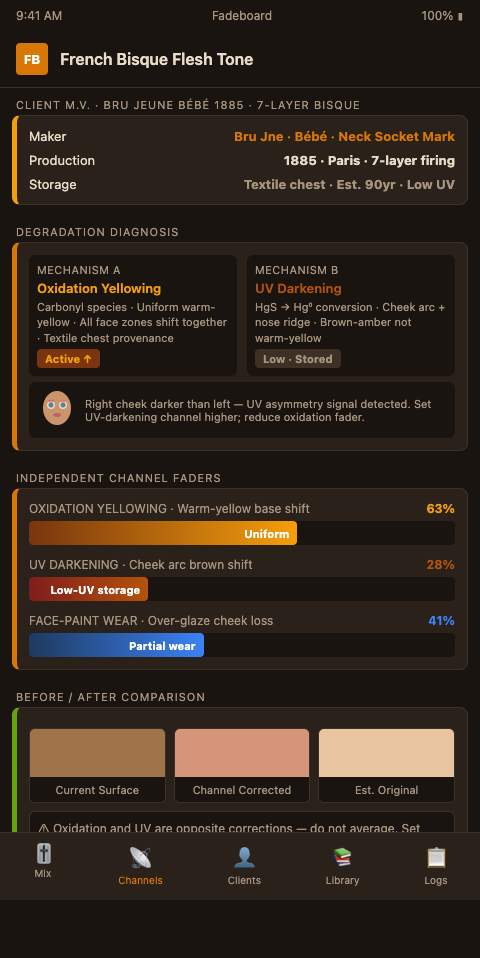
The key distinction on 1880s French bisque is between oxidation yellowing and UV darkening. These produce superficially similar amber-warm shifts but require opposite responses in your mix.
Oxidation yellowing originates from carbonyl species forming in aged porcelain surface treatments. Research on simulated aging of porcelain restoration adhesives documents this mechanism directly: oxidation-induced carbonyls cause a characteristic warm-yellow cast over decades, concentrated on surfaces with periodic humidity exposure. On a Bru or Jumeau head that spent time in a textile chest, this yellowing is almost universal. The tell is that it is uniform across the face — cheeks, forehead, and chin shift together.
UV darkening is different and more localized. Research on cinnabar photodegradation shows that UV converts mercuric sulfide (HgS) to metallic mercury (Hg⁰), producing a darkening that is most pronounced where light concentrated over the years — typically the cheek arc and the nose ridge on a display doll. This darkening reads brownish-amber rather than warm-yellow and does not appear uniformly.
A third mechanism affects over-glaze paints specifically. As the Wikipedia article on ceramic conservation notes, decoration painted on top of glaze is vulnerable to abrasion and surface degradation while underglaze pigments remain stable. On an 1880s French bébé that was played with, the over-glaze cheek rouge may have rubbed partly away — producing a paler, cooler shift on top of whatever the fired-in base tone has done independently.
This is where Fadeboard's channel model pays off. Rather than mixing to the visible surface color, you set three independent faders: an oxidation channel (how warm-yellow is the base shift?), a UV-darkening channel (how brown is the cheek arc specifically?), and a face-paint-wear channel (how much over-glaze pigment remains?). The combination of those three channel states, not a single color reading, produces a starting mix that accounts for what each mechanism contributed.
Understanding how maker's marks predict original pigment chemistry adds another layer to French bisque reading before any fader is set: Jumeau and Bru sourced pigments differently than German manufacturers, and those sourcing differences determine which degradation mechanism dominates on a given head. An 1885 Bru bébé marked "Bru Jne" on the neck socket was painted with a house-palette pigment mix that includes carmine-family cheek rouge and a cooler bisque-body base than a contemporary Simon & Halbig export head — knowing that changes which fader positions you enter first.
The parameters that govern photodegradation literature confirms that substrate chemistry determines direction: proteinaceous substrates favor reduction while non-proteinaceous substrates favor oxidation. Bisque is inorganic ceramic — it oxidizes. Understanding that the bisque body itself trends oxidative while organic face paints may fade in the opposite direction tells you that the flesh tone and the cheek rouge are moving on different trajectories even on the same head. Your faders for those two channels should never be set to the same value.
Advanced Tactics for 1880s French Bisque
Once you can distinguish the three major degradation mechanisms, two further habits sharpen your read on French bisque specifically.
Check the interior bisque color against the surface. If you have access to a chip, the unglazed interior bisque tone represents roughly the original post-firing base color before any surface degradation. Comparing interior to exterior gives you a rough read on the total oxidation shift without instruments. On a well-fired Bru from the 1880s, this difference is typically 3–6 ΔE units, representing about a century of standard oxidation. When no chip is available, check the neck socket interior with a penlight — the unglazed bisque in that recessed area is sheltered from UV and surface oxidation and gives a near-original body tone reading.
Flag asymmetry as UV evidence. If one cheek reads warmer or darker than the other, that is almost always UV darkening from directional light exposure over the storage period — not a manufacturing variation. When you see facial asymmetry, set your UV-darkening fader higher and your oxidation fader lower. The asymmetry itself is the signal. On 1880s Jumeau bébés, right-cheek darkening is slightly more common than left — consistent with dolls that spent years displayed near a window on the right side of a mantelpiece, which was a common Victorian parlor convention.
Common pitfall: treating SFBJ pieces as equivalent to pre-merger Jumeau. The Société Française de Fabrication de Bébés et Jouets formed in 1899 and consolidated multiple French manufacturers, including Jumeau, Bru, and Gaultier. SFBJ bisque from 1900–1910 uses a different base clay body than the pre-merger Tête Jumeau from the 1880s, and the firing chemistry changed as production was centralized. An SFBJ head marked with a Jumeau-style face shape is not interchangeable with an 1885 Tête Jumeau for channel-setting purposes — the glaze-oxidation fader starting position for SFBJ bisque should sit approximately 8–10% lower than for an equivalent-era genuine Tête Jumeau, because SFBJ bisque shows less ambient yellowing over the same timeframe.
Independent restorers working with 1880s French bisque are also well-served by understanding composition vs bisque fade differences, because many French bébés have composition bodies paired with bisque heads. The body and head may arrive on your bench showing entirely different degradation patterns that require separate fader configurations.
For restorers handling depression-era or earlier textile heirlooms alongside their doll work, the discipline of reading directional fade in fabric — particularly the challenge of mapping uneven fade across large textile surfaces — uses the same underlying logic: identify the mechanism before you match the color.
Match the Mechanism, Not the Surface
Independent doll restorers handling 1880s French bisque on kitchen workbenches under eleven-day deadlines cannot afford three sittings to discover they matched the wrong endpoint. Fadeboard's channel model gives you a structured way to read degradation direction before you open a pigment jar.
If you have lost sessions chasing a warm Bru flesh tone that kept shifting as it dried, the Fadeboard waitlist is open for independent studios right now. Sign up with a note about the specific French maker you encounter most often — Bru, Jumeau, or SFBJ — and the team will prioritize calibration data for those factory pigment profiles in the early-access build.
Bring your most recent mismatched French bisque job into the first session you run. The channel read on that specific head will show you exactly which mechanism you misidentified — oxidation yellowing, UV darkening, or over-glaze wear — and the correction path from that diagnosis is typically a single audited sitting rather than the three you were on track for.