Soundboard Calibration for Modern LED Stage Previews
The LED Problem for Historic Costume Archives
The shift from tungsten Fresnel fixtures to LED stage lighting has been fast enough that many theater archives are now preparing costumes for remounts under lighting conditions their original designers never encountered. A vaudeville bodice designed for carbon arc followspots, restored under warm tungsten examination lighting, and then displayed under 5600K LED will typically look wrong to everyone who sees it — wrong in a way that is hard to articulate but unmistakable to anyone with color-calibrated eyes.
The specific mechanism is spectral distribution. Gaslight footlights emitted a warm, continuous yellow-orange spectrum — roughly 1800–2200K with strong output in the yellow and orange range and minimal blue. Carbon arc lighting was radically different: a near-continuous spectrum with very high blue-white output, closer to 5000–6000K, that made the same yellow aniline dyes appear more neutral and the same blue and green dyes appear more saturated. Assessing LED Lights for Visual Changes in Textile Colors (JAIC) quantifies how those spectral differences translate into measurable hue shifts on aged textile dyes — the same shifts a costume archivist will see when a piece designed for one source is staged under another.
Modern LED fixtures complicate this further because LED spectral distributions are not continuous curves — they are sums of discrete emission peaks, typically a blue LED spike plus a broad phosphor emission. LED Lighting in Museums: Conservation and Color of Textiles (Smithsonian MCI) documents how LED spectra cause measurably different perceived color in historic textiles compared to tungsten or fluorescent sources of nominally equivalent CCT.
The standard metric for measuring LED color quality in archive and display contexts has been CRI (Color Rendering Index), but CRI was developed for tungsten reference sources and systematically misrepresents how LEDs render saturated colors. TM-30 or the Quest for New Metrics — LED Professional Magazine explains why TM-30 Rf (fidelity index) and Rg (gamut index) better capture the saturation shifts that affect historic costume color on modern LED stages.
For a theater archive preparing costumes for a remount under contemporary LED fixtures, the calibration question is: what does the correct restoration target look like under this specific LED source, and how do I configure Fadeboard to generate that target?
Calibrating Fadeboard for LED Stage Previews
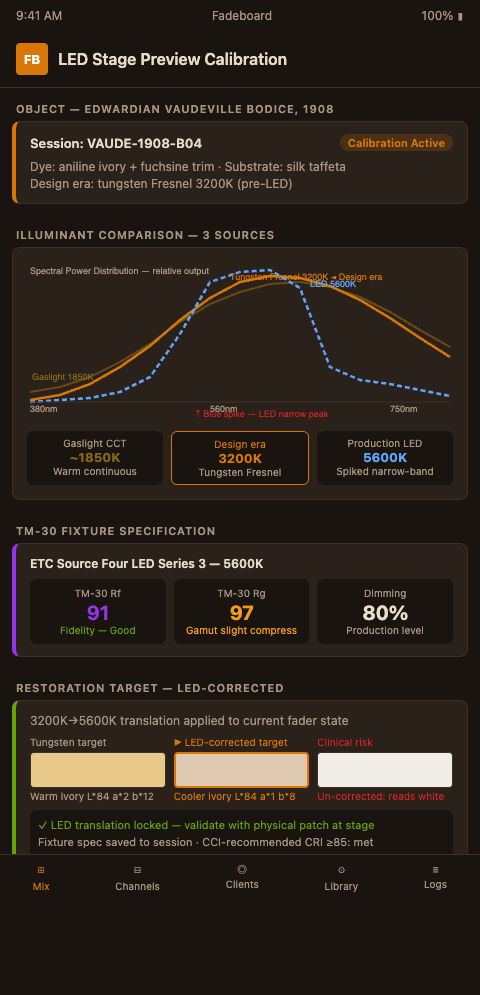
Step 1 — Characterize the production's LED fixture spec. Before running a Fadeboard session for any remount restoration, obtain the LED fixture specification from the production's lighting designer. The relevant parameters are: CCT (color temperature in Kelvin), TM-30 Rf and Rg values if available, or at minimum CRI, and fixture dimming level at which the costumes will typically be seen. A 5600K LED at full output is a different calibration target than a 3200K LED at 70% dimming.
Using TM-30 to Improve Your Lighting Design — Illuminating Engineering Society provides the practical framework for interpreting TM-30 values for real-world lighting design — including the Rg gamut index that shows whether an LED fixture expands or compresses the apparent saturation of the colors in its illuminated scene. An Rg below 100 means colors look less saturated than under the reference source; an Rg above 100 means colors look more saturated. Historic costume dyes that were already faded will look different under a high-Rg LED than under a neutral-Rg source.
Step 2 — Load the fixture spec into the LED translation channel. Fadeboard's LED translation channel takes the fixture CCT and gamut index as inputs and generates a conversion matrix that maps spectral profiles from any historical light source (gaslight, limelight, carbon arc, tungsten Fresnel) to the expected appearance under the specified LED fixture. This is the step that most archive restoration workflows skip — they address the original design intent without asking how that intent translates to the modern production light source.
Step 3 — Set the restoration target in LED-translated terms. Once the LED translation channel is configured, the restoration target channel operates in LED-corrected color space rather than abstract spectral space. The target you set is what you need the fabric to look like under the production's actual fixtures — not what it looked like under gaslight, not what it measures in your examination booth. For a 5600K LED production, a warm ivory that reads correctly under gaslight may need to be shifted slightly cooler in restoration to avoid the clinical white problem.
Step 4 — Validate with a physical test patch under the actual fixtures. No computational translation replaces physical validation. After running the session and formulating the test colorant, take the test patch to the stage or to a set mock-up lit with the production's actual fixtures at the specified dimming level. View the patch under stage conditions alongside a period-accurate costume photograph or color swatch if one exists. VIDEO: TM-30 Basics — U.S. Department of Energy explains the perceptual consequences of different Rf/Rg combinations for exactly this kind of on-site validation.
Step 5 — Document the fixture spec in the session record. The Fadeboard session record should include the full LED fixture specification as part of the calibration documentation. This matters because productions change their lighting rigs — a festival revival of the same production five years later may use different fixtures. The session record tied to a specific fixture spec makes it straightforward to rerun the translation channel with a new spec and generate an updated restoration target, rather than starting the analysis from scratch. For archivists calibrating a collection for a major touring remount, the theater archive pipeline workflow integrates LED calibration as a standard production checkpoint rather than a project-specific add-on, making the fixture-spec documentation a routine intake field rather than a production-specific afterthought.
Advanced Tactics for LED Stage Calibration
Account for color mixing in multi-fixture rigs. Professional stage lighting rigs use multiple fixture types — often LED wash units combined with tungsten Fresnel followspots or conventional specials. The costume under lighting will receive a blended spectrum from multiple sources, not a pure LED output. The calibration should reflect the blended spectrum at the costume position, not the specification of any single fixture type. A lighting designer can provide a simulated color mix reading if the full production rig is available for measurement. Archivists unfamiliar with the conceptual distinction between source-specific calibration and general examination conditions can reference natural-light calibration methodology from quilt conservation — the structural distinction between calibrating for a specific illuminant versus an ambient examination environment transfers directly to stage lighting work.
Use the CCI LED bulletin as a minimum spec baseline. LED Lighting in Museums — Technical Bulletin 36 (Canadian Conservation Institute) recommends CRI ≥85 and CCT between 2700–4000K for heritage textile display. Productions using 5600K LED fixtures for dramatic effect are operating outside the CCI minimum spec for preservation — which means costumes used in such productions carry higher degradation risk per performance hour. The Fadeboard session can calculate an estimated degradation rate per performance at a given fixture spec and cumulative run length, providing an evidence basis for negotiating fixture adjustments with the production lighting designer.
Build a fixture spec library across the productions you support. If your archive regularly supplies costumes to the same producing organizations, building a Fadeboard fixture spec library — a record of the LED parameters used by each production house — speeds the calibration step for future remounts and provides a comparative basis for assessing which venues are most preservation-compatible.
For productions with complex LED incandescent shift considerations — particularly those remounting classic works that have been performed under both incandescent and LED rigs in recent years — the translation channel provides a unique value: it can generate both the incandescent-calibrated and the LED-calibrated restoration targets simultaneously, allowing a single treatment decision to serve both production contexts.
Theater archivists stepping into LED calibration work for the first time should treat the first production as a calibration exercise as much as a restoration project. Running the full Fadeboard session with LED translation, validating with physical patches under the actual stage fixtures, and documenting the calibration process in the session record will establish the institutional knowledge base that makes every subsequent LED production faster and more accurate.
If your archive is preparing costumes for a remount under modern LED fixtures, join the Fadeboard waitlist and start the LED translation session before the production's pre-load-in deadline. Archivists who calibrate before the rig is hung avoid the corrections that only become visible at dress rehearsal.