Why Batting Contact Creates Localized Dye Loss Patterns
The Pale Halo Problem
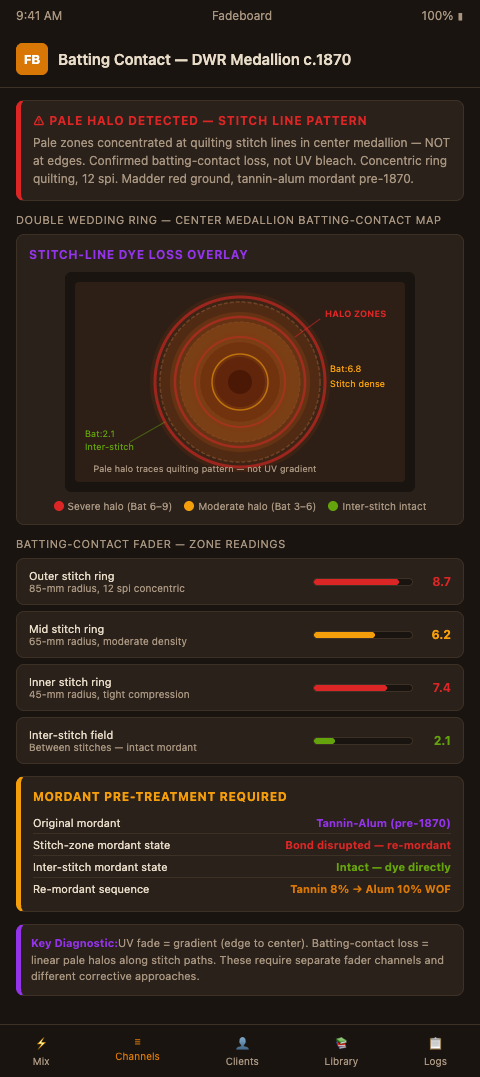
A workshop specialist examining a circa-1870 Double Wedding Ring quilt noticed something that didn't fit the standard sun-fade narrative: the pale areas were not at the edges or near the window-side border. They were concentrated at the quilting stitch lines — the dense hand-quilting that ran in concentric rings through the center medallion. Everywhere the needle had passed and drawn the backing tight against the cotton wadding, the dye was lighter. The surrounding fabric, just millimeters away, retained much stronger color.
This is batting-contact dye loss, and it operates on a completely different mechanism than UV bleaching or wash-cycle color lift. Cotton Incorporated's colorfastness research documents that red, black, and blue dyes show greatest loss at friction points, and that repeated wash cycles compound this localized loss. The quilting stitches are friction points — they concentrate pressure, moisture transfer, and mechanical abrasion at specific linear paths across the quilt face.
The problem for restoration is that the pale halo pattern mimics faded piecework block coloring if you look at the quilt from a distance. You might map the whole medallion as "moderately faded" and mix a single bath for it, when in reality the stitch-line areas need a deeper concentration and the inter-stitch areas are closer to the original color than they appear at arm's length.
The Chemistry of Contact-Zone Dye Loss
Natural dyes bond to cotton cellulose through mordant chemistry. A metal-salt mordant — typically aluminum, iron, or tannin-based — acts as a bridge between the dye molecule and the cellulose fiber. Mordant chemistry on cellulose fibers works through ionic bonds: the metal ion attaches to the cellulose hydroxyl groups on one side and coordinates with the dye chromophore on the other. This system is effective but not indestructible.
Mechanical abrasion at contact surfaces weakens those ionic bonds. Research on abrasion resistance of dyed fabrics demonstrates measurable dye transfer and localized color loss in cotton fabrics under abrasion from adjacent fibers — exactly the condition at a batting-contact zone where the cotton wadding fibers press against the top fabric face. Over decades of use, the friction from movement — a person shifting in bed, a quilt being folded and unfolded — concentrates at the quilting stitch lines and progressively disrupts the mordant-dye-fiber bond.
Moisture amplifies this process. Research on dye degradation rates under substrate contact shows that substrate contact combined with moisture accelerates dye degradation significantly compared to free-hanging textile surfaces. A quilt used on a bed absorbs body moisture through the top fabric, and that moisture migrates through the batting. At the quilting stitch lines, where the fabric is compressed, moisture accumulates and the dye-mordant bonds are subject to hydrolytic as well as mechanical stress simultaneously.
Repeated laundering compounds the structural damage at these contact zones. Six hot washes — a number not uncommon for a utility quilt in the early 20th century — can remove half the surface fiber layer at friction points, taking dye with it at a rate far higher than the surrounding fabric. The result is those diagnostic pale halos: lines of dye loss that trace the original quilting pattern like a photographic negative.
Mapping Batting-Contact Zones in Practice
Identifying batting-contact dye loss requires close examination — within 12 inches of the quilt surface — rather than the overview assessment used for UV fade. The key diagnostic is the shape and distribution of the pale areas. UV fade produces gradients: darkest at the interior, lightest at the exposed edge. Wash-cycle damage produces relatively even overall lightening with preferential loss of printed pattern detail. Batting-contact loss produces narrow, linear, or grid-pattern pale zones that correspond to the quilting design.
To map these zones accurately, trace the quilting pattern on a paper diagram of the quilt. Mark every area where hand quilting is dense and the stitches draw the fabric down tightly. These are the highest-probability batting-contact loss zones. Cross-reference these marks with the actual fade pattern on the quilt face: if the pale areas align with the quilting diagram, you are looking at batting-contact loss, not UV bleaching.
FORS — fiber optic reflectance spectroscopy — can identify original colorant baselines non-invasively at batting contact zones, confirming whether the original dye is absent (true contact-zone loss) or present but chemically altered (UV degradation of the chromophore). For workshop practitioners without FORS access, the back-of-quilt comparison is the practical equivalent: examine the protected underside of the quilting stitch areas. If the back shows significantly deeper color than the front at those points, mechanical contact loss from the top surface is confirmed.
In Fadeboard's channel system, batting-contact loss gets its own independent fader — separate from the sun-exposure fader and the wash-cycle fader. This matters because the corrective dye concentration for a batting-contact zone is calibrated differently than for a UV-faded zone. UV-faded fabric still has its mordant structure largely intact; the chromophore has degraded but the fiber-mordant bond remains. You are adding dye back to a still-functional mordant platform. Batting-contact loss may have disrupted the mordant-fiber bond itself, which means you may need a mordant re-treatment before the dye will hold.
For sun-bleached chintz appliqué corners, the degradation mechanism is primarily photochemical rather than mechanical, and the correction approach differs accordingly — that post covers the UV-specific fader calibration for glazed cotton appliqué patches.
When Batting Contact and UV Overlap
The most complex panels are those where batting-contact loss and UV bleaching have operated simultaneously. A south-facing bedroom quilt that was also used daily has experienced both: UV bleaching of the overall color and mechanical contact loss concentrated at the stitch lines. In these panels, the pale halo at the stitch lines is even paler than the surrounding UV-faded fabric — a double degradation.
In Fadeboard, these panels carry elevated fader positions on both the batting-contact channel and the sun-exposure channel. The resulting dye recipe accounts for both deficits. When mixing for these panels, the initial mordant check is critical: test whether the remaining mordant structure will accept the required dye load by doing a small test on a scrap of period cotton with the same mordant type (tannin-alum for cotton, as would have been used on most 19th-century piecework) before committing to the full panel bath.
Research on bio-mordants and abrasion susceptibility confirms that tannin pre-treatment of cellulose is especially susceptible to abrasion-induced loss — meaning that older, tannin-mordanted cotton quilts from the pre-1870 period are particularly prone to batting-contact damage. If the quilt's construction date suggests tannin mordanting, factor in a higher batting-contact fader starting position before your first test swatch.
The hand-quilting stitch preservation workflow addresses how to work around the original stitching while applying corrective dye to the contact-loss zones — a critical technique for Baltimore Album and Amish solid-color quilts where the quilting design is as historically significant as the piecework colors.
For conservators working with liturgical textiles where contact damage follows a similar mechanical pattern, liturgical purple variation across Advent and Lent vestments addresses the parallel problem of differential dye loss in fabric areas subject to fold and drape pressure over centuries of use.
Building Your Batting-Contact Reference
Before you set the batting-contact fader for any panel, examine at least three areas in that panel where you can see the quilting stitch lines clearly. Rate each area on a simple three-point scale: light halo (fader position 2–3), moderate halo (fader position 4–6), severe halo with visible mordant disruption (fader position 7–9). Average those readings for the panel's batting-contact fader setting.
Document the stitch density while you're at it: a densely quilted Baltimore Album panel with 12 stitches per inch in a feathered plume pattern will show more severe batting-contact loss than a coarsely quilted utility quilt with 4 stitches per inch in simple diagonal lines. Stitch density feeds directly into how aggressively the contact-zone dye loss has developed — and therefore into how high you need to push the batting-contact fader to correct it accurately.
Workshops ready to stop averaging pale halos into whole-panel fade readings can join the Fadeboard waitlist and open a dedicated batting-contact session for their next intake. Bring the quilt's construction date, the stitch density per inch, and photographs of three representative stitch-line zones, and we will walk through the batting-contact fader calibration together — from mordant check through corrective dye concentration — so the next Baltimore Album or utility-weight piece on your bench gets a zone-accurate recipe instead of a single diluted bath.