Integrating Soundboard Mixing With Natural Dye Baths
When the Bath Is Right and the Panel Is Wrong
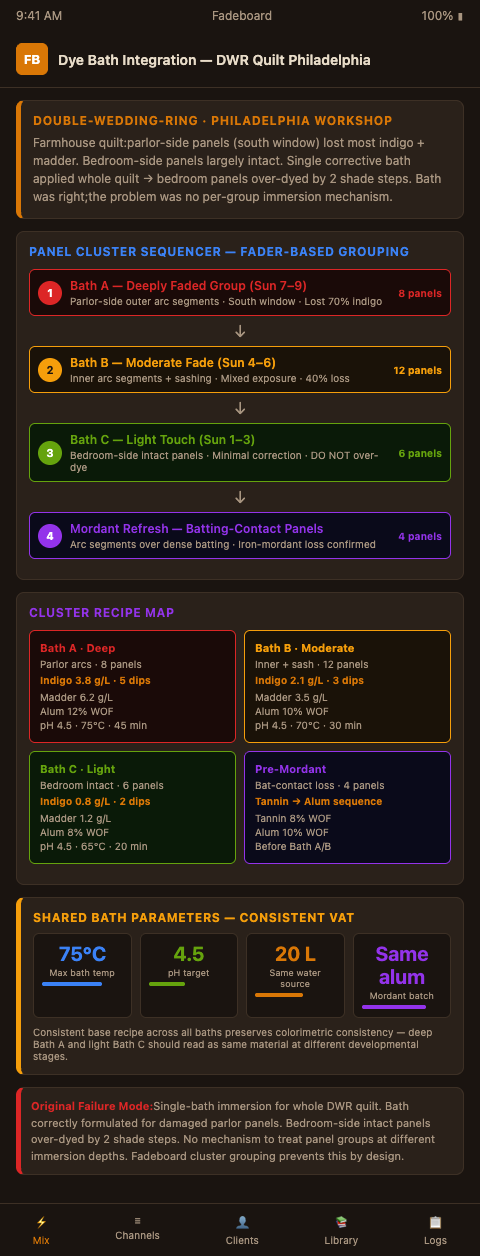
A double-wedding-ring quilt arrived at a Philadelphia workshop after a family moved it from a farmhouse in which the front parlor had a south-facing window and the back bedroom had none. The parlor-side panels — the outer arc segments facing the window — had lost most of their indigo saturation and a significant portion of their madder red. The bedroom-side panels were largely intact. The restorer mixed a single corrective bath, set it for the deeper fade, and immersed the whole quilt. Two hours later, the bedroom-side panels were over-dyed by nearly two shade steps.
The problem was not the dye chemistry. The bath was correctly formulated for the damaged panels. The problem was the absence of any mechanism for treating panels at different immersion depths within a single quilt. A practical workflow for natural-dyeing quilt cotton demonstrates that bath preparation, immersion, and rinse sequence must be calibrated per batch — not per quilt. When the quilt contains panels at different degradation states, "per batch" means per panel group.
The natural dye market is projected to grow at approximately 6% CAGR through 2034, with restoration demand among the key drivers. That growth is putting more natural-dye bath work into workshops that were trained on synthetic dye logic — and the differences in how those two chemistries behave in a multi-panel quilt are not trivial.
The Soundboard as a Pre-Bath Planning Tool
Fadeboard does not control the dye bath directly. What it does is generate a panel-indexed recipe set that the restorer executes as a sequence of baths, each calibrated for a specific group of panels. The soundboard metaphor is precise here: the faders represent independent variables, and the output is not a single mixed signal but a recipe that describes how each channel should be set for each panel.
For natural dye bath integration, the relevant faders are the sun-exposure channel, the wash-cycle channel, and the mordant-saturation channel. Sun exposure tells the restorer how much chromophore has been lost to photochemical degradation and therefore how deep the replenishing bath needs to be. The wash-cycle fader accounts for mordant depletion — because natural dyes on cotton follow subtractive color mixing principles, dye layers in fiber baths subtract wavelengths predictably, but only when the mordant bond is intact. A panel where the alum mordant has been partially washed out will absorb the same bath at a shallower final depth than a mordant-intact panel in the same immersion.
The mordant-saturation channel is the one most often missing from manual workflow planning. Restorers who test bath depth on a reference swatch and then scale to the full panel are testing only one variable: dye concentration. They are not accounting for differences in mordant uptake across the quilt. A panel that went through a tannin-then-alum mordanting sequence correctly will bond dye at a different rate than a panel where the tannin bath was thin or the alum concentration was low. The two-step tannin-then-alum mordant process on cotton controls color uptake, and sequence directly affects final hue — a panel with a weaker mordant history will read lighter in the same bath.
Fadeboard encodes all three variables as fader positions. Before the restorer touches the dye bath, Fadeboard produces a recipe table: panel group A (south-facing, high sun exposure, six wash cycles) gets a mordant refresh followed by a deep bath at X grams per liter; panel group B (interior, low sun exposure, two wash cycles) gets no mordant refresh and a shallow bath at Y grams per liter; panel group C (batting-contact damage, medium exposure) gets a targeted iron-mordant top-up before a mid-depth bath. The restorer runs three baths instead of one. Each bath is sized for its panel group. Shade drift between the groups is designed out, not corrected after the fact.
For calico patch dyeing in restoration contexts, the same fader-to-bath-sequence logic applies, but at the scale of individual replacement patches rather than full panels — the mordant saturation fader becomes the critical control when matching a new patch to surviving original fabric.
Advanced Tactics for Dye Bath Integration
Bath sequencing by mordant type. When a quilt contains panels mordanted with different metal salts — alum on the outer border, iron on a dark center, chrome on a transition band — Fadeboard's mordant-saturation fader must be set separately for each mordant type. Mordanting techniques — pre, meta, and post — alter dye exhaustion rate and final color depth on cotton, which means the iron-mordanted panels and the alum-mordanted panels will not exhaust the same bath at the same rate even at identical immersion times.
Overlap zones as calibration checks. In a sampler quilt where different blocks were mordanted by different hands, the seam between two adjacent blocks is a calibration point. Before running the full bath, the restorer can take a small swatch from the seam area, run it through the planned bath, and compare the result under D65 lighting. If the result falls between the two adjacent fader-position targets, the bath is correctly centered. If it pulls toward one target, the bath concentration needs adjustment before full immersion.
Tannin pre-bath as a corrective step. For panels where alum mordant has washed out significantly, a tannin pre-bath applied before the corrective dye immersion can partially restore mordant-binding capacity. Tannin pre-bath is required for cotton before alum mordant, and sequencing determines dye-bond strength. This is a repair-path intervention — not standard dyeing — but in severe wash-cycle damage cases, it can bring a depleted panel into the same color depth range as a less damaged neighbor, reducing the number of distinct bath recipes needed.
Recording bath parameters in the fader log. After each bath, the restorer logs actual bath temperature, immersion time, dye weight per liter, and final rinse pH in the Fadeboard session record. This creates a back-reference for the next mordant bath cycle and a handoff document for apprentices. The theatrical dye bath workflow for historic costumes documents a parallel logging structure for multi-panel garment work; the core principle — that the bath log is part of the recipe, not a separate document — applies equally to quilt restoration.
Vat dye interoperability. When a quilt contains both mordant-dyed cotton and vat-dyed indigo patches (common in 19th-century piecework), Fadeboard maintains separate fader columns for each dye chemistry. The vat-dyed indigo faders track reduction-oxidation cycle integrity rather than mordant saturation. Comparing vat and mordant dyes for quilt restoration covers the chemistry difference in depth; the integration point in Fadeboard is simply that the two dye types require separate fader logic and cannot share a bath recipe.
Run Three Baths, Not One
The instinct toward a single corrective bath is understandable — it saves time, reduces dye waste, and simplifies the session. But on any multi-panel quilt with uneven fade, a single bath will over-correct some panels and under-correct others. Fadeboard's integration workflow forces the restorer to plan three baths upfront, which typically takes thirty minutes of fader-mapping, and saves two to three sessions of corrective re-dyeing afterward.
Workshops integrating Fadeboard into their natural dye practice for the first time often start with a simple rule: one bath recipe per Fadeboard fader-position cluster. If the fader positions for panels A, C, and F are within 10% of each other, they share a bath. If panels B, D, and G form a different cluster, they get a separate bath. The number of distinct bath recipes equals the number of distinct fader clusters — and that number is always smaller than the number of panels.
If your workshop handles multi-panel quilts with uneven dye histories, Fadeboard's bath-integration workflow can be set up for your first project in an afternoon. The fader-mapping session for a twelve-panel quilt typically produces three to four bath recipes, each with a clear mordant prep sequence and a target depth. That is the complete plan for the restoration, documented before the first dye bath is mixed.