A First Look at Soundboard Work on Archive Costumes
Why the First Session Is Diagnostic, Not Corrective
Conservators at the Victoria and Albert Museum audited over 3,000 stage costumes during a multi-year working-group project, photographing and repacking pieces that had received little systematic attention since acquisition. Their notes repeatedly flag a common problem: initial visual assessment under storage conditions often underrepresented the true degradation state of a garment, because the storage lighting, the housing material, and the compression of long-term folding all affected surface appearance. (Advanced Works Project: Auditing the Theatre and Performance Costume Collection — V&A Blog)
This is the core argument for a diagnostic first session rather than a corrective one. If the baseline is wrong — if the first observation is contaminated by lighting context, surface soiling, or temporary compression effects — every subsequent treatment decision inherits that error. A soundboard-based diagnostic session exists to establish the baseline before any of those corrections are attempted.
The Smithsonian's Museum Conservation Institute textile program describes condition reporting as a mandatory prior step to any analytical or treatment protocol. (Textile Conservation — Museum Conservation Institute, Smithsonian) In a Fadeboard session, the condition report and the channel map are built simultaneously: as you identify each degradation type and its spatial distribution, you are both documenting the condition and setting up the model you will use to predict original color.
For archivists coming from a visual-inspection background, the shift in perspective is important. You are not looking at the garment and forming an impression — you are building a structured model. The model has components (channels), each component has a calibrated range (the fader's scope), and the session ends with a documented set of parameters rather than a verbal description. That documented output is what distinguishes this workflow from what was done before.
Setting Up the First Session
A first Fadeboard session on an archive costume follows a consistent sequence that applies regardless of the garment type, era, or degradation state.
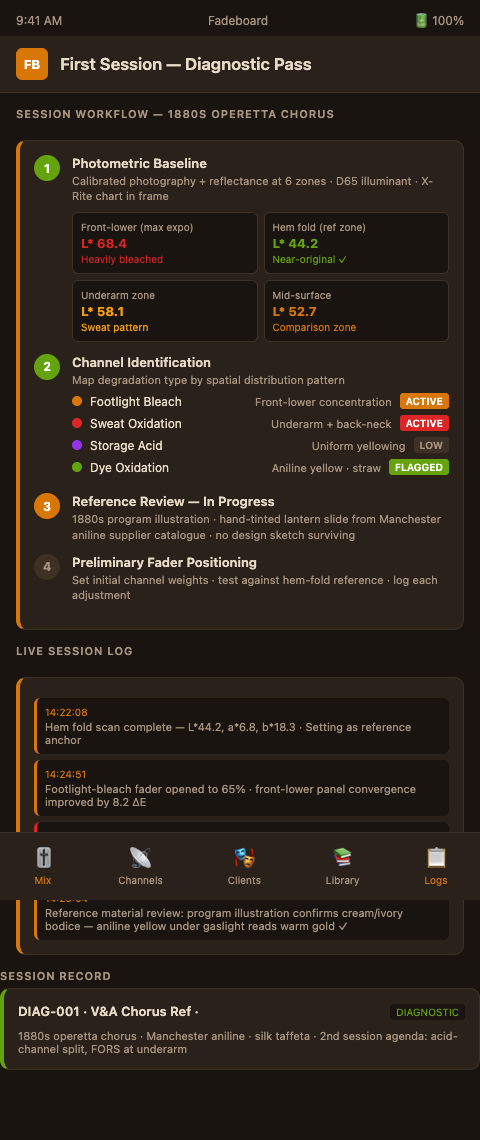
Step one: photometric baseline. Before any fader work, establish calibrated color readings for key surface zones. The American Museum of Natural History's conservation protocol mandates photographic documentation with color-calibration targets before any treatment begins. (Conservation Methodologies: Condition Reporting — AMNH) In a soundboard session, this means taking reflectance readings — or at minimum, calibrated digital photographs under standardized lighting — at four to six zones: least-exposed area (the internal reference), maximum-exposure area (typically the front lower panels on a bodice), underarm zone (sweat-chemistry reference), and a mid-surface zone for comparison. These readings anchor the fader model to measured data rather than visual impression.
Step two: channel identification. Look at the distribution of degradation across the garment surface and identify which degradation types are present. Is the bleaching concentrated at the front lower panels (footlight exposure)? Is there saturation loss at the underarm with no corresponding surface bleaching (sweat chemistry)? Is there overall yellowing with no spatial concentration (storage environment — acid off-gassing from the housing)? Each pattern points to a specific channel, and identifying the pattern tells you which faders to open.
Step three: reference material review. Consult whatever period references the archive holds — program illustrations, hand-tinted lantern slides, costume design sketches. The Cooper Hewitt's work on multiband imaging for dyed textiles demonstrated that even fragmentary visual records provide significant constraint on the solution space for color recovery. (Spotlight on Current Research: Multiband Imaging for Dyed Textiles — Cooper Hewitt, Smithsonian Design Museum) You are not looking for a perfect color-match reference — you are looking for evidence that rules out wrong hypotheses.
Step four: preliminary fader positioning. With baseline readings and channel identifications in place, set initial fader positions. These are provisional — they will be adjusted as you move through the session — but they give you a starting model that you can begin testing against reference materials and against the internal reference zone you identified in step two.
For archivists whose first-session experience involves a specific operational context — specifically the LED stage environment for a remount — the full LED stage calibration workflow covers the additional translation layer that a production context requires.
Advanced Tactics for the First-Pass Session
A well-executed first session should yield more than a baseline — it should generate hypotheses about the original palette that can be tested in the session or in subsequent work.
Build the session log as you go, not after. The AIC's Technical Studies Group standards for dye analysis in textile conservation specify that analytical sequencing and results should be recorded contemporaneously to prevent retrospective rationalization. (TSG Chapter V: Analysis and Testing Methods for Textiles — AIC Conservation Wiki) In a Fadeboard session, this means logging each fader change as you make it, with a brief note on the reasoning. The session log is a permanent archive record; a post-hoc reconstruction is not.
Use the internal reference zone as a continuous check. The least-exposed area identified in step one — inside a hem fold, behind a lining panel — should remain consistent throughout the session. If rolling back the footlight-bleach fader changes the appearance of the internal reference zone, something in the model is wrong. The internal reference is your control; its readings should not change as surface-facing channels are adjusted.
Note where the model fails. Every first session will produce a zone or two where the channel model does not produce a plausible result — where rolling back all the degradation channels still does not account for a particular color anomaly. Those failure zones are often the most informative part of the session: they indicate an undocumented treatment (a prior cleaning, a spot-dye repair, an overpainting), an unexpected dye type, or a contamination source that was not identified in the channel-setup phase. Flag them for the session record and investigate before any treatment is planned.
Plan the second session before leaving the first. The first session's primary output should include a second-session agenda: which hypotheses need more data, which channels need refinement, what reference materials should be sourced before the next appointment. A first pass that ends without a specific next step is a missed opportunity.
For archivists approaching their first session in the context of broader documentation questions — how does a Fadeboard session log integrate into archive management systems — the stage hue documentation workflow covers the archive-record integration side in detail.
The bisque-focused first bisque doll soundboard session covers first-session methodology on a comparable pigment-bearing object — the diagnostic structure is nearly identical despite the different material context.
Edge Cases in First Sessions
A few situations arise regularly in first sessions that the standard protocol does not fully anticipate.
The piece has been treated before. Prior restoration work — overpainting, dye baths, spot-cleaning with solvents — changes the surface in ways that complicate the baseline reading. A 1920s vaudeville gown that was treated in the 1970s may carry a restoration layer that reads as "original" in a cursory examination. UV fluorescence often reveals the prior treatment as a distinct zone. When it does, the session splits the baseline into two: one for the surviving original colorant and one for the restoration layer. The original colorant reading is the one that matters for period-accurate reconstruction; the restoration layer is documented as a prior intervention.
The internal reference zone is itself compromised. Garments from active production runs sometimes show significant sweat chemistry or greasepaint residue even in nominally protected zones — the inside of a hem fold that was routinely re-pressed with a hot iron may have received heat damage that bleached the internal reference. When no truly clean internal zone exists, the session builds the reference from the most protected surviving fabric area — even if that zone is only marginally less degraded than the main surface. Document the limitation explicitly in the session log. A reference that is 20% degraded is still a reference; the session notes that the restoration target is a minimum estimate.
Multiple garments from the same production. Chorus costumes from an 1880s operetta run often share a dye lot — the wardrobe mistress ordered from the same Manchester aniline supplier for the full chorus. Running a single diagnostic session on the best-preserved chorus piece and then flagging that session as the calibration reference for the other chorus pieces reduces total analysis time substantially. Each individual piece still needs its own channel calibration for unique degradation patterns, but the original-state estimate from the reference piece constrains the others.
Schedule Your First Session
If your archive is preparing for a touring company loan, an exhibit loan, or an in-house remount project, a Fadeboard diagnostic session is the right starting point. Contact us with a list of the specific garments involved and any photometric data or period references you have on hand — we will build the channel model for your first pass and leave you with a session log that drives every downstream treatment and production decision.
Theater archivists working through their first session often report that the most useful outcome is not the restoration target but the degradation model itself — a structured account of what happened to the garment and why. That model, documented in the session log, is the evidence base that makes every subsequent conversation with a production team, a conservator, or an acquisition committee substantive rather than anecdotal. Book a first session with your next project garment and start building that record.