Getting Oriented to Soundboards in a Costume Archive
What a Faded Wardrobe Actually Tells You — and What It Hides
The Victoria and Albert Museum's Theatre and Performance Archives holds more than 300,000 items, and a 2022 working-group audit photographed and repacked thousands of stage costumes that had sat in storage for decades. Conservators noted something consistent across the collection: surface color as observed under modern fluorescent or LED work-lighting told them very little about original designer intent. The garments looked flat, yellowed, or bleached — states that reflected storage conditions and lighting context as much as actual dye loss. (Advanced Works Project: Auditing the Theatre and Performance Costume Collection — V&A Blog)
That observation points to a foundational problem in costume archive work. When you examine a piece under 5600K LED overhead lighting, you are not seeing what a period audience saw under 3200K gaslight footlights. The dye is degraded, yes, but it is also being reported to your eye through the wrong light source — a double displacement that compounds the difficulty of any color recovery decision.
For archivists responsible for staging remounts or touring company loans, this matters practically. The production team expects historically-faithful costumes. If the garment reads "wrong" on stage, the archivist hears about it at load-in. Getting ahead of that problem requires more than a visual inspection note. It requires a structured method for separating how much the dye has actually shifted from how much the current lighting context is misrepresenting the original.
ICOM's costume documentation standards emphasize systematic cataloguing that captures what the garment is, not merely what it looks like under current conditions. (ICOM Costume Documentation — costume.mini.icom.museum) That standard implicitly calls for a method of disentangling present observation from original intent — and that is exactly where a soundboard-style workflow finds its footing.
The Soundboard Model Applied to a Costume Archive
An audio mixing console has independent channel faders. The engineer does not move a single master slider to fix a muddy mix — they isolate the offending frequency band, adjust it, and hear the result without disturbing the rest of the signal. Fadeboard applies that same logic to pigment analysis.
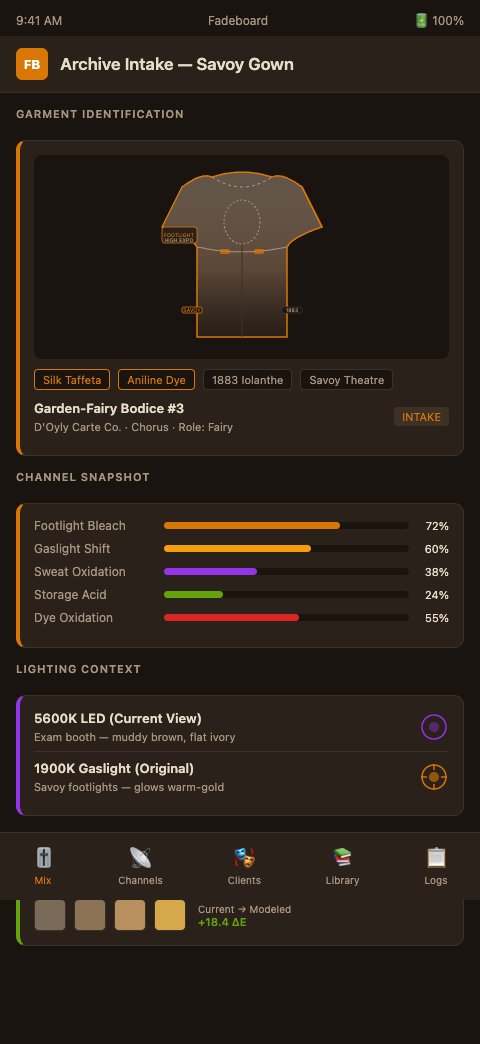
Think of each degradation pathway as its own channel with its own fader. For a historic theater costume, those channels might include: gaslight yellowing (the ambient warm color temperature of the performance space), footlight bleaching (direct upward light that concentrated UV and heat on the lower hem and bodice), sweat-salt oxidation (a chemistry problem, not a lighting problem), and general photodegradation of the dye molecule itself from decades of stage and storage light exposure.
In a conventional visual examination, all of those channels are running simultaneously at volumes you cannot independently control. The garment looks muddy, and you cannot tell whether the muddiness comes primarily from footlight bleaching on the front panels, from salt damage at the underarms, or from the fact that the studio's 5600K overhead is stripping apparent warmth from every surface. Under gaslight at 1800-2000K, that ivory bodice would have glowed. Under your work light, it looks gray.
Fadeboard addresses this by treating each channel as adjustable. You dial back the footlight-bleach fader and observe the simulated pre-bleach state. You roll in the gaslight-era color temperature simulation and observe what the dye appears to have been communicating to a period audience. The faders are not making the dye reappear — they are building a documented model of what the color system was before any degradation pathway operated on it.
The Standards in the Museum Care of Costume and Textile Collections — Collections Trust make clear that conservation decisions must be grounded in documented analysis, not in subjective visual impression. The soundboard model produces that documentation as a byproduct of the analysis itself: every fader position is a recorded parameter, and the session log constitutes an artifact-specific degradation report that survives the archivist, the production cycle, and the loan period.
For archivists thinking about their first session, the workflow begins with measurements — reflectance readings or calibrated photography — that anchor the fader model to actual photometric data rather than eye estimates. That measurement baseline is what separates a Fadeboard session from an educated guess.
For a complementary view of how documentation anchors every subsequent restoration choice, the stage hue documentation workflow covers the pre-work in detail.
Advanced Tactics for a First Archive Session
Once you understand the channel architecture, several practical approaches improve the quality of a first session.
Start with the least-degraded sample area. Most historic theater costumes have a structurally protected zone — inside a hem fold, behind a lining panel, under a button placket — where original dye concentration is higher and footlight exposure was zero. Read that zone first. It gives you a high-end anchor for the fader range: this is what the dye looked like before bleaching began. Everything else on the surface is a degraded version of that reading.
Use period lighting simulation before aesthetic judgment. Before you decide whether a garment is "too yellow" or "too cold," run the gaslight-era channel. Aniline yellow from an 1880s operetta wardrobe that looks bilious under 5600K LED will typically read as warm gold under a 2000K simulation. The problem is not the dye — it is the reporting light. Establishing this early prevents corrections that fight the period intent rather than restoring it.
Log your starting fader positions as a baseline document. The Metropolitan Museum's Costume Institute conservation laboratory uses spectrophotometers and fiber-optic reflectance systems to establish a quantitative baseline before any intervention. (Costume Institute Conservation — The Metropolitan Museum of Art) Your Fadeboard session log serves a parallel function in a smaller-scale workflow: it is the record against which every future intervention is measured.
Calibrate against a same-era reference. A surviving program print, a hand-tinted lantern slide, or a period fashion plate in the archive's paper collection provides qualitative ground truth that no instrument can fully replace. If the program illustration shows a garden-fairy green bodice, and your gaslight simulation brings the faded silk toward that hue, you have external corroboration for the fader model. If it does not, you know to investigate another degradation channel before proceeding.
A complementary entry point for those working with three-dimensional pigment problems — doll restoration studios deal with similarly compound degradation pathways on bisque surfaces — is the overview of bisque pigment soundboard basics.
Common pitfall: treating the internal reference as fixed. The zone you identify as the archive's least-degraded reference is not immune to degradation — it is only less degraded than the most-exposed surfaces. A hem fold that protected fabric from footlight bleaching may still carry acid off-gassing damage from an acidic tissue storage environment, or salt migration from perspiration wicking through the lining. When rolling back the footlight-bleach fader does not bring the main surface into alignment with the internal reference, the discrepancy often points to a secondary damage pathway operating on both zones at different rates. The session should flag this and assign both zones their own degradation channels rather than treating the reference as ground truth. For a Savoy Theatre gown that spent forty years folded in an acid-tissue box before reaching the archive, both the footlight-exposed front panel and the hem fold will need their own channel calibration.
For archivists whose collections include costumes approaching remount or touring use, the practical session workflow in your first archive soundboard session walks through a complete first-pass protocol on a single garment.
Getting Started
Fadeboard is built for costume archivists who need to separate what a garment looks like now from what it was designed to communicate on stage. If your archive holds period wardrobe slated for a touring company remount or a museum exhibit, and the production team is asking whether the colors are historically faithful, a soundboard session is the structured way to answer that question.
The first session requires three things: a garment, a light source you can control, and at least one unexposed reference zone — a seam allowance, a lining underside, a hem fold that never faced a footlight. Everything else the session builds from those starting conditions. Archivists who have worked only with visual inspection will find the shift demanding at first — you are building a parameter model rather than forming an impression — but the session log you produce in two hours contains more actionable information than a condition report that took twice as long to write.
For archives preparing a first session under production pressure — a touring remount scheduled in six weeks, a loan request pending approval — the diagnostic session is still the right first step. Running a full Fadeboard channel pass before any treatment decision is made prevents the most common archive error: committing to a restoration target based on how the garment looks under examination lighting, then discovering at dress rehearsal that the target was calibrated to the wrong illuminant. The Savoy Theatre gaslight footlights and your 5600K LED examination booth are not the same light source.
Join the Fadeboard waitlist and get started before your next remount deadline — early-access archivists receive a guided first-session protocol tailored to their specific garment type and era.