Why Stage Sweat Alters 19th-Century Costume Pigments
The Chemistry That Happens at 98 Degrees
In the 1880s, a touring music hall company might play six nights a week for months at a stretch. Lead performers wore the same bodices and gowns through dozens of performances without laundering — cleaning was expensive, and the wardrobe mistress generally spot-treated staining between shows. The result was repeated cycles of perspiration absorption and air-drying in garments that had no protective lining at the underarm or back-neck seam.
The Maryland Center for History and Culture has documented the historical practice of sewing cotton underarm pads — called sweat shields — into bodices to absorb perspiration and protect expensive outer fabrics. When those shields were absent or became saturated, perspiration migrated directly into the dyed silk or cotton ground. (Underarm Liners: Shields Against Summer Sweat — Maryland Center for History and Culture)
Chemically, this matters because human perspiration is not neutral. It is mildly acidic, containing lactic acid, urea, and salt. A C&EN analysis of sweat-stained artifacts found that the acid and salt content in perspiration initiates a two-stage degradation: first, the dye-fiber bond weakens as the acid disrupts mordanting; second, repeated wet-dry cycling drives salt crystallization into the fiber interstices, causing mechanical damage that accelerates future dye loss. (Sweat-Stained Artifacts — Artful Science / C&EN Blog) The visual result resembles bleaching, but the mechanism is quite different.
For the archivist, the practical problem is that sweat damage and sun bleaching look similar at the surface — both produce areas of reduced saturation and shifted hue. But they respond differently to treatment, and if you build a soundboard model that attributes sweat zones to photodegradation, your fader calibration will be wrong.
Separating the Sweat Channel From the Light Channel
Fadeboard's channel architecture handles this through dedicated separation of the perspiration-chemistry channel from the photodegradation channel. They are different faders because they are different mechanisms, and confounding them produces a model that cannot accurately predict original hue.
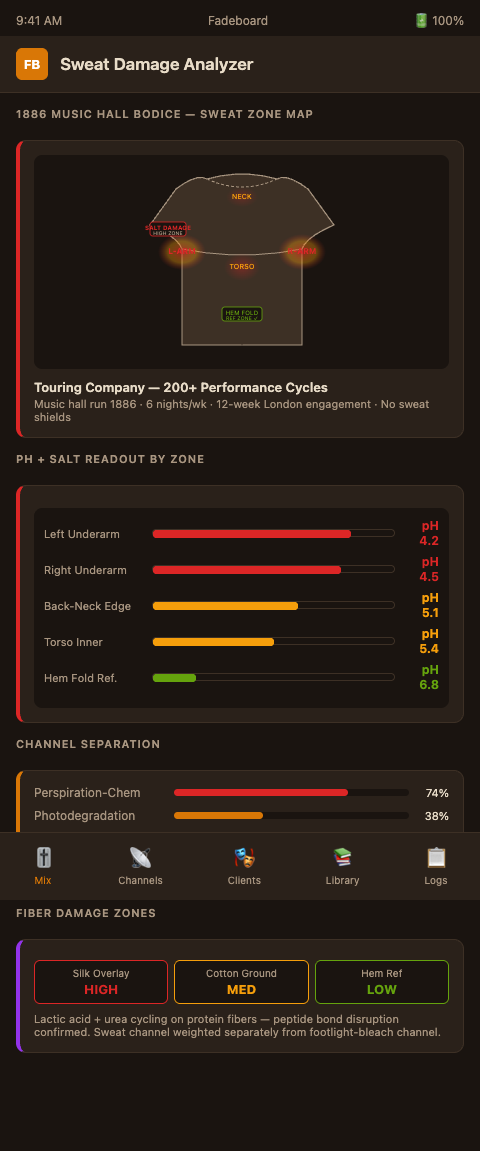
In practice, the sweat-damage channel is identified by pattern rather than by chemistry alone. Perspiration damage concentrates at the underarm seam, the back-neck edge, the inner bodice at the torso, and — on bass and baritone collar linings — along the jawline where greasepaint and sweat co-mingled. Sun bleaching, by contrast, concentrates on surfaces facing the light source: the front panels of a bodice that received direct footlight exposure, the shoulder area of a cape, the top surface of a hat brim. Once you map where the damage is concentrated, you can assign preliminary channel weights before any chemical analysis is done.
An HPLC study published in npj Heritage Science found that sweat-dye interaction products in historic costume fibers are detectable non-destructively using fiber-optic spectroscopy — the degradation compounds have distinctive absorption signatures that differ from simple photodegradation products. (Analysis of Sweat-Induced Dye Degradation by HPLC — npj Heritage Science) For archives with access to portable spectrophotometry, those signatures provide a more precise basis for channel calibration than visual mapping alone.
The key practical implication: when the sweat channel is dialed back in the soundboard model, you should see a restoration of saturation primarily in the structural damage zones — underarm panels, back-neck areas — rather than across the whole surface. If rolling back the sweat-oxidation fader produces uniform improvement, it is probably doing too much work that belongs in the photodegradation or storage-environment channels.
Ballets Russes costumes conserved at UAL Special Collections show this precisely: garments surviving from active performance bear visible perspiration marks at the underarm and neck that are structurally distinct from the surface fading evident on the decorative panels. The archive's conservation notes treat these as separate conditions, not a single "fading" problem. (Ballets Russes Costumes Marks of Performance — UAL Special Collections)
For archivists whose collections include costumes with significant greasepaint contamination alongside sweat damage — a common combination in tenor and baritone collar linings — the greasepaint residue handling workflow addresses the interaction between lipid staining and dye chemistry in that specific zone.
Advanced Tactics for Sweat-Damaged Costumes
Working with historic touring wardrobe that has accumulated multiple performance cycles of perspiration damage requires several specific approaches beyond the basic channel separation.
Map damage zones before building the model. Photograph the garment under raking light and under UV before any fader work. The UV photograph will reveal salt-crystallization hazing and acid-bleaching zones as darker or lighter than the surrounding fabric, often in patterns that do not match the visible-spectrum surface. This gives you a spatial map of the sweat-damage channel that you can use to weight its fader contribution by zone rather than applying a single global value.
Account for sweat-induced dye migration. In protein fibers — silk, wool — acid conditions from perspiration can cause dye molecules to migrate out of the mordanted fiber and re-deposit in adjacent areas or on lining fabrics. A logwood black collar lining may show transferred red overtones at the salt-line boundary. That transferred color is evidence of the original dye chemistry, not a separate contamination. When dialing the sweat channel, watch for these migration artifacts as additional data points about the original dye type.
Distinguish fresh versus historic perspiration chemistry. Historic touring wardrobe from an active collection — loaned out for remount productions — sometimes carries accumulated recent perspiration from the new production run layered over the historic degradation. The Canada Conservation Institute guidelines on textile care specify that recent acidic soiling should be stabilized before any color analysis, because fresh perspiration is chemically active while historic perspiration residue has typically oxidized and stabilized. (Caring for Textiles and Costumes — Canada Conservation Institute / Canada.ca)
Consider the fiber type when weighting the channel. Sweat-induced degradation is more severe in protein fibers (silk, wool) than in cellulose fibers (cotton, linen), because acid conditions disrupt the peptide bonds in protein chains. A ScienceDirect analytical study of wool and silk degradation confirmed that salt-bridge disruption and oxidation are the dominant mechanisms in protein-fiber costume textiles subjected to perspiration cycles. (Historical and Archaeological Textiles: Degradation Products of Wool and Silk — ScienceDirect) If your 1880s music hall gown is silk on cotton ground, the silk overlay will show more severe sweat damage than the cotton structure — and the channels should be weighted accordingly.
For archivists working with costumes at the intersection of sweat damage and dye chemistry — particularly the differential behavior of aniline dyes versus natural mordant dyes under acid conditions — the related analysis of cheek rouge versus lip-paint fade differences offers a parallel model for distinguishing mechanistically different degradation pathways that produce similar visual outcomes.
For those working with the full sweat-to-dye interaction on stage garments, the sweat stain preservation workflow covers the preservation side of this analysis — how to stabilize the damage evidence while still pursuing color recovery.
Working With Sweat-Damaged Historic Wardrobe
If your archive holds touring wardrobe with accumulated perspiration damage from multi-night runs, and you are preparing the pieces for exhibit or production loan, Fadeboard can build a channel-separated degradation model that distinguishes sweat chemistry from light exposure before any treatment decisions are made.
The key detail to bring to a first session is performance history: how many documented touring seasons, what venue types, what costume care regime was standard for the company. A music hall wardrobe that played six nights a week for a twelve-week London run in 1886 accumulated roughly 200 performance hours before the garment was retired — a figure that maps directly to sweat-channel weight and to the footlight bleaching dose. Archives that have performance contracts, venue records, or wardrobe supervisor logs can narrow those estimates considerably. Archives without documentation can work from fiber type and damage spatial pattern alone — the pattern of perspiration damage tells you something even when the records do not.
Silk protein fiber from an 1880s music hall gown and cotton ground from the same garment carry different sweat-channel weights. Calibrating each independently requires separate FORS readings at the exposed silk panels and the cotton structural zones, then setting the sweat fader contribution by zone rather than globally. The session takes longer, but the restoration target that emerges is specific enough that the colorist at the dye bath can work from it directly.
Sign up for Fadeboard and bring your garment type, fiber composition, and whatever performance history survives — we can show you what the original hue looked like before the touring seasons took their toll.