Why Cheek Blush Fades Differently Than Lip Paint
The Two-Direction Problem
A Kämmer & Reinhardt character doll from 1895 arrives with cheeks that read brownish-copper and lips so faded they are nearly the same tone as the surrounding bisque. Your first instinct is to remix the lip paint darker and warm the cheeks slightly. Three washes later the lips are correct and the cheeks are burnt sienna. The problem was not technique — it was that you treated two opposite degradation mechanisms as one.
Jackson's Art Blog on fugitive pigments documents exactly this scenario: restorers routinely confront red lip paints that have faded to near-white on antique dolls while other facial pigments remain comparatively intact. The antique doll market values intact facial pigment heavily — the Market Decipher dolls collectibles report places the antique doll segment at $3.8 billion with condition of lip paint among the primary valuation factors. Getting the two-direction fade wrong is not just an aesthetic failure; it has direct financial consequences for your client's heirloom.
Why the Chemistry Splits
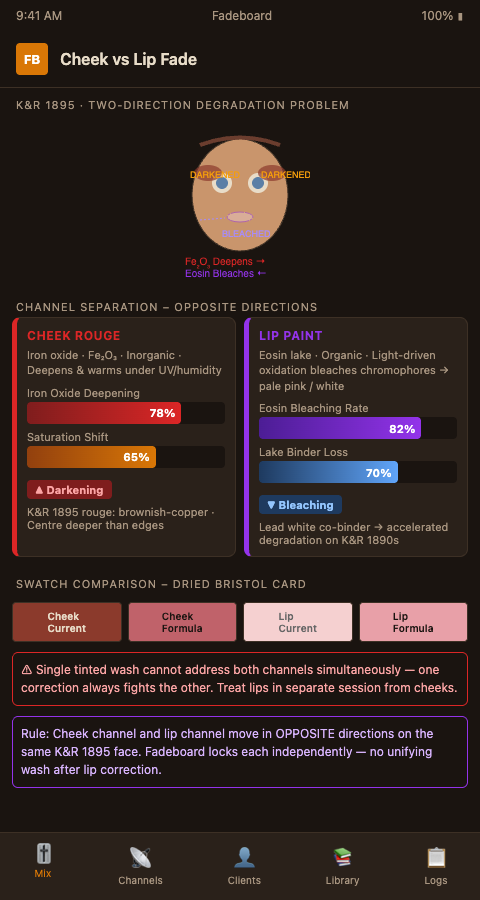
Cheek rouge on German bisque from the 1880s–1910s was typically based on iron oxide or manganese pigments — inorganic compounds fired or applied in ways that resist photo-bleaching. Under UV exposure and humidity, iron oxides do not lose color; they deepen toward red-brown and in some cases develop a warmer, more saturated cast. This is darkening and warming, not fading. For an expanded look at cheek rouge variations across German bisque makers, different factories used different iron oxide grades and application methods, so the same fader positions will not apply uniformly across Kestner, K&R, and Simon & Halbig heads from the same decade.
Lip paint on the same heads was routinely formulated from organic lake pigments — eosin, cochineal, or vermilion-based compounds that behave very differently. Research on eosin lake degradation establishes that eosin-based red lakes bleach under light, with linseed oil and oxygen governing the fugitive fading rate. The study isolates the mechanism clearly: light-driven oxidation converts chromophores in eosin to colorless products, and the more organic the binder, the faster the loss.
Vermilion presents a third pathway. Research on cinnabar photodegradation shows that mercuric sulfide (HgS) converts to metallic mercury under UV, producing darkening rather than bleaching — but the result is a blackish-brown shift rather than the warm deepening of iron oxide. On dolls with vermilion-based lip paint, you may see darkening instead of bleaching, which looks superficially like cheek-rouge behavior but requires a completely different restoration response.
The interaction with surrounding pigments compounds the reading difficulty. Van Gogh pigment studies document how cochineal and eosin red lakes fade while the underlying blue pigments remain, shifting apparent hue from red-pink toward a muted blue-pink. On a bisque doll with blue-shaded under-eye modeling, faded eosin lip paint can produce a face that reads with a subtle blue-gray cast around the mouth — not because blue was added, but because the red that balanced it is gone.
This is where Fadeboard's independent fader model resolves what a single-color approach cannot. You set a separate degradation channel for cheek rouge (typically trending toward warm darkening) and a separate channel for lip paint (trending toward pale bleaching or, if vermilion, toward dark-brown shift). The channels move in opposite directions. Mixing a single wash to address both is physically impossible — one correction always fights the other.
Research comparing co-pigment effects on eosin lakes adds further nuance: lead white mixed into eosin lake accelerates degradation while cobalt blue may slow it. If the original factory applied eosin mixed with lead white as a brightener — common in German bisque of the 1890s — the lip paint will have degraded faster than a pure eosin sample would predict. Fadeboard's fader settings account for this by letting you adjust the bleaching-rate channel for known binder interactions.
Advanced Tactics for Facial Pigment Splits
Three practical habits reduce error when working with chemically mismatched facial pigments.
Read under two light sources before mixing. Under warm incandescent light, iron-oxide cheek rouge and bleached eosin lip paint can look closer in tone than they are. Under cool daylight (or a D65-equivalent lamp), the difference in saturation and hue becomes legible. The difference between what you see under the two sources tells you which channel is dominant — warm light emphasizes the rouge deepening; cool light reveals the lip bleaching.
Identify the lip pigment type before setting faders. If the lip paint has shifted toward pale pink or near-white, you are dealing with a lake bleacher (eosin or cochineal). If it has shifted toward brownish-black, you have vermilion darkening. The endpoint and therefore the restoration target differ substantially. Getting this wrong means mixing toward the wrong original color.
Treat lips in a separate session from cheeks. Because the two channels operate in opposite directions, applying corrections simultaneously introduces too many variables. Paint and dry the lip correction first, then reassess the cheek under fresh light. This single-session face painting discipline — working one channel at a time — is where restorers with no lab infrastructure can match the consistency of studio conservators.
Common pitfall: applying a single tinted wash after the lip correction dries. After successfully correcting the lip, some restorers apply a unifying wash over the whole face to "even out" the overall tone. On a face where the cheek rouge has darkened while the lip was bleaching, this unifying wash will push the restored lip back toward a slightly warmer cast — undoing the correction. Fadeboard's session log prevents this by keeping the lip channel and the cheek channel as separate, locked entries: once the lip pass is complete and logged, the cheek correction runs against the updated face state without referencing the lip formula at all.
The full challenge of madder red lip restoration on historic bisque covers a third pigment type — madder-lake reds — that fades with its own specific mechanism distinct from both eosin and vermilion. If your client collection spans the 1860s–1910s, all three lip pigment types may appear across different dolls. Natural madder sourced before 1868 produces a different spectral signature than synthetic alizarin introduced after that year, and the two fade along different trajectories — a doll from 1863 and one from 1873 may arrive with lip colors that read identically today but require different restoration pigment choices to maintain that match over the next fifty years.
For restorers who also handle textile heirlooms, the batting contact dye loss patterns in quilts addresses a parallel two-direction problem: indigo and madder in the same quilt panel degrade at different rates under the same conditions, requiring separate channel readings just as bisque cheek and lip pigments do.
One Mix Cannot Do Two Opposite Jobs
Independent studios restoring antique bisque dolls under tight turnaround cannot solve a two-direction degradation problem with a single tinted wash. The chemistry of cheek rouge and lip paint on German bisque from the 1890s splits in opposite directions — one darkens while the other bleaches — and Fadeboard's channel model gives you the framework to address both without losing an entire sitting to a mix that fights itself.
The Fadeboard waitlist is open for solo restorers now. If you are currently managing separate recipe logs for cheek work and lip work and still losing sessions to tone conflicts on the same face, that is the exact problem the channel model solves. Join the waitlist and note which maker's facial pigment combination gives you the most trouble — your input shapes which factory profiles get built into the first release.