Crowd Tension Mapping for Convention Centers and Trade Shows
Convention centers are not stadiums. They are not concert halls. They are not nightclubs. And yet, for decades, the security industry has tried to apply the same crowd management frameworks developed for single-venue, single-event spaces to environments that bear almost no structural resemblance. The result has been a persistent blind spot in event security, one that convention center operators are only beginning to address. As the Department of Homeland Security's Cybersecurity and Infrastructure Security Agency (CISA) has noted, the Commercial Facilities Sector, which includes convention centers, operates on the principle of open public access where the general public can move freely without highly visible security barriers, creating unique challenges compared to more controlled venues (CISA Commercial Facilities Sector).
According to the International Association of Venue Managers (IAVM), convention centers in the United States hosted over 270 million attendees in 2023, a figure that surpassed pre-pandemic levels for the first time. The National Fire Protection Association (NFPA) reported a 14% increase in crowd-related incident reports at convention facilities between 2019 and 2024, with the majority of incidents occurring not in the main exhibition halls but in transitional spaces such as lobbies, corridors, escalator banks, and registration areas. A 2022 study published in the Journal of Safety Research found that multi-floor, multi-building venues experienced crowd density incidents at 2.3 times the rate of comparable single-floor facilities, even when overall attendance numbers were lower.
The problem is structural. A stadium funnels 60,000 people into a single bowl with predictable ingress and egress points. A convention center spreads 80,000 people across 2.5 million square feet of exhibition space, meeting rooms, lobbies, loading docks, food courts, and parking structures, often spanning multiple connected buildings and as many as four or five floors. Attendees do not follow a single schedule. They arrive at different times, pursue different agendas, and move through the facility in patterns that shift dramatically from hour to hour and day to day. Traditional security models that rely on static post assignments and fixed camera coverage simply cannot keep up.
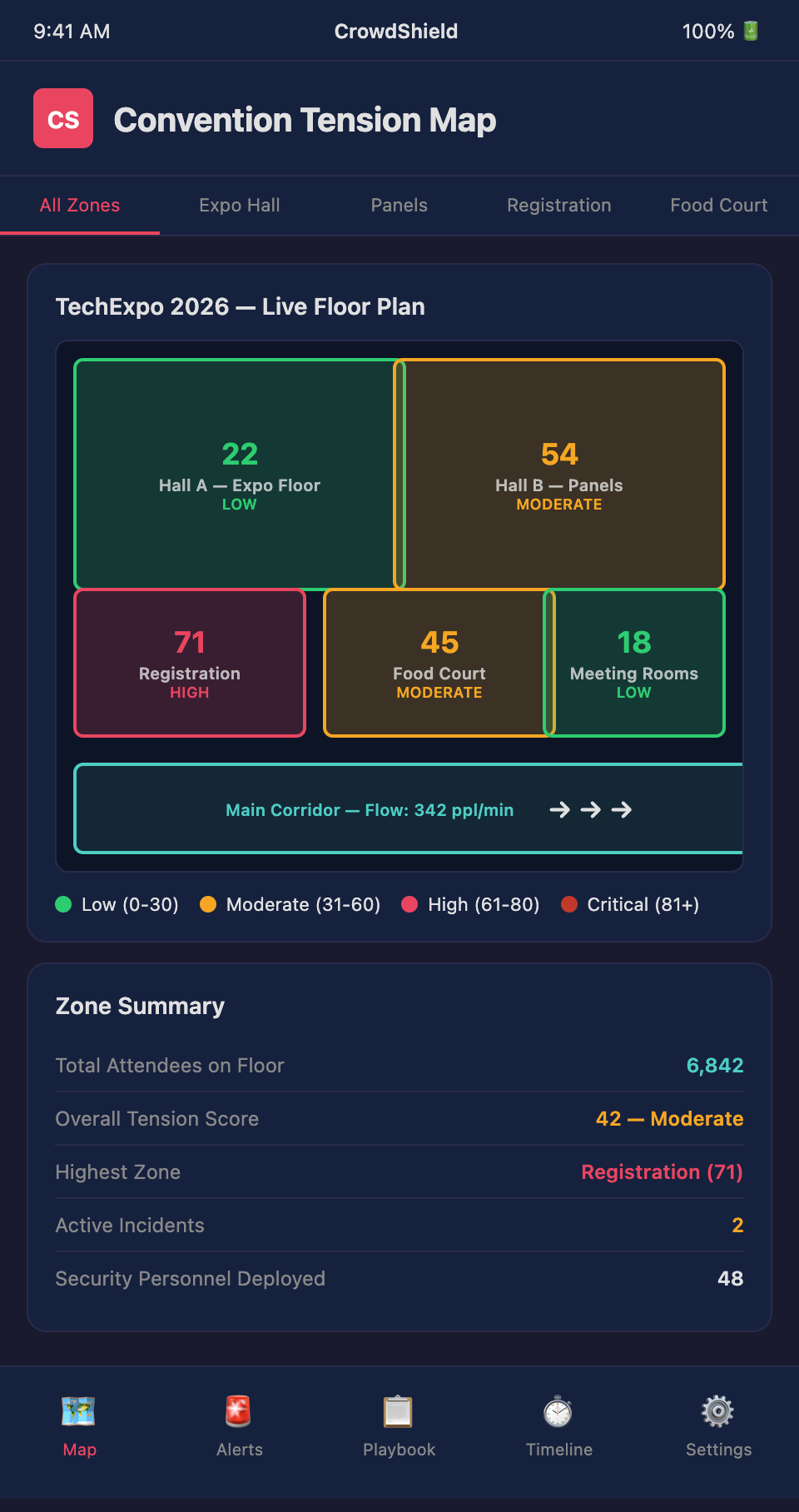
Research by Prof. G. Keith Still, a leading authority in crowd science at Manchester Metropolitan University, has demonstrated that crowd density becomes critical at 2-4 people per square meter and that understanding the relationship between density and flow is essential for preventing crowd disasters in complex venues (Prof. G. Keith Still - Crowd Density). Spatial tension mapping is a fundamentally different approach to crowd security intelligence. Rather than treating a convention center as a collection of discrete rooms to be individually monitored, it treats the entire facility as a dynamic spatial system where crowd density, movement velocity, directional flow, and behavioral signals combine to produce a continuously updating risk surface.
CrowdShield's spatial tension mapping engine ingests data from multiple sensor layers. Passive infrared counters at doorways and corridor chokepoints track real-time occupancy by zone. Anonymized Wi-Fi and Bluetooth probe data from attendee devices generate movement heatmaps without capturing any personally identifiable information. Existing CCTV feeds are processed through computer vision models that detect crowd density, movement speed, and behavioral anomalies such as sudden stops, counter-flow movement, or clustering patterns that diverge from normal circulation. Environmental sensors capture noise levels, temperature, and air quality, all of which correlate with crowd stress. The system fuses these inputs into a unified spatial model that updates every fifteen seconds.
What makes this approach critical for convention centers specifically is the concept of multi-scale tension. In a stadium, crowd tension tends to be relatively uniform across a given section. In a convention center, you can have a calm, well-spaced vendor hall on the first floor while a dangerous crush is developing outside a panel room on the third floor and a heated confrontation is building between competing exhibitors on the mezzanine. These events are happening simultaneously, in different parts of the same facility, and they require different response strategies. A single security operations center looking at a wall of camera feeds cannot process this complexity in real time. Spatial tension mapping can.
The choose-your-own-adventure decision framework is where spatial intelligence becomes operationally actionable. When CrowdShield detects an emerging tension pattern, it does not simply generate an alert. It presents security operators with a branching set of response options, each with projected outcomes based on similar historical patterns. For example, if crowd density outside a popular panel room is approaching unsafe levels forty-five minutes before the session begins, the system might present three options: deploy additional staff to manage the queue and open overflow viewing areas, activate a secondary entrance to the panel room to reduce single-point loading, or initiate a public address announcement directing attendees to a simulcast location. Each option includes an estimated impact on the tension score, the staffing resources required, and the projected timeline for resolution.
This branching logic is essential because convention center security decisions are rarely binary. The correct response depends on context that changes from hour to hour. A crowd density spike at 9:00 AM on Day 1 might be a registration bottleneck that requires additional entry lanes. The same density reading at the same location at 5:30 PM on Day 3 might be an evacuation risk from a fire alarm during teardown. The spatial tension map provides the context that transforms raw data into actionable intelligence.
For convention center operators evaluating spatial tension mapping, several advanced considerations deserve attention. First, the multi-day nature of conventions means the system must learn and adapt. Day 1 data establishes baseline patterns. By Day 3, the tension model should be significantly more accurate because it has observed the specific behavioral patterns of this particular event's attendee population. CrowdShield's machine learning pipeline processes end-of-day analytics to refine predictions for the following day, adjusting for factors like attendee dropout rates, schedule changes, and weather impacts on outdoor queuing areas.
Second, convention centers host radically different event types. A medical device trade show and a comic book fan convention produce entirely different crowd dynamics, even in the same facility. CrowdShield maintains event-type profiles that adjust baseline tension thresholds, behavioral detection parameters, and response option sets based on the category of event. A density level that is perfectly normal in a packed fan convention autograph line would be a serious red flag in a pharmaceutical expo corridor.
Third, the multi-building challenge requires careful sensor placement strategy. Many large convention centers consist of two or more connected buildings with limited connection points. These connection corridors become critical chokepoints that the tension map must monitor with high granularity. CrowdShield recommends placing sensor clusters at every inter-building connection, with additional coverage at vertical circulation points like escalators, elevators, and stairwells that connect between floors.
According to the CEIR (Center for Exhibition Industry Research), the exhibition industry tracks four key metrics -- exhibit space, number of exhibitors, attendance, and revenue -- providing the baseline data that predictive systems rely on to calibrate expectations for specific event types (CEIR Exhibition Index). Fourth, integration with show management systems adds a powerful predictive layer. When CrowdShield can ingest the event schedule, including session times, expected attendance by room, and exhibitor traffic projections, it can anticipate tension patterns before they materialize. If a keynote speaker is expected to draw 8,000 attendees to a hall that seats 6,000, the system flags the deficit hours in advance and begins prompting mitigation options before the first attendee arrives.
Fifth, the staffing optimization dimension of spatial tension mapping addresses one of the most persistent cost pressures in convention center security. The NFPA 101 Life Safety Code requires not fewer than one trained crowd manager for each 250 occupants in assembly occupancies, a staffing standard that creates significant resource demands for large conventions (NFPA Codes and Standards). Traditional security staffing models assign fixed posts based on facility layout and regulatory requirements. Officers stand at doors, patrol corridors on fixed routes, and monitor camera feeds in a security operations center. This model wastes resources during low-tension periods and leaves gaps during high-tension moments that do not coincide with the fixed patrol schedule. CrowdShield's tension map enables dynamic staffing where personnel are redeployed in real time to the zones showing the highest tension scores, ensuring that security presence is concentrated where it is most needed at any given moment.
Sixth, the loading dock and back-of-house dimension is frequently overlooked in discussions of convention center crowd management, but it represents a significant vulnerability. Exhibition setup and teardown periods bring hundreds of trucks, forklifts, and contractor crews into the facility simultaneously with attendee traffic during show open and close periods. The interface between the industrial back-of-house environment and the public-facing event space creates risk zones where attendees may wander into loading areas or where equipment movement may encroach on pedestrian spaces. CrowdShield monitors these interface zones with elevated sensitivity during setup and teardown windows.
The convention center security landscape is evolving rapidly, and the tools must evolve with it. If you are interested in how CrowdShield's spatial tension mapping handles the unique challenges of stadium and arena environments, the foundational principles are similar but the implementation differs significantly. For convention-specific challenges like registration chokepoint management and multi-day event risk scoring, the spatial tension framework provides the intelligence backbone that makes proactive security possible.
Convention centers deserve security intelligence designed for their specific complexity. CrowdShield is building the first incident-prevention engine purpose-built for multi-building, multi-floor, multi-day events. If you manage security for a convention center or trade show and want early access to spatial tension mapping tailored to your environment, join the CrowdShield waitlist for convention center operators. Pilot programs are now open for facilities hosting events of 10,000 or more attendees.