Panel Room Crowd Crush Prevention at Fan Conventions
The line for Hall H at San Diego Comic-Con International is one of the most well-documented crowd management phenomena in the events industry. Comic-Con International has implemented wristband-based line management systems to monitor queue size and assist staff in managing the front of the Hall H line, a direct response to the crowd safety challenges these queues create (Comic-Con International - Hall H Wristbands and Guidelines). Attendees begin queuing more than twenty-four hours before panels featuring major film studios or beloved franchise announcements. The hall seats approximately 6,500 people. Demand regularly exceeds 25,000. The line wraps around outdoor tents, across parking lots, and through adjacent park space. Similar dynamics play out at New York Comic Con, PAX, Dragon Con, Anime Expo, and dozens of other fan conventions where exclusive panels, celebrity appearances, or first-look content create demand that vastly exceeds available seating.
The crowd safety implications are severe. A 2023 report from the Event Safety Alliance documented 42 crowd compression incidents at fan convention panel queues across North America in the preceding two years, resulting in 156 injuries requiring medical attention. The report noted that panel queue incidents disproportionately affect younger attendees, with 64% of those injured being under the age of 25. Research published in Safety Science in 2022 analyzed video footage from multiple fan convention panel queues and found that crowd density in the highest-risk zones regularly exceeded 6 persons per square meter, a threshold that crowd safety engineers consider the onset of dangerous compression where individuals lose the ability to control their own movement.
Research on crowd collapses and crushes has established that when crowd density exceeds approximately five people per square meter, individuals begin to lose the ability to move voluntarily, and at densities of six to seven per square meter, people become pressed against each other and can be unable to control their own movement (Wikipedia - Crowd Collapses and Crushes). The fundamental problem is that fan convention panel rooms create a scarcity dynamic that incentivizes early queuing and aggressive positioning. Unlike general admission at a stadium where all seats offer a comparable experience, panel rooms offer a binary outcome: you are either inside or you are not. There is no partial access. This binary scarcity drives attendees to queue earlier, push harder, and resist any crowd management instruction that might cause them to lose their place. The emotional investment is enormous. An attendee who has waited fourteen hours in line and is told the room is now full is not simply disappointed. They are experiencing a loss that triggers genuine stress responses, and when thousands of people experience this simultaneously in a confined space, the collective emotional energy creates a volatile environment.
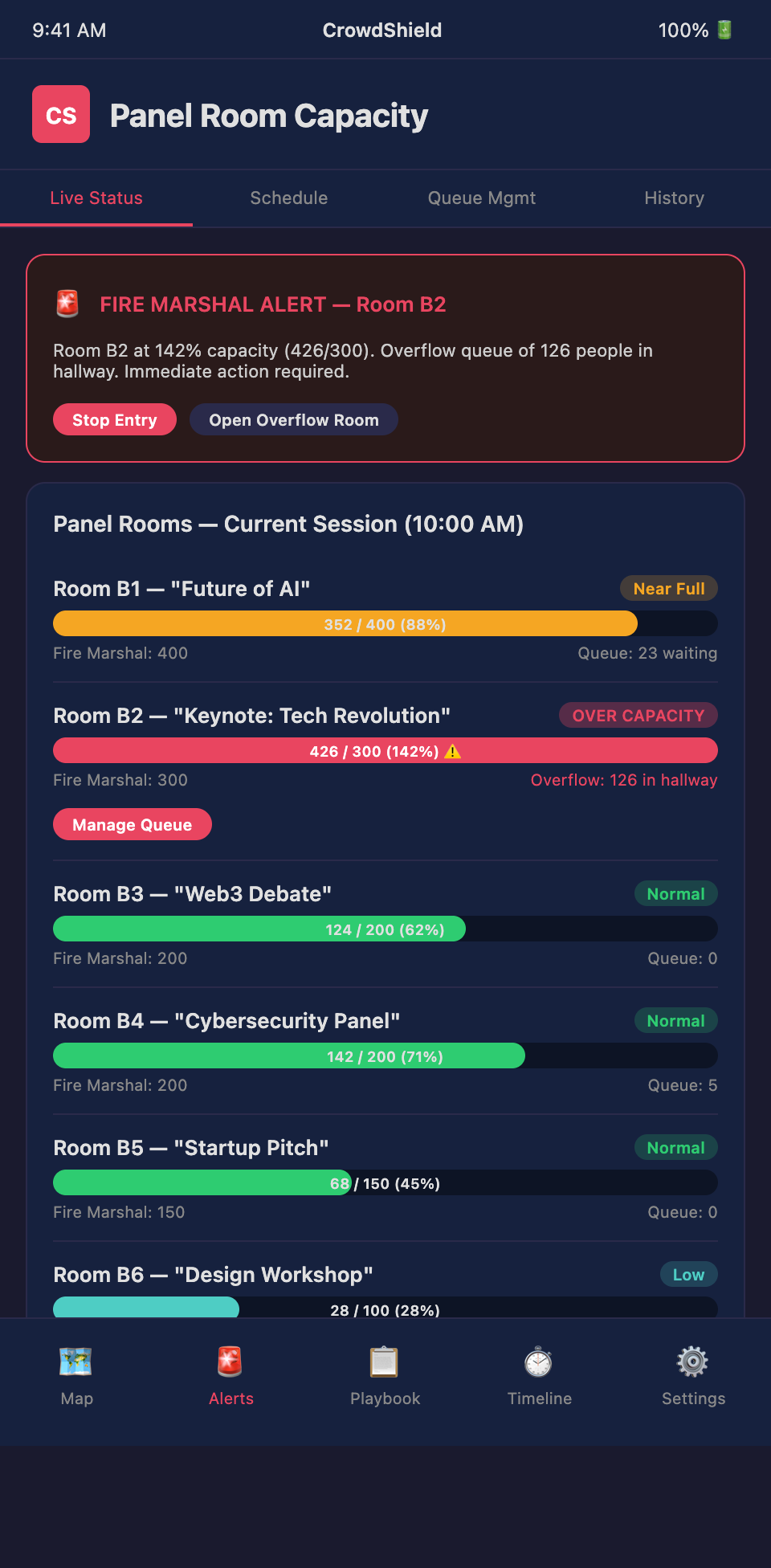
CrowdShield addresses panel room crush risk through continuous spatial monitoring of both the queue zone and the surrounding approach corridors, beginning hours before the panel is scheduled to start. The system tracks queue length, queue density at different points along the line, the rate of new arrivals joining the queue, and the movement patterns of the broader convention population in the vicinity.
The choose-your-own-adventure decision framework activates when the system detects that projected demand will significantly exceed room capacity. This detection typically occurs twelve to eighteen hours before the panel, based on queue growth rate analysis, social media activity monitoring, and historical data from similar panels at previous events. The early detection window is critical because the most effective interventions require lead time to implement.
When projected demand exceeds capacity by a moderate margin, CrowdShield presents options such as opening the queue management area earlier to allow organized queuing in a controlled space with adequate room, deploying additional queue management staff to maintain safe density throughout the line, activating overflow viewing rooms with live video feeds of the panel to reduce the binary access dynamic, and distributing numbered wristbands or digital queue positions to eliminate the need for physical line-holding.
When projected demand exceeds capacity by a large margin, the response options escalate. The system may recommend establishing a hard queue cutoff once the line reaches a capacity-matched count, with clear communication to attendees beyond the cutoff that entry is not possible and directing them to overflow viewing. It may recommend restructuring the queue layout to prevent dangerous compression at turns and bottlenecks. In extreme cases, it may recommend moving the panel to a larger venue if one is available, splitting the panel into two sessions, or activating a lottery system for admission.
Each response option is presented with data-driven projections. The system estimates how each intervention will affect peak density in the queue zone, the emotional temperature of the crowd based on behavioral analysis, and the downstream effects on other areas of the convention. Importantly, CrowdShield also models the timing sensitivity of each option. A wristband distribution that begins twelve hours before the panel is highly effective. The same intervention attempted two hours before the panel may actually increase tension by creating a rush to the distribution point.
Several advanced factors make panel room crush prevention particularly challenging at fan conventions. The cosplay factor is significant. Many attendees at fan conventions wear elaborate costumes that restrict their mobility, visibility, and ability to respond to crowd surges. CrowdShield's computer vision models are trained to detect costume-wearing attendees in queue zones and adjust density thresholds downward accordingly, recognizing that a cosplayer carrying a large prop has a larger effective footprint and reduced ability to self-evacuate in a compression event.
The overnight queuing problem requires specialized monitoring. When attendees camp overnight for next-day panels, the queue zone transitions from a managed event space to something resembling an improvised campground. Standard crowd density metrics do not apply to sleeping attendees in chairs and sleeping bags. CrowdShield adjusts its monitoring parameters for overnight queue periods, focusing on factors like queue integrity, perimeter security of the overnight area, and the critical transition period at dawn when sleeping attendees wake up and the queue compresses from a spread-out resting configuration to a standing, moving line.
The room transition period is another high-risk moment. When a panel ends and the room must be cleared before the next panel's queue is admitted, two large crowds are moving in opposite directions through the same corridor space. CrowdShield maps these counter-flow patterns and can recommend staggered exit and entry timing, separate flow paths, or holding patterns that prevent the exiting and entering crowds from colliding. The system can model transition periods for each panel room based on room capacity, exit configuration, and corridor width, providing show management with data-driven guidance on minimum transition times needed between sessions to prevent corridor congestion from reaching dangerous levels.
The multi-panel conflict scenario arises when multiple high-demand panels are scheduled in the same time block across different rooms. Attendees who fail to gain entry to their first-choice panel rush to their second-choice panel, creating a secondary demand surge at a room that may already be at capacity. CrowdShield tracks these spillover patterns by monitoring the movement velocity and direction of attendees who are turned away from full panels, predicting which alternative panel rooms will experience a secondary demand spike, and pre-positioning queue management resources at those locations.
The Event Safety Alliance's crowd safety workshops train event professionals to identify risks within crowds, apply practical mitigation mechanisms, and develop familiarity with analytic processes for recording proportionate measures -- skills that are directly applicable to the high-intensity queuing environments of fan convention panels (Event Safety Alliance - Crowd Safety Workshop). The accessibility dimension of panel queue management is often overlooked in the rush to manage general admission crowds. Attendees with mobility impairments, wheelchair users, and individuals with conditions that prevent standing in long queues require accommodation that traditional first-come-first-served queuing does not provide. CrowdShield's spatial model includes accessibility monitoring that ensures ADA-compliant pathways remain clear, that accessible seating sections in panel rooms are properly managed, and that the queue environment does not create conditions that disproportionately exclude attendees with disabilities.
Finally, the emotional dynamics of panel queue management require security personnel to combine crowd control with customer service in ways that other venue types rarely demand. CrowdShield's decision prompts include communication guidance alongside physical crowd management options, recognizing that how information is delivered to a disappointed crowd is as important as the physical arrangements for managing them. The system provides templated communication scripts calibrated to different scenarios, from routine capacity announcements to disappointment management when a highly anticipated panel reaches maximum occupancy, helping security staff deliver difficult messages in ways that de-escalate rather than inflame crowd emotions.
For related approaches to managing high-demand entry scenarios, see how CrowdShield handles crowd tension mapping in convention centers at a facility-wide level. The emotional intensity of fan convention panels shares similarities with nightclub and late-night venue dynamics where scarcity and exclusivity also drive crowd tension. For the specific challenge of managing convention attendees in costume, see our coverage of cosplay, props, and weapons policy enforcement.
Fan conventions should not have to choose between offering exclusive panels and keeping their attendees safe. CrowdShield gives convention security teams the spatial intelligence and branching decision support to manage high-demand panel queues proactively. Join the CrowdShield waitlist for fan convention operators to explore how spatial tension mapping can protect your attendees at their most passionate moments. Early access includes queue zone sensor packages and real-time crush prevention dashboards.