Vendor Hall Territorial Disputes and Crowd Conflicts at Trade Shows
Trade show vendor halls operate under a set of social and commercial pressures that make them fundamentally different from any other crowd environment. Unlike a concert audience united by shared enthusiasm for a performer, or a stadium crowd aligned behind a team, a vendor hall contains thousands of people with competing commercial interests in close physical proximity. Exhibitors are competitors. Attendees are prospects being actively courted. Booth placements carry financial implications that can reach seven figures. And all of this plays out in a densely packed environment where personal space is a luxury and frustration accumulates over multi-day events.
The Trade Show Exhibitors Association (TSEA) reported in its 2024 annual survey that 38% of exhibitors at major trade shows experienced some form of conflict with neighboring exhibitors during the previous year. The most common disputes involved noise levels from demonstrations or presentations that disrupted adjacent booths (cited by 52% of those reporting conflicts), physical encroachment of displays, signage, or attendee lines into neighboring booth space (47%), and deliberate traffic interception where exhibitors positioned staff or signage to redirect foot traffic away from competitors (29%). The Freeman Company's 2023 Trade Show Intelligence Report documented that security intervention requests from exhibitors increased 22% year over year, with the majority related to territorial and traffic flow disputes rather than traditional safety concerns.
According to the CEIR (Center for Exhibition Industry Research), which conducts the most comprehensive census of B2B exhibitions in the United States, the exhibition industry has tracked consistent growth in exhibitor density and attendee volume, conditions that directly contribute to the competitive spatial dynamics that produce booth conflicts (CEIR Census). These conflicts are not trivial. A 2023 incident at a major automotive industry trade show in Detroit escalated from a noise complaint between adjacent exhibitors to a physical altercation involving six people, resulting in the ejection of both exhibitor teams and significant damage to display equipment. At a consumer electronics expo, a dispute over line management for a product demonstration blocked a fire exit for forty-five minutes before security intervened. The financial stakes amplify the emotional intensity. An exhibitor who has invested $300,000 in a trade show presence and believes a competitor is unfairly diverting traffic from their booth is experiencing a genuine threat to their business investment, and that emotional state can escalate rapidly.
CrowdShield addresses vendor hall conflicts by mapping the spatial dynamics that produce them. The system monitors foot traffic patterns throughout the exhibition hall, creating real-time flow maps that show how attendees move between aisles, where they cluster, where they linger, and where they accelerate past exhibits without stopping. This traffic flow data is overlaid with booth layout information to identify structural tension points where the physical arrangement of exhibitor spaces creates conflict-prone conditions.
The system identifies several categories of spatial tension specific to vendor halls. Asymmetric traffic patterns occur when a popular booth generates a crowd that spills into adjacent aisles and disrupts traffic flow to neighboring exhibitors. Chokepoint conflicts arise when booth designs or demonstration crowds narrow aisle width below safe circulation thresholds. Queue collisions happen when multiple popular booths in proximity generate lines that compete for the same physical space. Dead zone resentment develops when traffic flow patterns consistently bypass certain areas of the hall, creating frustration among exhibitors in lower-traffic zones who may resort to aggressive tactics to attract attention.
The choose-your-own-adventure framework for vendor hall conflicts operates on two timescales. Pre-event, when CrowdShield analyzes the booth layout and floor plan, it identifies structural conflict risks before the first exhibitor sets up. If two direct competitors are placed in adjacent booths, if a high-traffic demonstration area is positioned next to a booth that requires quiet conversation, or if the floor plan creates natural chokepoints where competing lines will intersect, the system flags these risks and presents layout modification options. Moving a single booth or adjusting an aisle width before setup is far less costly than managing the conflicts these arrangements will produce during the show.
During the event, real-time monitoring detects emerging territorial tensions through spatial indicators. When crowd density around a popular booth exceeds a threshold, the system calculates the spillover impact on neighboring exhibitors and the aisle circulation pattern. It then presents response options calibrated to the severity and type of conflict. For a minor queue encroachment, the options might include deploying a staff member to manage the queue boundary, providing portable stanchions to define the queue space, or contacting the exhibitor's booth manager to request queue adjustments. For a more serious traffic flow disruption, the system might recommend opening a temporary bypass route around the congested area, deploying directional signage to redistribute traffic, or coordinating with show management to adjust the demonstration schedule of the offending booth.
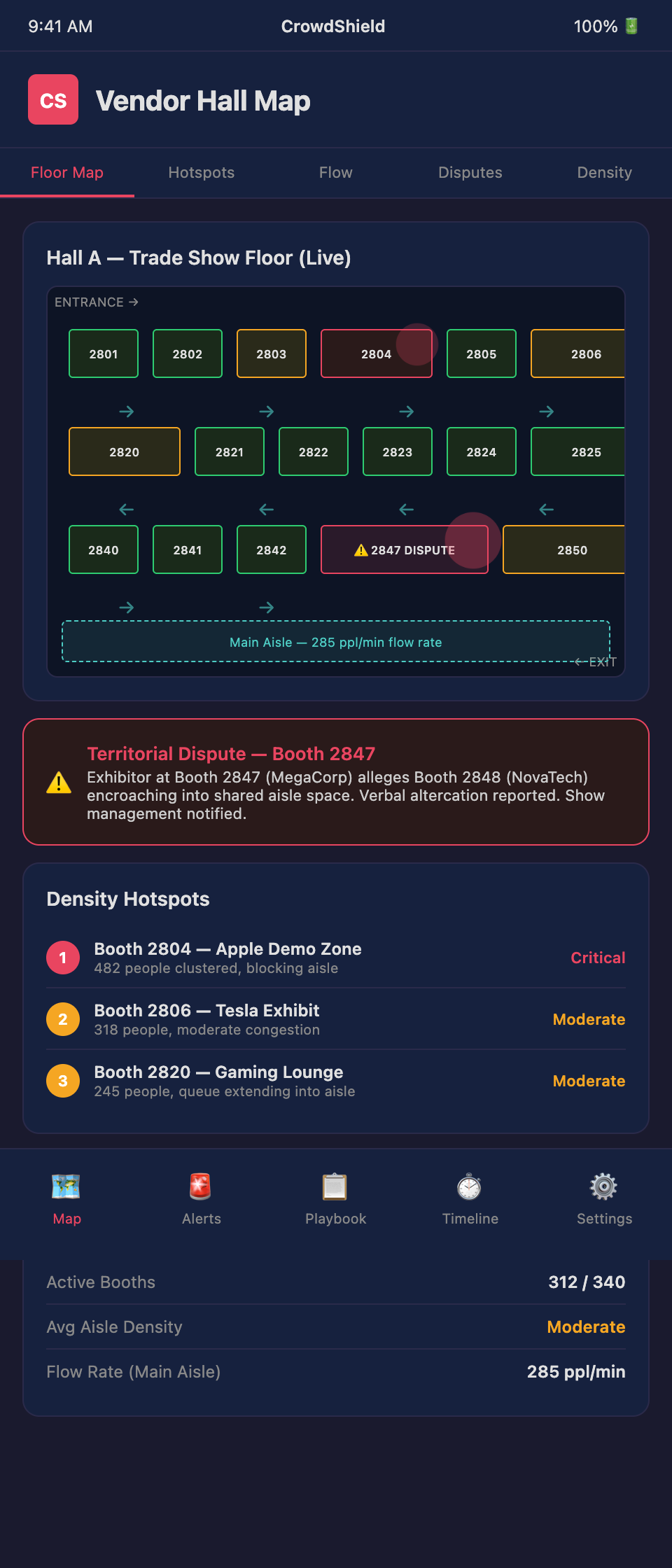
Advanced vendor hall conflict management requires understanding the temporal dynamics that conventional security overlooks. Exhibitor tensions tend to escalate over the course of a multi-day show. A minor annoyance on Day 1 becomes a simmering resentment by Day 2 and a confrontation trigger by Day 3. CrowdShield tracks conflict-related interactions over time, building a tension history for specific exhibitor locations that allows security to proactively check in with exhibitors showing accumulating frustration patterns before those tensions boil over.
The time-of-day pattern also matters significantly. Trade show vendor halls experience dramatic crowd density swings throughout the day. The morning opening rush, mid-morning peak, lunch lull, and late-afternoon final push each create different conflict dynamics. The morning rush generates queuing conflicts as attendees rush to popular booths. The midday peak creates general congestion and aisle circulation problems. The lunch lull can generate a different kind of tension as exhibitors in quiet zones become aware that their traffic is not recovering. The late afternoon push, when attendees make final rounds before the hall closes, generates aggressive traffic-interception behavior from exhibitors who feel they have not achieved their goals.
UFI, the Global Association of the Exhibition Industry, estimates that 32,000 exhibitions were held worldwide in 2024 across 1,530 tracked venues with a combined 44.3 million square meters of indoor exhibition space, illustrating the scale at which these vendor hall dynamics play out globally (UFI Global Exhibition Industry Statistics). Product launch timing adds another layer of complexity. When a major exhibitor schedules a product reveal or celebrity appearance, the resulting crowd surge can completely disrupt traffic flow in an entire section of the hall. CrowdShield ingests exhibitor event schedules and models the crowd impact of scheduled activities, prompting preemptive traffic management before the event begins.
The small exhibitor vulnerability deserves particular attention. Large exhibitors with prominent booth positions and significant traffic draw have the resources and physical presence to manage crowd dynamics around their space. Small exhibitors in standard 10-by-10 booth configurations along secondary aisles are far more vulnerable to the knock-on effects of crowd dynamics they did not create. When a product demonstration at a nearby large booth sends a crowd of 500 people surging past a row of small exhibitor booths, those exhibitors experience physical encroachment, display damage risk, and the inability to engage with potential customers. CrowdShield's vendor hall monitoring specifically tracks the impact of large-booth crowd events on surrounding small exhibitors and recommends mitigation measures such as temporary crowd barriers, staff deployment, or show management coordination to protect the smaller exhibitors who lack the resources to protect themselves.
The demonstrator-versus-display booth conflict is another pattern unique to trade shows. Some exhibitors operate active demonstration areas with presentations, product testing, and interactive displays that generate noise, crowds, and sustained traffic. Adjacent exhibitors with quiet, display-focused booths designed for one-on-one sales conversations may find their business model incompatible with the noise and foot traffic generated next door. CrowdShield identifies these booth-type conflicts during the pre-event floor plan analysis phase and recommends layout adjustments or sound mitigation measures before the show floor opens.
The IAVM (International Association of Venue Managers) Convention Center Performance Reporting Framework provides convention centers with benchmarks for evaluating performance across all key venue functional areas, including security operations that must address the commercial conflict dynamics unique to exhibition environments (IAVM Convention Center Performance Reporting Framework). The theft and intellectual property protection dimension of vendor hall security also creates crowd management implications. High-value displays attract not only legitimate attendees but also individuals engaged in competitive intelligence gathering, counterfeit product promotion, or outright theft. When an exhibitor's security team detects and confronts a suspected theft or espionage attempt, the resulting confrontation can escalate rapidly and attract a crowd of bystanders that further complicates the situation. CrowdShield's real-time spatial monitoring can detect these sudden crowd formation patterns at exhibitor locations and dispatch de-escalation teams before bystander involvement makes the situation harder to manage.
For a broader perspective on how spatial tension mapping works in convention environments, see our comprehensive overview of crowd tension mapping for convention centers. The competitive dynamics of vendor halls share interesting parallels with nightclub and late-night venue conflicts where status and territory also drive confrontations. For understanding how vendor hall data feeds into longer-term security optimization, see our analysis of multi-day event analytics for convention security.
Your vendor hall does not have to be a battleground. CrowdShield gives trade show security teams the spatial intelligence to identify exhibitor conflict dynamics before they escalate and the branching response tools to resolve them efficiently. Join the CrowdShield waitlist for trade show operators to get early access to vendor hall conflict mapping. Pilot programs include pre-event floor plan analysis and real-time exhibitor tension monitoring for your next major show.