Mosh Pit Dynamics: Spatial Analysis of High-Energy Crowd Zones
The Science of the Mosh Pit
To the uninitiated observer, a mosh pit looks like chaos — a roiling mass of bodies slamming into each other in apparent random violence. To a crowd scientist, it is something far more interesting: a self-organizing system with emergent properties that closely resemble the behavior of gas particles in a two-dimensional container.
A landmark 2013 study by physicists Jesse Silverberg and Matthew Bierbaum at Cornell University applied the tools of statistical mechanics to mosh pit behavior, analyzing video footage of hundreds of heavy-metal and punk concerts. Their findings, published in Physical Review Letters, demonstrated that the collective motion of moshers follows the same mathematical models used to describe the kinetic theory of gases. Individual moshers behave like particles in a gas, moving in random directions with a Maxwell-Boltzmann speed distribution. When the "temperature" of the pit rises — louder music, faster tempo — the average kinetic energy of the moshers increases in direct proportion (Silverberg, J.L. et al. — "Collective Motion of Moshers at Heavy Metal Concerts," Physical Review Letters, 2013).
The study also identified a second collective behavior pattern: the circle pit, where moshers spontaneously organize into a vortex-like rotational flow around a central open area. This behavior mirrors the formation of vortices in fluid dynamics and operates under similar mathematical constraints.
What makes mosh pits remarkable from a safety perspective is their self-regulation. Ethnographic research by sociologist Gabrielle Riches at the University of Lethbridge documented the informal "rules of the pit" — unwritten social norms that govern moshing behavior across genres and cultures. When someone falls, nearby moshers pick them up. Participants at the edge of the pit form a human barrier that prevents involuntary participants from being drawn in. People who are clearly injured or distressed are passed to the perimeter by crowd consensus (Riches, G. — "Embracing the Chaos: Mosh Pits, Extreme Metal Music and Liminality," Journal for Cultural Research, 2011).
This self-regulation works — until it does not.
When Pits Collapse: The Transition from Safe to Dangerous
A mosh pit becomes dangerous when its self-regulating mechanisms break down. This happens under specific, identifiable conditions.
Excessive density around the pit. The pit itself may be functioning normally, but the crowd surrounding it is too dense for people at the edge to move away if they want to exit. When the "wall" of spectators around the pit becomes rigid due to compression from behind, people who fall in the pit cannot be extracted, and people who want to leave the pit cannot escape. The pit-to-perimeter density ratio is a critical metric.
Pit collapse. In a healthy pit, the open central area is maintained by the centrifugal motion of the moshers. When the crowd pressing inward exceeds the outward force of the moshers, the open area collapses and the pit becomes a compression zone. This is the most dangerous transition — a space that was functioning as an energy-release valve suddenly becomes a crowd-crush hotspot.
Crowd surge interaction. At festivals, mosh pits do not exist in isolation. They are embedded in a larger crowd that responds to external stimuli — a surprise guest appearance, a pyrotechnic effect, or a crowd push from the rear. When a crowd surge hits an active mosh pit from behind, the impact can compress the pit violently, overwhelming its self-regulatory mechanisms.
Genre and demographic mismatch. The "rules of the pit" are culturally transmitted within specific music communities. When a festival lineup mixes genres — a metal band followed by a pop act, attracting an audience unfamiliar with pit norms — the self-regulation breaks down because the cultural knowledge base is absent.
Spatial Analysis for Mosh Pit Monitoring
CrowdShield's spatial tension mapping is particularly well-suited to mosh pit monitoring because the key indicators are spatial in nature — the size and shape of the pit, the density of the surrounding crowd, the movement patterns within the pit, and the flow dynamics at the pit boundary.
Pit geometry tracking. The system uses overhead camera analysis to identify and track the pit as a distinct spatial feature within the crowd. A healthy pit has a roughly circular or oval shape with a visible open area. The system monitors the area of the open zone over time. A shrinking open area indicates increasing inward pressure. A rapidly shrinking area — say, a 50 percent reduction in pit area within 60 seconds — triggers an alert.
Boundary density monitoring. The system measures crowd density in a ring around the pit perimeter. When the perimeter density exceeds 4 persons per square meter, the pit's self-regulation is at risk because the human barrier at the edge cannot absorb impacts or allow exits. This is independent of what is happening inside the pit itself.
Movement velocity distribution. In a healthy pit, the average movement speed of moshers falls within a characteristic range for the music genre and tempo. The system tracks this distribution in real time. A sudden decrease in average velocity across the pit — indicating that moshers are losing mobility — is a precursor to pit collapse. Conversely, a sudden increase in velocity in a localized area may indicate a crowd surge entering the pit from one direction.
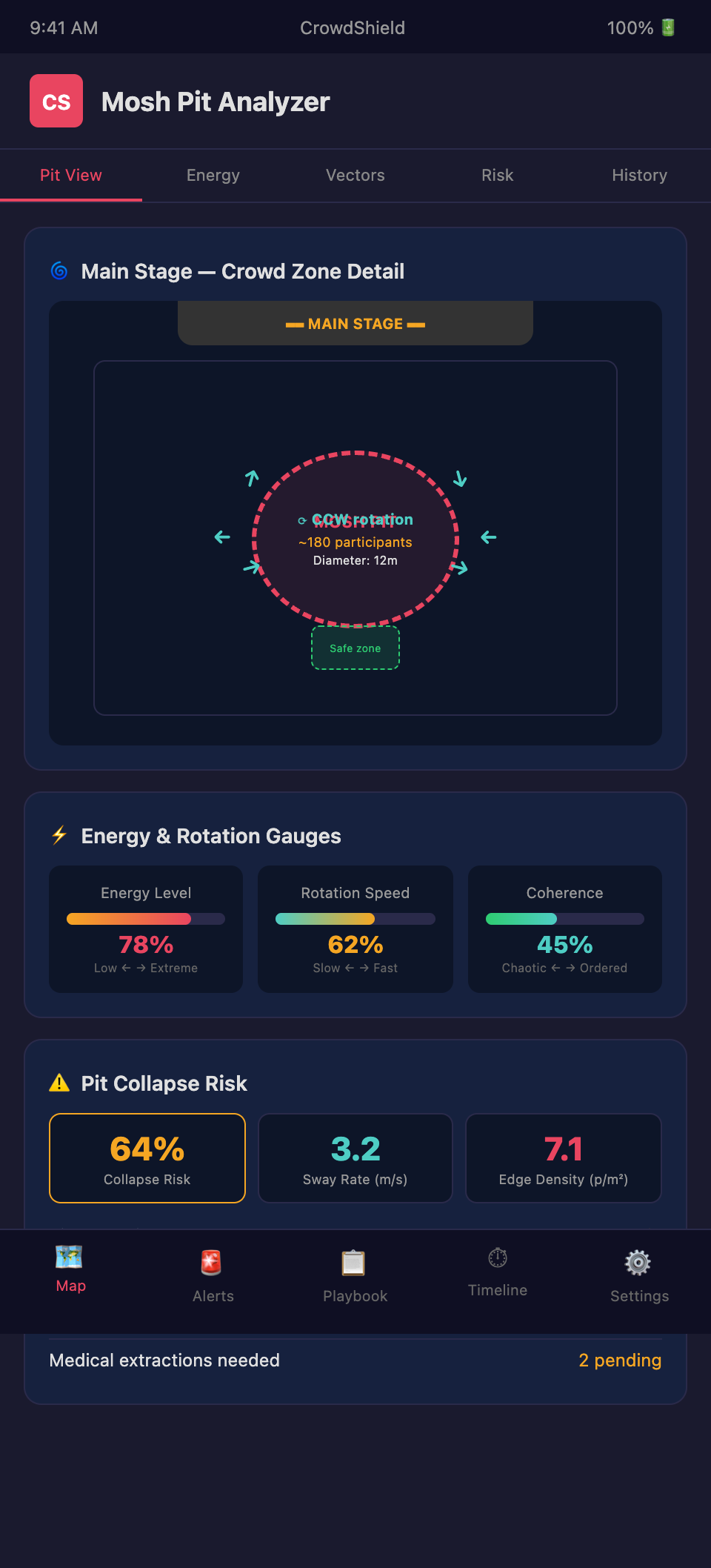
Choose-your-own-adventure pit interventions. When the system detects pre-collapse conditions, it delivers prompts calibrated to the severity of the risk:
"Main Stage Pit Zone — Pit area decreasing. Perimeter density 4.3/sqm. Movement velocity declining. Recommended actions: (A) Deploy pit stewards to reinforce perimeter and create exit lanes. (B) Request stage MC to direct crowd to take two steps back. (C) Reduce front-of-stage sound pressure to lower crowd energy temporarily. (D) Activate crowd break — insert steward line into pit to create segment division."
Option D — the crowd break — is a technique used by experienced festival security teams at European metal festivals. A line of trained stewards enters the pit, links arms, and physically divides it into two smaller sections, each of which is more manageable than the original. Spatial data tells the team exactly where to position the break line for maximum effect.
Advanced Tactics: Pre-Event Pit Planning and Genre Calibration
Effective mosh pit management starts before the festival gates open.
Genre-specific risk profiles. Not all mosh pits carry the same risk. A pit at a punk show has different dynamics than a pit at a metalcore show, which is different again from the crowd behavior at an electronic-music festival where moshing is rare but crowd surges during bass drops are common. The system should be calibrated with genre-specific behavioral models that adjust alert thresholds based on the act currently performing.
Pit zone designation. Many European festivals, particularly those with strong metal and punk lineups, designate specific "pit zones" in front of the stage with reinforced barriers, dedicated medical stations, and trained pit stewards. Spatial data from previous editions of the festival can inform the sizing and placement of these zones. The Wacken Open Air festival in Germany, which hosts 75,000 metal fans annually, is widely cited as a model for managed pit zones with low incident rates despite extremely high-energy crowds (Wacken Open Air — Safety Information).
Real-time artist communication. The most effective pit intervention is a direct communication from the artist to the crowd. When the spatial system detects dangerous conditions, the prompt chain should include an option to alert the artist's stage manager, who can request the performer to pause, address the crowd, and direct them to create space. This intervention was used successfully during multiple performances at Download Festival in the UK to halt developing crowd crush events.
For more on how crowd density thresholds interact with pit dynamics, see Managing Crowd Density at Open-Air Festival Grounds.
For an analysis of how crush develops when density exceeds survivable thresholds, see Understanding Crowd Crush Risk at Music Festivals: Lessons from Astroworld and Roskilde.
For a look at how high-energy crowd dynamics manifest in the confined spaces of nightclubs, see Understanding Crowd Density Thresholds and Aggression Risk in Venues.
Monitor Your Festival's High-Energy Zones with CrowdShield
Mosh pits are a feature of live music culture, not a bug. The goal is not to eliminate them — it is to detect the moment they shift from self-regulating to dangerous and intervene before anyone gets hurt. CrowdShield gives your security team the spatial intelligence to monitor pit dynamics in real time and the guided prompts to act decisively. Join the CrowdShield waitlist to bring science-driven pit monitoring to your festival.