Future of Robotic Cutting Systems for Bridge Superstructure Removal
From Jackhammers to Robots: What Changed on the Texas Bridge
Robotic cutting systems for bridge superstructure removal are past the proof-of-concept stage. A Texas highway bridge project documented by For Construction Pros demonstrated a 90% reduction in labor costs after substituting a Brokk remote-operated bridge cutting machine for the conventional crew that would have performed the same superstructure cutting work. As reported in the Brokk case study, the robot operated in conditions that would have required extensive worker protection systems for a human crew — confined clearance above the deck, proximity to active traffic lanes, and repetitive impact loads that create cumulative vibration exposure for human operators. The robot absorbed those conditions without modification to the structural plan.
The Conjet automated concrete removal platform is one example of the automated bridge demolition technology that is changing what bridge superstructure removal teams can accomplish within a single overnight lane closure window. A single hydrodemolition robot replaces 20 to 25 jackhammer operators for equivalent concrete removal work. At bridge deck scale, throughput rates of approximately 800 square feet per hour enable overnight demolition windows that would be unachievable with manual crews. These are not marginal efficiency gains. They are capability shifts that change what is feasible within a restricted traffic window.
The robotic demolition superstructure future includes autonomous bridge deconstruction tools that are already deployed on European deck rehabilitation and high-clearance superstructure projects. The CONEXPO coverage of electric demolition robots documents a market shift toward zero-emission robotic platforms that can operate in enclosed and low-ventilation environments — bridge box girder interiors, tunnel approach structures, and confined piers — without the exhaust management requirements of diesel-powered equipment. For bridge demolition projects in urban corridors with air quality restrictions, this operational envelope is not a feature. It is a planning prerequisite.
Scoring Robotic Operations as Precision-Tempo Measures
The Demolition Symphony Planner treats robotic cutting windows as precision-tempo measures — sections of the demolition score where cutting proceeds at high speed and high precision, but only after the structural preparation notes before the measure have been completed and verified. A robotic cutting measure does not open on schedule; it opens when every prerequisite in the preceding gate has been cleared.
Pre-Robotic Preparation — The Structural Setup Movement. Robotic cutting platforms require defined cutting planes and confirmed structural conditions before they can operate at full tempo. For deck removal, the cutting plane must be established by a structural engineer who has verified that the cut location does not intersect a load-bearing element in the current partial structure configuration. The Demolition Symphony Planner writes this verification as a pre-robotic setup note in the score — a mandatory gate that prevents the robotic measure from opening until the cut geometry has been structurally authorized. This is the same principle that governs lean scheduling pull-planning: downstream work does not start until upstream conditions are confirmed ready, as explored further in lean scheduling for bridge demolition.
Robotic Measure Notation — High-Tempo, Bounded Duration. Within the robotic measure, cutting proceeds at machine pace rather than crew pace. The Demolition Symphony Planner notates robotic measures with a distinct tempo symbol and a bounded duration derived from the equipment's documented throughput rate. For a deck section of known area, the Conjet hydrodemolition rate of 800 square feet per hour produces a predictable measure duration that can be matched to the available lane closure window. If the closure is four hours and the deck section is 2,400 square feet, the robotic measure runs exactly three hours, with one hour of buffer for setup and verification — a calculation that is explicit in the score, not estimated in conversation.
Structural Verification Gate After Robotic Measures. Hydrodemolition and high-impact robotic cutting generate vibrations that may affect the remaining structure differently than manual cutting methods. After each robotic cutting measure closes, the Demolition Symphony Planner requires a structural verification gate: sensor readings at the nearest instrumented points in the remaining structure must confirm that no anomalous response occurred during the robotic operation. Teams relying on segmental concrete bridge disassembly techniques will find this gate familiar — segment-by-segment removal always requires verification of the remaining structure's condition before the next segment cut is authorized.
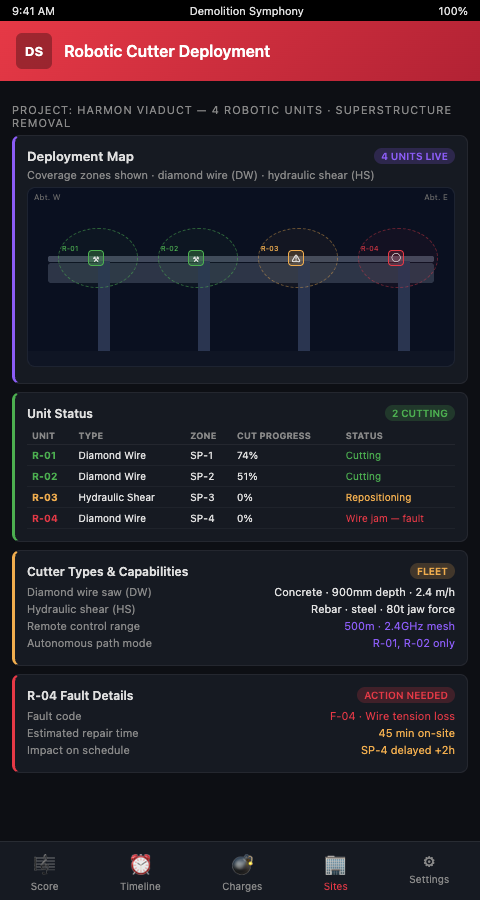
Remote Operation Radius as a Score Variable. Brokk platforms are operable from distances up to 900 feet, enabling the operator to work from a position completely removed from the cutting zone. The Demolition Symphony Planner encodes the operator standoff distance as a safety notation in the robotic measure — confirming that the operator position is outside the debris exclusion zone and that the communication link between the operator and the robot has been verified before the measure opens. This notation transforms a safety check that might otherwise be verbal into a documented gate within the score.
Advanced Tactics for Robotic Integration in Bridge Demolition
Hydrodemolition for selective deck removal in rehabilitation projects. The UHPC Solutions hydrodemolition case study documents that selective hydrodemolition — removing deteriorated concrete while leaving the reinforcing steel and structural substrate intact — supports repair cycles extending 21 to 35 years. For bridge demolition projects that involve partial deck removal as part of a deck replacement program rather than full demolition, robotic hydrodemolition enables precise removal at boundaries that manual jackhammering cannot achieve consistently. The Demolition Symphony Planner marks partial removal measures with layer-depth annotations, defining both the cutting boundary and the depth target as performance parameters for the robotic platform.
Autonomous systems and the emerging coordination challenge. The Neuroject analysis of demolition robots identifies an emerging coordination challenge: as robotic platforms gain autonomous navigation capability, the interface between machine decision-making and structural engineering judgment becomes a planning gap. A robot that autonomously selects its next cutting position based on sensor feedback may choose a cut that a structural engineer would not authorize in the current partial structure state. The Demolition Symphony Planner addresses this by maintaining human-authorized cut-plane notation as a mandatory pre-measure gate even for semi-autonomous systems — the machine's execution is automated, but the structural authorization is not.
Electric platform advantages in confined superstructure environments. Bridge box girder demolition — cutting the interior webs of a hollow superstructure from the inside — is one of the most hazardous manual demolition tasks in bridge work. Electric robotic platforms, documented in the CONEXPO electric demolition robot coverage, eliminate diesel exhaust in these confined spaces and significantly reduce the noise exposure that accumulates during extended interior cutting operations. The Demolition Symphony Planner marks confined-space measures with platform-type requirements: where air quality restrictions apply, the score specifies electric-only equipment as a pre-measure condition.
Cross-niche parallel — robotic deconstruction in complex venues. Teams managing building demolition alongside bridge work will recognize the robotic integration challenge from selective robotic deconstruction in complex venues, where robotic platforms operating in congested interior spaces require structural authorization gates identical in principle to the bridge deck application. The planning framework transfers: robotic precision is an execution advantage, but the structural sequencing logic that governs when and where the robot operates is non-negotiable regardless of the platform's capability.
What Robotic Systems Cannot Decide
Robotic cutting systems decide where to cut within a defined cutting plane. They do not decide whether the current partial structure can sustain the load redistribution that cutting will produce. That decision requires a structural engineer reading the current FEA model and the current sensor data — two inputs that no robotic platform, including semi-autonomous systems, currently integrates into its operational decision logic.
This is not a criticism of robotic systems. It is a planning requirement that the Demolition Symphony Planner addresses directly: by placing a structural authorization gate before every robotic measure, the score ensures that the decision about whether to cut is always a human engineering decision, while the decision about how to cut at maximum speed and precision is delegated to the machine. This division of responsibility is the correct operational architecture for robotic bridge demolition — not full automation, but automated execution within human-authorized structural parameters.
The boundary between machine decision-making and human engineering judgment is where the Demolition Symphony Planner's gate notation does its most important work. As autonomous bridge deconstruction tools become more capable — selecting cutting positions based on sensor feedback, adjusting throughput rates based on material resistance — the risk of the machine making a structurally unauthorized decision grows. The pre-measure structural authorization gate is not a friction point in an otherwise efficient robotic operation. It is the mechanism that preserves engineering authority over the demolition sequence regardless of how capable the robotic platform becomes.
Scoring the Machine for Maximum Tempo
Bridge and overpass demolition teams integrating robotic cutting systems into their projects gain a significant capability advantage only when the robotic operations are embedded in the demolition plan with the same structural rigor as manual operations. The Demolition Symphony Planner provides the notation framework that makes this integration explicit: robotic measures are bounded by structural gates, throughput rates are matched to traffic windows, and operator safety requirements are encoded as pre-measure conditions.
The result is a demolition plan where machine speed and structural judgment coexist in the same score. Automated bridge demolition technology that operates within the Demolition Symphony Planner's gate structure also generates the compliance documentation that equipment insurance underwriters and project owners require for robotic demolition operations. When each remote-operated bridge cutting machine cycle is preceded by a documented structural authorization gate — logged in the score with the engineer's confirmation, the cut plane specification, and the operator standoff distance verification — the project team has a complete record demonstrating that every robotic cutting operation was authorized and monitored in accordance with the demolition plan.
Try the Demolition Symphony Planner for your next robotic bridge demolition and build a plan where every automated cutting measure is bounded by human-authorized structural gates — so your bridge and overpass demolition team captures the full efficiency of robotic cutting systems for bridge superstructure removal without surrendering the engineering oversight that keeps the remaining structure standing.