Measuring Memorial Impact in Memory Care Partnerships
The Measurement Vacuum in Memory Care Bereavement
The federal government's own bereavement services report to Congress concluded that no group of bereavement services shows clear effectiveness evidence. That is a damning finding for an industry that touches every grieving family. For memory-care partnerships specifically, the vacuum is wider: the bereavement happens twice — first during the long decline, then at death — and most programs measure neither phase.
Memory-care executive directors have operational reasons to care. They are negotiating with funeral partners who compete for referral relationships, and without outcome data, the decision collapses into price and proximity. Bereavement ICU scoping reviews have identified memorial services, mementos, and storytelling as helpful to grieving families, but helpfulness is not the same as measured impact.
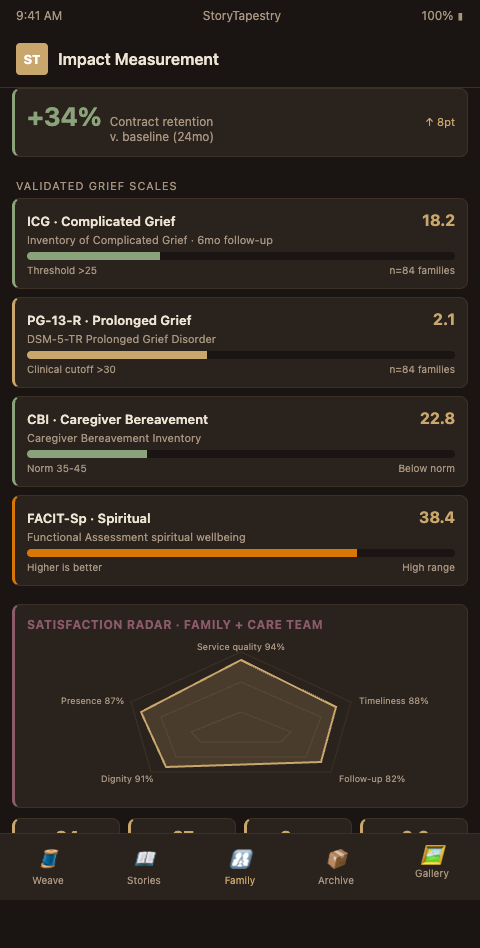
Validated instruments exist. The Inventory of Complicated Grief and the PG-13-R are established measurement instruments for prolonged grief, and a core outcome set identifies coping and wellbeing as the two dimensions families recognize as meaningful. Funeral homes that administer these instruments at 3-month and 12-month post-memorial intervals generate the data memory-care partners need for their own quality reporting. The home that produces a defensible outcomes dossier wins the partnership.
The reporting gap also has competitive implications. Memory-care administrators negotiate with multiple funeral partners per year, and when two homes are otherwise similar on price and proximity, the tiebreaker is outcome data. Homes with a quarterly outcome report — grief scale trajectories, family engagement hours, staff participation rates, contradiction resolution counts — win renewals and new contracts. Homes with "we serve families compassionately" lose to homes with numbers, regardless of how compassionate they actually are. The measurement discipline is not optional for homes that want to grow memory-care partnership volume.
The Tapestry Scorecard: From Output to Outcome
StoryTapestry treats measurement as a continuous weave rather than a post-hoc survey. The scorecard tracks four dimensions across the full relationship: fragment-collection completeness (output), family engagement during weaving (process), memorial quality (artifact), and bereavement outcome (impact). Each dimension has specific, quantifiable indicators, and the indicators feed a composite score that funeral homes share with memory-care partners quarterly.
Fragment-collection completeness measures how many caregiver, family, and community voices contributed. A tapestry with three sources is structurally thinner than one with 12. Memory-care partners care about this because it indicates whether their staff was consulted — and if not, whether a training opportunity exists. Tracking the facility-source count per decedent gives partners a tangible picture of their team's contribution to the memorial.
Family engagement during weaving captures how many hours the primary family spent interacting with the in-progress tapestry, how many contradictions they reconciled, and how many additions they made after initial intake. Research on families valuing funerals that facilitate social support maps to this metric: high engagement is not a vanity number, it is a clinical signal that the family is actively meaning-making rather than passively receiving a service.
Memorial quality requires external rating. StoryTapestry offers an optional peer-review step where a bereavement specialist — often embedded with bereavement program scaling across the partner network — reviews the final tapestry against a quality rubric: narrative coherence, fragment diversity, contradiction transparency, sensory richness. This produces a defensible quality score that protects partners from receiving low-quality output that damages their reputation.
Bereavement outcome is where validation happens. At 3 months and 12 months post-memorial, families receive short validated instruments — a brief ICG subset and selected PG-13-R items — administered with consent as part of the aftercare program. CBT shows moderate treatment effects for prolonged grief, and programs that track families into this window can refer those with elevated scores to clinical grief support rather than letting them slip into untreated complicated grief. The measurement serves the family and the partnership simultaneously.
The tapestry metaphor holds across the scorecard: each dimension is a thread, and the composite picture only becomes visible when all four threads are woven together. Programs that track only output (fragments collected) miss whether families were helped. Programs that track only impact (grief scores) miss why some memorials worked better than others. The scorecard surfaces the relationship between thread quality and tapestry outcome, which is what memory-care partners actually want to see. For comparison, diaspora engagement metrics adapt similar measurement logic to cross-cultural memorial contexts.
Cross-dimensional analytics surface deeper patterns. StoryTapestry's scorecard engine correlates fragment-collection completeness against bereavement-outcome scores across a partner's cohort, revealing which kinds of fragments (caregiver anecdotes, sensory memories, community contributions) produce the strongest grief-trajectory improvements. This turns the measurement infrastructure into a learning system: partners see not only whether their memorials worked but what specifically made them work. A memory-care facility director who learns that caregiver contributions correlate with 18% better grief outcomes at 12 months has concrete justification for investing staff time in fragment participation. The data changes the facility's internal workflow, which improves the program's inputs, which improves future outcomes. The feedback loop is the scorecard's hidden value.
Advanced Measurement Tactics
Pre-register your outcome instruments with the partner. Before launching, hand the memory-care executive director the exact ICG and PG-13-R subsets you will administer, the schedule, and the reporting format. This eliminates the "you are measuring the wrong things" objection later and positions you as a clinical-grade partner rather than a vendor. National bereavement alliance evaluation guides document which instruments hold up in partnership contexts.
Segment outcomes by cognitive stage at capture. Families whose loved one had stories captured during early-stage MCI have categorically different memorial experiences than families who started capture in late-stage dementia. Reporting aggregate scores hides this. Separate the cohorts, show the partner the difference, and you have an argument for proactive pre-decline referral that benefits both businesses.
Triangulate self-report with behavioral data. Validated grief instruments rely on family self-report, which has recall and recency bias. Complement instrument scores with behavioral indicators: how often the family returned to view the tapestry in months 1-12, how many additions they made post-memorial, how many referrals to grief support they accepted. When self-report scores and behavioral indicators agree, the measurement signal is strong. When they diverge, the divergence is itself data — often a family minimizing their distress in self-report while behaviors reveal ongoing need. Build a secondary outreach trigger for these divergent cases.
Capture staff-side data. Memory-care facility staff who contribute caregiver fragments are also grieving — residents are part of their emotional lives for years. Administering a brief staff-satisfaction instrument after memorials where staff contributed quantifies the program's impact on the facility's workforce. This becomes powerful data for the facility's retention and engagement reporting, which turns your funeral home from a memorial vendor into a staff-wellbeing contributor.
Report contradictions-reconciled as a quality indicator. Memorials with zero reconciled contradictions are usually thin — families contributed passively or the workflow collapsed disagreements. Memorials with 15-30 reconciled contradictions show active family engagement and a tapestry that honors complexity. Count them and include the count in your partner report.
Tie the scorecard to memorial partnership revenue. Memory-care partners will pay differently for programs with documented outcomes than for programs without. A tiered revenue share — base rate for all referrals, premium rate for memorials scoring above quality thresholds on the scorecard — aligns incentives across the partnership and moves the relationship from transactional to strategic.
Benchmark against peer partnerships quarterly. Aggregate anonymized scorecard data across your partner network and share relative performance back to each facility. Memory-care executives respond strongly to peer comparisons because their own boards benchmark them. A partner whose memorial program ranks third out of seven peer facilities on family engagement will invest in improvement, which improves your program for everyone.
Invest in measurement-trained staff. Administering validated grief instruments is a skill. A staff member who calls a grieving family 12 weeks after a memorial and tries to administer the PG-13-R without training will damage the relationship and produce unreliable data. Train at least two aftercare staff per branch on instrument administration, grief-response de-escalation during measurement calls, and referral pathways for families whose scores indicate clinical concern. The training cost is modest; the data-quality improvement is substantial; and families whose scores flag concern receive clinical referrals they would otherwise miss.
Publish aggregate outcomes in annual partnership reports. Once two years of scorecard data accumulate, produce an annual outcomes report that aggregates — anonymized — across all memory-care partners. This becomes a marketing artifact for new partnership conversations and a quality artifact for existing partner renewals. Memory-care facility boards, state regulators, and professional associations increasingly expect this kind of transparency from clinical partners, and funeral homes that offer it distinguish themselves from vendors that do not.
Ready to Quantify Your Impact?
Memory-care partnerships survive on measurable outcomes, not testimonials. StoryTapestry's measurement module ships with pre-loaded validated instruments, quarterly reporting templates, and integration with your existing CRM. If you are preparing for a partner renewal conversation in the next 90 days, request a scorecard audit — we will run your last 20 memorials through the tapestry scorecard and produce the partner report you need to win the renewal. The audit engagement includes a 30-minute intake call, two weeks of data extraction support from our measurement team, and a final deliverable covering four scorecard dimensions: family grief-trajectory indicators, facility staff-recognition scores, care-continuity handoff completeness, and polyphonic fidelity against reconciliation review. Firms that move forward onto the full measurement module receive instrument-administration training for two aftercare staff, a CRM integration handoff with your IT lead, and a quarterly benchmarking call against anonymized peer data.
Pilot onboarding begins within 10 business days of the audit, and the first partner-ready report is typically in your hands within 60 days. Bring your aftercare coordinator, your director of partnerships, and one facility administrator who wants to see the outcomes data — the audit call produces an action plan the three of them can execute before the next renewal meeting.