Revenue Models for Memory Care Memorial Partnerships
The Pricing Problem in Memory Care Memorials
The US funeral homes market hit $13.03 billion in 2024 with 5.92% CAGR, but the margin pressure is intense. National median funeral cost with cremation is $6,280, and baby boomers are challenging the industry by demanding less formal, less expensive memorial services. Funeral homes that depend on traditional at-need service revenue face declining average ticket values.
Dementia care creates a parallel opportunity. Dementia care costs hit $384 billion in 2025, projected to reach $1 trillion by 2050, and families paying for memory care are already in a multi-year financial relationship with care providers. Memorial work that begins during memory care — not after death — sits inside that existing spend corridor. But funeral homes typically do not bill for pre-death story work, which means they are leaving a multi-year revenue relationship on the table.
The industry's shift is already documented. Funeral homes must shift to modular pricing that unbundles services, and subscription models create recurring revenue in adjacent elder-care categories. The question for memory care memorial partnerships is not whether to adopt these models but how to combine them so the multi-year decline window produces revenue at each stage without feeling transactional to the family.
Price anchoring starts at the memory-care facility, not the funeral home. Families paying $7,000 to $12,000 per month for memory-care placement have calibrated expectations about monthly elder-care expenses. A story-preservation subscription at $60 to $80 per month sits in a recognizable range rather than requiring families to develop a new mental model for the service. Funeral homes that introduce subscription pricing cold — without the facility's implicit anchoring — encounter more sticker shock than homes whose subscription arrives as one of several monthly elder-care line items the family is already processing.
Three Revenue Threads Woven into the Tapestry
StoryTapestry supports a three-thread revenue model designed for memory-care partnerships: subscription capture, milestone services, and at-need memorial. Each thread operates independently but weaves together into a complete customer relationship across the 4-8 year dementia window.
Thread one is subscription capture. Families pay a monthly fee — typically $40-$80 — for active tapestry infrastructure during the decline. This includes quarterly interview sessions with the funeral home, ambient capture integration with the partnered memory-care facility, and ongoing threading and reconciliation as new fragments arrive. Over a five-year decline, a subscription at $60/month produces $3,600 of revenue that did not exist in the traditional funeral model.
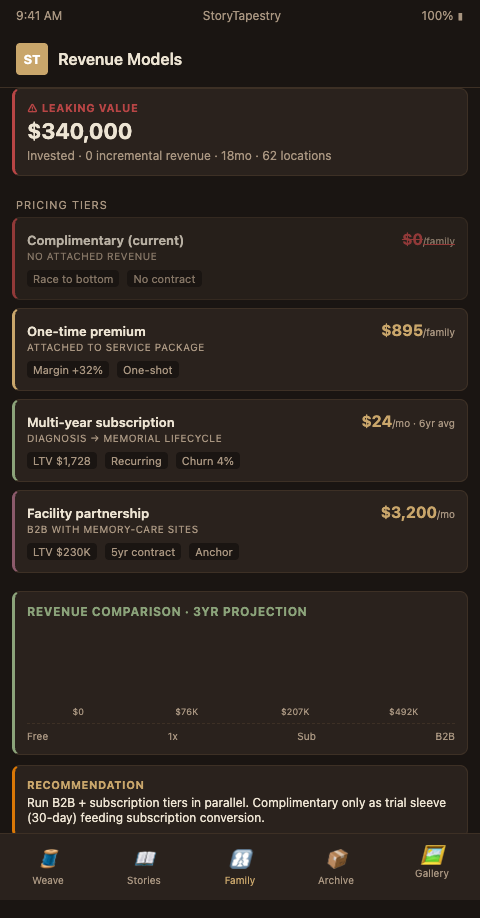
Thread two is milestone services. Specific events during the decline trigger discrete memorial work: a 70th birthday tapestry review where family gathers to add and annotate, a post-diagnosis "origin story" interview arc, a transition-to-memory-care life-summary session. Each milestone is priced $250-$900 depending on scope. Milestone events give families reasons to engage with the funeral home beyond crisis moments, and they generate revenue without requiring a death. For multi-site networks, the same logic scales across bereavement program scaling.
Thread three is at-need memorial. When death arrives, the family already has a rich tapestry. The at-need memorial service is priced on the final ceremony, reception, and tapestry presentation — not on emergency content gathering, because the content already exists. This typically prices higher than a traditional service because the memorial artifact is deeper, but the family's cumulative spend (subscription + milestones + at-need) is often less than a family that waited until death and paid a crisis-priced traditional service. Families get better memorials for less total cost; funeral homes get more total revenue per relationship.
The three-thread weave requires pricing discipline. Funeral homes that price only threads two and three cannibalize themselves. Funeral homes that price only thread one never capture the memorial-moment revenue. All three threads must coexist, each tied to distinct value delivery. Tools from other categories show the pattern: subscription models create recurring revenue in home care, meal delivery, and medication management. Dementia memorial work maps naturally.
Memory-care facility partners share in the revenue. A revenue-share agreement — typically 10-15% of subscription revenue back to the facility — turns the memory-care partner into an aligned referral source. Facilities benefit from improved family satisfaction (a tangible retention and occupancy metric) plus a modest revenue stream. Funeral homes benefit from pre-qualified referrals where the family has already agreed to engage. Building a referral pipeline between memory care and funeral services becomes sustainable when both sides are financially invested.
Partnership with veteran memorial revenue models shows parallel architectures in adjacent niches — the three-thread structure adapts to context while the underlying logic holds. In veterans' work, the "decline window" is typically shorter but the comrade-network breadth is wider, producing similar total relationship value through different thread mixes.
Per-capture pricing is the fourth thread for some families. Some families resist subscriptions but will pay for specific captures: a 90-minute structured interview at $450, an ambient-capture week during a family visit at $280, a single milestone event package at $650. Pay-per-capture is operationally heavier (no predictable monthly revenue) but it serves families who want to engage without committing to a monthly relationship. StoryTapestry tracks pay-per-capture customers as prospects for subscription conversion — after 3-4 discrete captures, families often see the value and convert. Treating pay-per-capture as a funnel rather than an endpoint improves conversion to higher-LTV subscription relationships.
Advanced Revenue Model Execution
Price subscription tiers by capture intensity, not tapestry depth. Families who want quarterly interviews plus ambient capture pay more than families who want only quarterly interviews. Do not price by "basic/standard/premium" tapestry quality, which creates two-tier services families resent. Tiering on inputs (how much capture is active) rather than outputs (how good the memorial will be) feels fair and motivates upgrade behavior.
Offer subscription pause, not cancellation. When a family encounters a financial crunch, let them pause subscription capture for 1-3 months rather than canceling. Active capture pauses (no new interviews, ambient capture disabled), but the existing tapestry remains accessible and active for viewing and family comment. Pause behavior preserves the relationship; cancellation rarely comes back.
Bundle milestone services into annual prepay. Families who prepay 12 months of "milestone credits" get a modest discount and predictable engagement. This smooths revenue for the funeral home and gives the family permission to engage more than they might otherwise. A $3,000 annual milestone prepay covers one interview arc, one milestone gathering, and two family review sessions — all events the family would otherwise put off.
Build at-need pricing transparency. Because the family has been paying subscription and milestone revenue for years, the at-need price needs clear justification: ceremony, venue, final memorial production, tapestry printing and projection for the service. Show the line items. Families who have paid $3,600 in subscription plus $2,400 in milestones over five years will balk at a $9,000 at-need bill unless the justification is concrete. Families with a long relationship history also notice pricing inconsistencies across years, so build in annual pricing-review communications to prevent at-need surprise.
Structure the memory-care revenue share to support specific facility needs. Rather than a pure percentage, offer facilities a choice: 15% cash, 12% cash + free training for staff, or 10% cash + sponsored family events. Facilities that need training will take option two; facilities needing family engagement tools take option three. This makes the partnership a strategic tool for the facility, not only a revenue stream.
Track lifetime customer value per memory-care partner. Report to partners quarterly what total revenue their referrals generated and what share flowed back to them. Transparency builds trust, and partners who see concrete numbers renew contracts more reliably. For bereavement program scaling networks, this reporting becomes centralized infrastructure.
Plan for subscription churn patterns that look different from SaaS. In dementia memorial work, subscription "churn" usually means either death (conversion to at-need revenue) or family abandonment of capture. Families who abandon are signaling the program is not working for them — that is a diagnostic moment, not a lost customer. Survey abandoners within 30 days to improve the program.
Segment pricing by facility partnership tier. Families referred through a high-engagement memory-care facility (where staff actively support fragment contribution and ambient capture is running) receive one price. Families referred through a low-engagement facility or arriving without a facility referral receive a higher price because the funeral home is doing more of the capture work alone. This incentivizes facility partners to increase their engagement — their families save money, the facility sees families treating them better, and the funeral home sees richer tapestries. Transparent tiered pricing turns the incentive structure into a flywheel.
Restructure Your Revenue Model
Complimentary dementia bereavement programs undercharge for real clinical value. StoryTapestry's revenue infrastructure supports subscription, milestone, and at-need billing natively, with memory-care partner revenue-share tracking built in. Request a revenue-model audit — we will map your current memory-care partnership revenue, project what the three-thread model would produce over 36 months, identify the three partnership agreements you should restructure first, and share comparable data from peer funeral homes already running the model so your projections are grounded in actual outcomes. The audit engagement runs two weeks, requires five hours of your team's time across two working sessions, and produces a pricing tier map, a revenue-share schedule tuned to your partner engagement data, and a renegotiation script for each of the three priority partnership conversations.
Firms that move forward receive a 60-day implementation where our revenue operations lead configures the billing platform, trains your office manager on milestone invoicing, and sits in on the first partner renegotiation call. Pilot contracts include revenue guarantees tied to baseline tapestry-completion metrics, so you see measurable returns before the first subscription billing cycle closes. Most firms book their first restructured partnership renewal within 45 days of audit completion. Bring your owner or general manager, your office manager, and your partnership lead — the audit call produces a board-ready revenue deck the three of them can present to their peers that week.