Building a Referral Pipeline Between Memory Care and Funeral Services
The Brochure Strategy That Does Not Work
Memory-care referral outreach typically starts wrong. A funeral director compiles a list of facilities, mails brochures, and hopes for the phone to ring. Hospice-funeral partnership literature documents how one-way marketing fails to build the trust required for clinical referrals, and the same pattern applies in memory care. Facility administrators do not refer to vendors; they refer to partners whose clinical judgment they trust.
The industry has better blueprints. Home care agencies built referral pipelines around healthcare providers and discharge planners as primary referral sources, with dedicated relationship-management roles. Hospice-funeral partnerships that use a dedicated point person to build trust with hospice teams produce referrals in volume that brochure campaigns cannot match.
The structural challenge in memory care is longer. A hospice referral to a funeral home typically happens weeks before death; a memory-care referral may happen years before. The funeral home is investing in a relationship that will not produce a funeral for 24-60 months. Brochure marketing has no financial model for this. Protocol-based partnerships do — if they are built around bidirectional value, not one-sided vendor pitches.
Facility administrators carry institutional memory of failed funeral partnerships. A memory-care director with 15 years of experience has been approached by 40 or more funeral home sales visits, has tried 4 or 5 partnership arrangements, and has watched most of them collapse when the funeral home's liaison left or stopped showing up. Administrators enter new partnership conversations skeptical, and for good reason. Funeral homes that want to win these partnerships need to lead with structural commitments — documented liaison backup plans, multi-year contract terms, measurement reporting cadence — that acknowledge the failure history and differentiate the proposal from the patterns that burned the administrator previously.
The Referral Tapestry: Threads Between Two Care Systems
StoryTapestry's referral infrastructure treats the memory-care-to-funeral-home pipeline as a tapestry of relationships rather than a single handoff. Four threads run through every partnership: the administrator relationship, the social-work relationship, the family-facing touchpoint, and the post-death aftercare loop. Each thread produces different referral signals at different times in the resident's decline.
The administrator relationship is the strategic layer. Memory-care administrators make the contract-level decision about which funeral home becomes the facility's default bereavement partner. They care about family satisfaction scores, survey data, and reputational risk. The funeral home's approach should be partnership-grade: quarterly business reviews, shared outcome reporting (drawing on memorial impact measurement work), and documented response times for at-need calls.
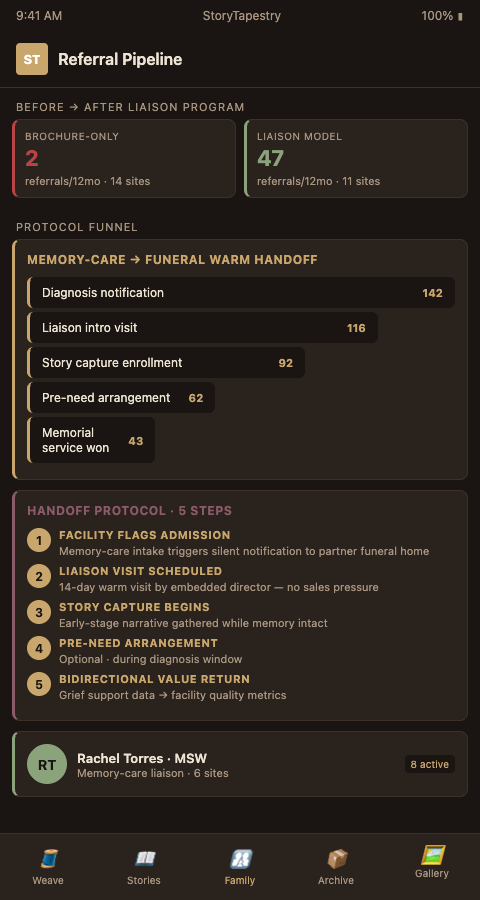
The social-work relationship is the clinical layer. Memory-care social workers and grief-support coordinators know which families are anticipating loss, which are in crisis, and which need pre-decline story capture support. They are the hospice-equivalent warm-handoff source for memory-care memorial work. A funeral home that invests a dedicated liaison — the way hospices have volunteer coordinators — into monthly facility visits, case reviews, and cross-training sessions earns the social worker's trust. Collaborative relationships require ongoing education, which becomes the liaison's structural job.
The family-facing touchpoint is the engagement layer. Families visiting memory-care facilities often encounter the funeral home indirectly — through a posted tapestry sample, a pre-planning brochure in the family lounge, or a monthly "life story" workshop the funeral home hosts at the facility. This is not traditional marketing. It is contextual presence that makes the funeral home familiar to families before any referral happens. By the time the social worker suggests the funeral home, the family has already seen the tapestry artifact in the facility's family room.
The post-death aftercare loop closes the tapestry. Aftercare conducted at the facility — a memorial moment for staff who cared for the resident, a follow-up with the family that also leaves tangible artifacts for the facility's own reflective practice — keeps the funeral home present in the facility's ongoing life. This is where warm handoff timing from hospice to funeral home principles adapt to memory care: the handoff does not end at death, it loops back into the facility's community.
Tool support matters. LeadingResponse's preneed multichannel marketing reaches 5M consumers 55+ monthly with 4x conversion rates when paired with partnership infrastructure, and memory-care referral pipelines benefit from similar marketing-automation support behind the relationship work. The marketing does not replace the relationship; it amplifies it.
Adjacent referral networks deserve attention. Elder law attorneys and geriatric care managers drive senior leads who overlap with memory-care families. Funeral homes serving memory-care populations benefit from cultivating these adjacent sources alongside direct facility relationships. Cross-sector referral pipelines improve volume and create partnership redundancy when any single relationship weakens.
The same clinical-referral logic applies in parallel contexts. OB unit funeral referrals in perinatal loss programs follow similar protocol-based handoff structures, with different timing and clinical contexts but identical partnership architecture.
Measurement is the trust artifact that keeps partnerships alive. A memory-care administrator renewing the annual partnership contract wants to see family-satisfaction data, care-team engagement metrics, and grief-outcome trajectories. Funeral homes that bring the StoryTapestry scorecard to renewal conversations — already packaged as a facility-specific dossier — shift the conversation from "should we continue this relationship" to "should we expand it." Facilities that see concrete outcome data are more likely to grant additional access (participation in resident life reviews, inclusion in family conferences, presence at admission orientation) that deepens the partnership and the pipeline.
Advanced Referral Pipeline Tactics
Dedicate a named liaison to each memory-care partnership. The liaison is not a salesperson; they are a relationship architect who handles everything from intake coordination to aftercare follow-up. One liaison per 8-12 partner facilities is a workable ratio. Funeral homes that spread the liaison function across all directors dilute the facility's sense of a committed relationship and lose partnerships to competitors with dedicated roles.
Build a protocol playbook with each facility. The playbook specifies: who the liaison's counterpart is at the facility, how pre-decline story-capture referrals happen, what the warm-handoff workflow looks like at decline events, how at-need response is triggered, and what aftercare touchpoints occur post-funeral. Memory-care administrators receive these playbooks from licensed care vendors routinely and will respond well to a funeral partner treating the relationship at the same operational level.
Co-produce family education content with the facility. Host quarterly "life story preservation" workshops at the facility, co-led by the funeral liaison and the facility's social worker. This is better than traditional pre-need seminars because the content is genuinely relevant to families in active memory-care engagement. Workshop attendance produces subscription capture conversions, which supports the polyphonic storytelling workflow that memory-care memorials depend on.
Track referral quality, not only referral count. Count referrals is a trap. Track referral conversion to subscription engagement, milestone service, and at-need memorial. A facility that produces 15 referrals per year where 12 engage with subscription capture is more valuable than one producing 40 brochure-inquiry "leads" with 2 engagements. Report referral quality back to the facility quarterly.
Invest in cross-training for facility staff. Memory-care CNAs and social workers who understand what the funeral home offers will refer better. A 90-minute cross-training covering cognitive-sensitive interview techniques, tapestry workflow, and aftercare scope gives them vocabulary to recommend the service to families during vulnerable moments. Staff cross-training also improves the fragment quality when staff contribute directly to tapestries.
Create bidirectional referral flow back to the facility. Funeral homes serving multiple facilities sometimes encounter families whose loved one is not yet placed in memory care. Refer appropriate families to partner facilities for memory-care tours. This bidirectional flow changes the facility's calculus — you are not only a bereavement vendor, you are a referral source for their occupancy pipeline. Homesteaders Life documents how partnerships provide continuum-of-care via cross-referrals in hospice contexts; the logic transfers.
Institutionalize the relationship beyond the liaison. Key-person risk is real. If the liaison leaves, the partnership should survive. Document relationships, protocol history, and family cohort notes in a partnership CRM that the facility and the funeral home both access. Succession plans for liaison roles are part of mature partnerships.
Use events to deepen relationships, not only to generate inquiries. An annual "memory-care professionals appreciation" evening — hosted by the funeral home for the partner facilities' front-line staff, with clinical CE credit attached — does more for the referral pipeline than twelve months of direct marketing. Staff who attend remember the experience, reinforce their positive associations with the home, and become informal ambassadors when families ask them for memorial guidance. These events are not lead-generation; they are relationship investments that pay back over the following 18-36 months through organic referral flow.
Build Your Memory-Care Referral Pipeline
Brochures and email campaigns produce the referral numbers you are currently seeing. Partnership infrastructure produces categorically better numbers. StoryTapestry's partnership module includes liaison workflow templates, co-branded family education materials, administrator-facing measurement dashboards, and the broader infrastructure memory-care facilities expect from mature partners. Request a partnership starter kit and we will include the protocol playbook template that winning funeral homes are using with 4-6 facilities per liaison, plus the administrator-conversation guide for turning your next facility outreach into a signed partnership agreement. The kit arrives within three business days and includes the liaison onboarding curriculum, a protocol handbook with 14 documented workflows, a CE-credit event template for staff appreciation nights, and a facility-readiness scorecard that tells you which partners to approach first.
Funeral homes that move forward receive a 90-day partnership pilot with one dedicated liaison coach, two co-branded education sessions hosted at partner facilities, and an administrator-panel briefing where our partnership lead supports your director through the renewal conversation. Pilot engagements typically yield signed partnership agreements with three facilities inside 120 days and measurable referral volume growth by month six. Bring your director, your designated liaison, and one facility administrator willing to co-design the pilot — the starter kit conversation produces a 90-day action plan the three of them can execute together.