The Case for Polyphonic Storytelling in Dementia Memorials
Why Single-Voice Memorials Misfire for Dementia Loss
Dementia is structurally different from other losses because the grief is unique due to ambiguous loss across years of decline. The person is gone and not gone. Caregivers hold a different decedent than grandchildren. The dry-cleaner employee holds a different decedent than the hospice nurse. A single-voice obituary read at the memorial will resonate with one of these witnesses at the cost of all the others.
The literature on grief therapy as meaning reconstruction through reauthoring life narratives points to why this matters: memorial work is not only documentation, it is active meaning-making for the bereaved. When a family receives a memorial that centers one voice, the other bereaved stakeholders walk away without having participated in the meaning-making. The memorial becomes a ceremony done to them rather than with them.
Polyphonic storytelling has theoretical roots. Bakhtin's concept of polyphony describes multiple independent voices existing in a text without being collapsed into a single authorial voice. Applied to memorials, polyphony means the decedent is constructed from multiple simultaneous accounts, each preserving its own perspective and internal logic. The family does not receive a compressed "official" version — they receive a polyphonic artifact that honors the fracture dementia created.
The alternative is what most funeral homes already produce: a single-voice obituary, typically written by one family member or the funeral director from an intake interview, read at the service, and printed in the program. This format arose from newspaper-era constraints — column inches, editorial voice, single-author conventions. Those constraints no longer apply. Digital memorial artifacts have no column limits, no single-author requirements, and no structural reason to compress a decedent's many relationships into a single third-person summary. The persistence of single-voice obituaries is a legacy-format habit, not a reflection of what grieving families need.
Polyphony as Tapestry Architecture
StoryTapestry's polyphonic workflow treats each contributor's voice as a preserved thread rather than raw material to be averaged. The final memorial artifact contains multiple simultaneous storylines — the spouse's story, the children's stories, the caregivers' stories, the community's stories — woven into a tapestry where attendees can follow any thread they choose rather than consuming a single narrative in order.
Research on collaborative storytelling in grief documents how telling stories alongside others revitalizes connection with the deceased. The study finding matters structurally: connection-revitalization happens when contributors see their voice preserved in the final work. Crowdsourced memorials create truer multifaceted portraits for the same reason — nobody is overwritten, so everyone is present.
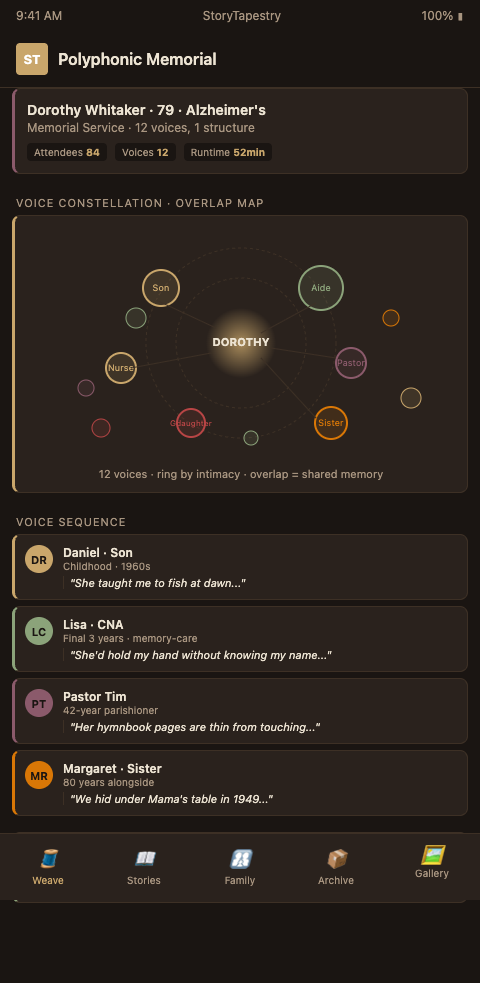
The tapestry metaphor becomes literal here. Imagine a memorial where the spouse's thread runs chronologically through 54 years of marriage, the children's threads branch off at specific decades, the caregivers' threads cluster densely in the last five years, and the community threads appear as cross-cutting horizontal weaves. Attendees visit the tapestry and choose which thread to follow first. The decedent exists as a constellation of simultaneous selves, not a compressed biography.
Review of life story book interventions confirms that multi-contributor voices improve autobiographical memory outcomes. StoryTapestry extends this finding from therapeutic use to memorial use: the artifact that was good for the living person is also good for the bereaved community. The structural work — collecting fragments from many sources, preserving each voice, threading without flattening — transfers directly from life-story therapy to polyphonic memorial.
Lucid episodes complicate and enrich the polyphony. A scoping review of dementia lucidity found 34 lucid episodes across 25 of 30 caregivers, meaning many late-stage patients have discrete moments of narrative self-presence that caregivers remember vividly. These moments — a grandmother naming her grandchildren correctly one Sunday, a veteran recalling his unit one afternoon — deserve their own thread in the polyphonic tapestry. They are neither "the decedent's true self" nor "the dementia self" — they are singular occurrences that the memorial preserves alongside other threads.
The fragmented source case study reconstruction of Margaret's 40-year life shows polyphony in action: 12 sources produced distinct voices that, in the final memorial, remained distinct. The employee Luis's thread ran parallel to the daughter Sarah's thread and the priest's thread; they intersected at specific points (the Christmas-gift tradition, the funeral of Margaret's husband) without collapsing. AI narrative threading made this structural preservation tractable at scale.
Polyphonic memorials connect across cultures too. Similar architecture applies to transnational families where voices span languages and continents. The underlying principle — that the decedent is reconstructed through multiple preserved voices rather than compressed into a single narrative — adapts across memorial traditions while respecting their distinct cultural specifics.
Polyphony also handles the care-staff bereavement that single-voice memorials systematically erase. A memory-care aide who cared for a resident for three years often has stronger late-stage memories of the resident than any family member who visited monthly. In a single-voice memorial, that aide's experience is footnoted or absent. In a polyphonic memorial, the aide's thread sits alongside the family threads as legitimate memorial content. This matters for the aide's grief processing and for the memorial's truthfulness. The person who fed the resident, brushed her hair, sang to her during sundowning, and held her hand on the night she died is part of who the resident was in her final years, and erasing that presence falsifies the memorial.
Advanced Polyphonic Design Choices
Give each thread a distinct visual and auditory identity. In the final memorial artifact, the spouse's thread should look and sound different from the caregivers' thread. Color coding, typography, audio recording voice — differentiate them so attendees perceive the polyphony immediately rather than needing to decode it. This seems aesthetic but it is structural: if threads look identical, the memorial collapses into a single voice visually even when it is plural in content.
Let threads contradict in the final artifact. The daughter's memory that "she was a strict mother" and the sibling's memory that "she was the family softie" should both appear, each in its own thread, without reconciliation in the presentation layer. Reconciliation happens during family review (reconciling meaning is different from reconciling away contradiction). The polyphonic memorial preserves the contradictions because they are real to the bereaved — forcing resolution erases someone's experience.
Invite post-memorial thread additions. The tapestry does not end at the service. Attendees who remember something during the service can add to threads after. Former colleagues who could not attend can contribute remotely. Grandchildren too young to contribute at the service can add as they grow older. The polyphonic memorial is perpetually extensible, which matches how grief and memory actually work — they revisit and accumulate over decades.
Offer family-curated thread hierarchies. Some families want all voices equal. Some want the spouse's thread centered with others as supporting. Both are valid, and the family should choose. Do not impose a "correct" polyphony structure. The curation decision is itself meaning-making work for the family, and locking it down prematurely interrupts the meaning-making.
Record the caregivers' grief alongside the content. Memory-care staff who participate in polyphonic memorial work are themselves bereaved. Let their thread include not only memories of the resident but also acknowledgment of their relationship with the resident ("I cared for her for 23 months; she taught me to braid my daughter's hair the way her mother taught her"). This honors their loss and surfaces dimensions of the decedent that staff alone hold.
Design the memorial experience as thread navigation, not linear presentation. Traditional funeral services have a linear order: eulogy, music, scripture, closing. Polyphonic memorials can follow this structure superficially while the real artifact is a navigable tapestry that attendees engage with at the reception, through a projected interactive display, or via a post-service digital handoff. The service is a moment in the tapestry, not the tapestry itself.
Measure engagement by thread depth, not attendance. A polyphonic memorial with 40 attendees where 32 of them added their own annotation to a thread is more successful than one with 200 attendees who received the artifact passively. Track this. Report it to families three months later. Families who see their memorial as an active artifact continue engaging with it — and with the funeral home — for years.
Plan for multigenerational audiences. A polyphonic tapestry built today will be visited by grandchildren and great-grandchildren 30 or 50 years from now. Design the artifact for that timescale: stable URLs, format independence, and documentation of contributors that will still be readable to descendants who never met any of the voice holders. The 9-year-old great-granddaughter who opens the tapestry in 2068 should find voices of people she never met, clearly attributed, with context that situates them in the decedent's life. This is the memorial infrastructure dementia families deserve — not an obituary that will disappear with next year's website migration. The same multigenerational design discipline underpins polyvocal diaspora memorials for transnational families whose descendants may one day want to hear voices that spoke languages their grandchildren no longer fluently share.
Weave Your First Polyphonic Memorial
Dementia memorials deserve the structural honesty that single-voice obituaries cannot deliver. StoryTapestry's polyphonic workflow ships with contributor-onboarding templates, thread-visualization tools, and the AI threading infrastructure that preserves voice distinctness across dozens of sources. Request a polyphonic demonstration — we will walk through a completed memorial so you can see how three caregiver voices, four family voices, and two community voices coexist in the final tapestry without collapsing into each other. The demonstration runs 45 minutes and covers contributor onboarding, voice-distinctness scoring, thread navigation from the visitor side, and the multigenerational URL durability stack that keeps the artifact accessible 30 years out. Firms that move forward receive a 60-day pilot on one polyphonic case, platform access for your two lead directors, and a named polyphonic specialist who supports your first contributor-outreach round.
The pilot includes a contributor-engagement report showing which voices surfaced, which threads deepened through annotation, and which audience segments returned to the tapestry in the first month. Most firms complete their first polyphonic memorial within 45 days of pilot start. Bring your director, your aftercare coordinator, and one family advisor willing to be your first polyphonic case's family liaison — the demonstration call produces a contributor-outreach plan the three of them can activate inside two weeks.