Why Polyvocal Memorials Resonate More in Diaspora Communities
Why Single-Voice Memorials Fall Short for Diaspora Families
A Ghanaian-Canadian woman passed away in Montreal. Her children commissioned the funeral home's standard obituary — 380 words, single-author voice, published in the local paper. Her sister in Accra read the English text via a relative's forwarded email and wept, not from grief but from recognition of what was missing. The obituary described a woman she barely knew. A single voice, written in a single language, from a single vantage point, could not hold the woman their community had lost.
The academic grounding for polyvocal memorial work is robust. Wikipedia's entry on Bakhtin's polyphony in literature defines polyphony as a plurality of independent voices that do not collapse into a single authorial perspective — the exact structural problem single-voice obituaries cannot solve. PMC research on social media narratives of diasporic identity documents how social media already empowers multi-voice diaspora storytelling in daily life; memorial practice has lagged. arXiv research on collective memory in Palestinian oral histories applies Halbwachs' group memory framework to diasporic remembrance, showing how memory is socially constructed across voices.
Ethnographic studies confirm the pattern. ResearchGate ethnographic research on culture and grief documents ritual, relationships, and remembering as collective practices across cultures. UNESCO's work on oral traditions and expressions identifies migration as a direct threat to oral tradition continuity — a pressure that only polyvocal documentation addresses. Britannica's entry on the griot tradition preserves a model: West African griots preserve multi-voice oral traditions across generations. And Pew Research data on ancestor veneration across East Asia shows that remembrance practices across cultures center on collective, not individual, memory.
A Polyvocal Tapestry Framework
The tapestry metaphor matches polyvocal memorials exactly: many threads from many weavers, no single voice dominating, a visible whole where each thread keeps its source identity. StoryTapestry is built to support polyvocal memorials through five design principles that elevate chorus over single-author narration.
Principle 1: Preserve speaker attribution. Every contribution in the tapestry carries its contributor's identity — not buried in metadata but visible in presentation. A story about the decedent's 1985 migration is attributed to the cousin who told it; a different story about the same migration told by the decedent's brother is attributed to him. The tapestry does not merge them into a single account; it presents both, with attribution.
Principle 2: Maintain language-of-telling. When a contributor tells a story in Igbo, the Igbo version remains accessible alongside any translations. Translations are presented as translations, not as replacements for the original. Readers can toggle to the original. This preserves what Bakhtin calls the utterance — the fact of a speaker saying something in a particular way — rather than flattening into an editorial voice.
Principle 3: Allow contradictions. Two contributors may remember the same event differently. The tapestry holds both versions rather than forcing resolution. An uncle's recollection of the 1972 move from Kingston may differ from a sister's; the tapestry displays them side by side. This matches how memory actually works in families and builds trust with contributors who would otherwise feel their version was being suppressed. This principle shares structural DNA with multi-perspective grief healing practice, where honoring diverging perspectives supports grief processing.
Principle 4: Surface the diaspora breadth. A map or diagram shows the contributor set at a glance — how many voices, from how many countries, in how many languages. This is the tapestry-from-above view. Readers see the breadth before they engage with individual threads. This requires the cross-cultural grief training infrastructure to support all those voices with appropriate care.
Principle 5: Make the whole feel like the family's, not the platform's. The memorial carries the decedent's name, the family's aesthetic choices, and the contributors' voices. StoryTapestry is the loom; the family is the weaver. The platform's branding is secondary to the memorial's identity. This is ethical design as much as it is marketing; extractive memorial platforms that foreground their own brand diminish the memorial.
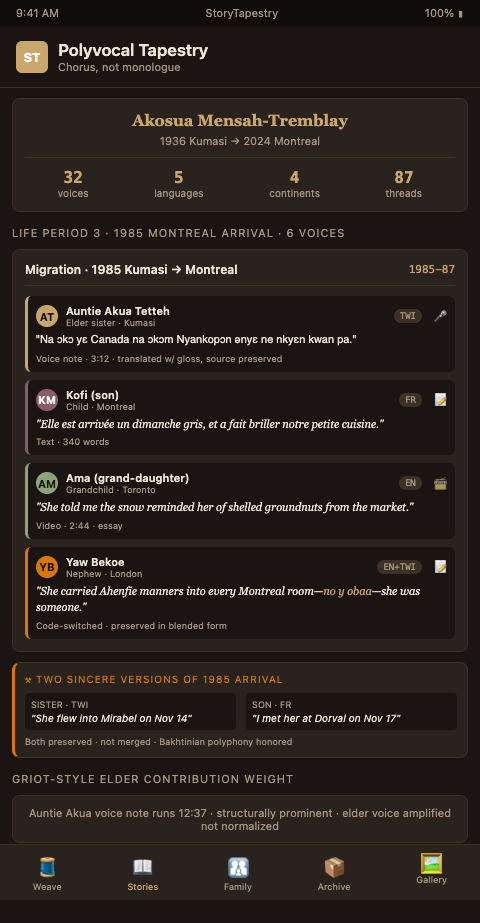
The tapestry works for diaspora memorials because diaspora identity is itself polyvocal. A diaspora person lives inside multiple languages, multiple cultural contexts, and multiple interpretive communities simultaneously. Collapsing their memorial into a single voice misrepresents who they were. A multi-country case study from earlier in this niche shows what this looks like in practice — 41 contributors across 8 countries, each voice preserved.
The polyvocal architecture also addresses a specific harm single-voice memorials cause in diaspora communities: the erasure of contributor identities whose voices do not match the dominant language or cultural register. When a Ghanaian-Canadian matriarch's memorial is produced as a single-voice English obituary, the monolingual English-speaking grandchildren see their grandmother accurately, but the Akan-speaking great-aunts in Kumasi see a woman they barely recognize. The memorial has preserved the part of her that was legible in English while erasing the part that lived in Akan. Polyvocal design rejects this sacrifice. Every voice that knew her keeps its place. The Akan great-aunt's voice note in Twi sits alongside the English grandchild's essay, both attributed, both accessible, neither subordinated.
The tapestry does not ask the family which version of the deceased to preserve; it preserves all of them, and lets readers engage with whichever threads speak to them. This is the structural answer to diaspora grief, and it distinguishes polyvocal memorial design from simple translation features that merely render one dominant narrative into multiple languages.
Advanced Tactics for Polyvocal Memorial Design
Six tactics separate polyvocal memorials that resonate from those that overwhelm:
Structure by life period, not by contributor. Display the tapestry organized by periods of the decedent's life, with multiple contributor voices appearing within each period. This lets a reader move chronologically while encountering polyvocal structure organically. Structuring by contributor forces readers to pick a "best" voice, which defeats the point.
Limit each contribution's display length. Long contributions suppress the polyvocal effect. A 2,500-word contribution crowds out shorter voices. Cap primary display at 250-400 words per contribution, with a "read more" expansion for longer pieces. This preserves variety in the visible tapestry.
Include audio and video alongside text. A three-minute voice note from an elder in Bangladesh brings a polyvocal memorial to life in a way no transcribed text can match. Build the platform flow to encourage audio-video contribution, not as an afterthought but as a first-class option. Audio contributors tend to share 2-3x more raw content than text contributors.
Invite griot-style elder contributions. The oldest generation often holds the richest stories but is least comfortable with self-directed contribution. Designate a family member to conduct elder interviews and upload them as elder-attributed contributions. Honor the tradition Britannica describes for griots by making elder voices structurally prominent in the tapestry.
Resist editorial smoothing. The temptation to smooth out contradictions, clean up language, and produce a "publication-ready" memorial is strong. Resist it. The memorial's power comes from its roughness and its multiplicity. Editorial smoothing homogenizes; the diaspora family will feel the loss.
Produce a polyvocal eulogy for the live service. Weave short quotations from multiple contributors into the eulogy read at the service, attributed to each speaker. This renders the polyvocal principle into the live ritual. The family hears many voices speak at the service, not one official voice.
Archive by contributor identity for future generations. A grandchild in 2060 should be able to find every contribution their specific grandparent made. Structure the archive so contributor identity is a first-class index, not only a metadata tag.
Design invitation language to signal that many voices are wanted. Standard funeral home outreach often asks for one or two paragraphs of memories, implicitly framing contribution as a chore to be completed briefly. Polyvocal invitations explicitly invite variety: a voice note, a short video, a photograph with a caption, a recipe, a song the decedent loved. Framing contribution as multimodal and varied produces polyvocal material naturally, where framing contribution as text-paragraph-only produces flattened, uniform submissions. The language of the invitation shapes the material the family receives.
Use cross-contributor prompting to surface conversation rather than isolated testimony. Rather than asking each contributor to answer the same generic prompt in isolation, surface previously submitted contributions and ask the next contributor to respond, add to, or differ with what has come before. "Your cousin in Sydney remembers your grandmother's 1985 visit to Manila this way; what do you remember?" This conversational framing produces richer, more layered polyvocal material than parallel isolated submissions, because contributors engage with each other's memories rather than producing standalone testimonies.
Treat the live service as a polyvocal event, not a single-voice performance. The memorial service itself should reflect polyvocal principles: multiple speakers rather than one eulogist, multilingual readings rather than single-language programs, music from different cultural traditions rather than one uniform soundtrack. The service becomes an embodied version of the tapestry, where the family experiences polyvocality as a lived event before they receive the digital archive. Funeral directors who adapt the live service in this direction consistently report that families experience the service as more authentic and more comforting than single-voice traditional formats.
Take the Next Step
StoryTapestry builds polyvocal memorial infrastructure because diaspora families deserve memorials that hold the full chorus of voices that knew their loved one. If your current memorial practice produces single-voice obituaries and funeral programs even for families with scattered communities, we will work with you on a polyvocal pilot — one case, co-designed with our platform team and your most transnational family. The pilot costs nothing beyond the standard Tier 2 package pricing; you pay for the memorial and we invest the design time. Contact our platform team to propose a pilot case. The pilot includes invitation language design, contributor prompt sequencing, cross-contributor conversation surfacing, speaker attribution infrastructure, language-of-telling preservation, and archive-by-contributor-identity indexing. We work alongside your coordinator throughout the case so you learn the polyvocal design mechanics hands-on rather than through an abstract training session.
Funeral services that complete the pilot typically adopt polyvocal design as their default transnational memorial format, because the difference in family response between single-voice and polyvocal memorials is large enough to be immediately visible at delivery and for months afterward. Your diaspora families come to you with multi-voice, multi-language, multi-perspective lives; your memorial practice should meet them where they live rather than forcing them into single-voice formats designed for monocultural contexts. Contact our platform team to propose your pilot case.