Why Multi-Perspective Infant Memorials Aid Long-Term Grief Processing
The Hidden Harm of Single-Perspective Infant Memorials
A grief counselor at a regional bereavement center noticed a pattern across the families she supported 18 to 36 months after infant loss. Mothers who had built memorials as solo projects, often curating a scrapbook or a memorial website alone, showed different trajectories than mothers whose memorials had included contributions from partners, older children, grandparents, and sometimes clinical staff. The solo memorial families often described feeling isolated in their grief even while their extended families grieved alongside them. The multi-perspective memorial families described a sense of shared holding.
The CDC stillbirth data documenting approximately 21,000 stillbirths annually, one in 175 births establishes the scale of families affected. The NICU parents long-term emotional health research documenting depression, anxiety, and PTSD risk establishes that grief trajectory shapes decades of family wellbeing. The systematic review on continuing bonds associated with adaptive bereavement confirms that relationships with the deceased continue in healthy mourning, and those relationships are plural rather than singular.
Single-perspective memorials reflect an older cultural assumption: grief is private, personal, and primarily owned by the mother. Modern bereavement research overturns this assumption. The family-centered approach research engaging partners, siblings, and grandparents confirms that whole-family engagement produces better outcomes than mother-focused memorialization alone. Yet memorial infrastructure has not caught up with research. Most commercial memorial products target mothers as primary customers and treat other family members as audience rather than contributors.
The StoryTapestry Framework for Multi-Perspective Grief Tapestry Construction
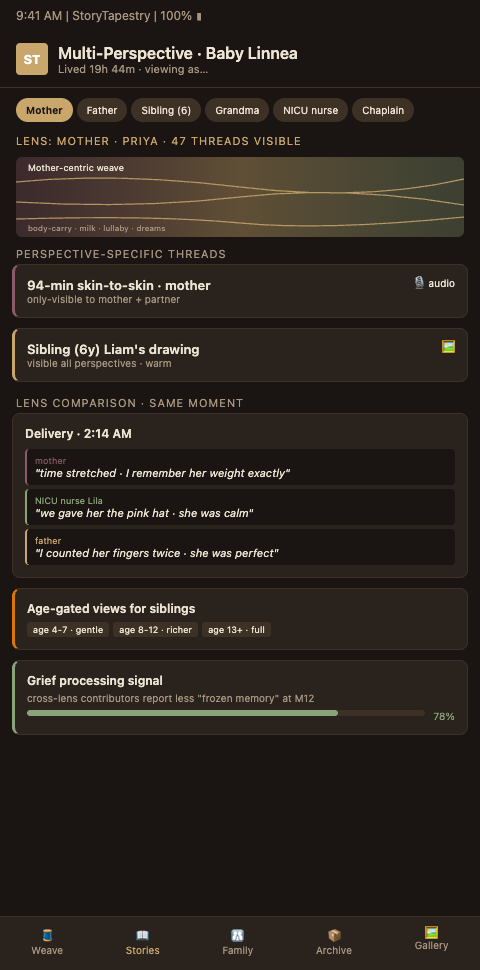
StoryTapestry approaches multi-perspective memorialization the way a master weaver approaches a commission that must represent multiple witnesses: each contributor brings their own hand-spun thread, and the tapestry integrates those distinct threads into a coherent pattern without flattening any of them. The framework operationalizes multi-perspective memorialization through four structural capabilities that most memorial platforms lack.
Capability one is differentiated contributor roles, an architecture documented in depth through a contributor thread case study that traced 15 distinct contributors across a 36-hour life. A grandmother does not contribute the same threads as a 4-year-old sibling. A NICU nurse does not contribute the same threads as a bereavement chaplain. The platform offers role-specific prompts and modality options. Grandmothers may contribute written reflections or recorded voice. A 4-year-old may contribute a drawing, a voice memo, or a photograph of a flower they chose. Clinical staff contribute professional observations within a scope defined by consent. The intergenerational perinatal bereavement program research documenting multi-voice gains confirms that multi-voice engagement produces measurable program outcomes.
Capability two is scaffolded sibling inclusion. Siblings of any age can contribute meaningfully when the platform adapts to developmental stage. The CU perinatal grief sibling resources support framework guides the platform's sibling prompts across age groups. A 3-year-old contributes drawings and dictated voice memos with parent scribing. An 8-year-old contributes written reflections with guided prompts. A 13-year-old may contribute video diary entries or original poetry. Each sibling thread is preserved alongside parent threads and grandparent threads, producing a tapestry that represents the whole grieving family.
Capability three is extended-family geographic inclusion. Perinatal loss is often recognized most intensely by the immediate household, while grandparents, aunts, uncles, and godparents grieve at distance. The platform allows geographically dispersed contributors to weave threads from anywhere. The Share Pregnancy and Infant Loss Support organization serving parents, grandparents, and siblings confirms that grief support extends across distance naturally when infrastructure accommodates it.
Capability four is temporal persistence. Multi-perspective tapestries are not built in a single week. A grandmother may contribute during the initial loss window. A sibling may add threads on the first anniversary. An uncle may contribute when his own child is born years later and the family recognizes the baby who came before. The tapestry accepts threads across decades, making the memorial a living document rather than a closed artifact.
The tapestry metaphor matters centrally here because no single contributor can see the full pattern they weave. Each contributor adds their thread with care. The integrated tapestry reveals patterns no single contributor imagined, including unexpected resonances between a grandmother's entry and a sibling's drawing, or between a nurse's observation and a father's reflection years later. The long-term grief processing benefit emerges from the tapestry's capacity to hold these emergent patterns and present them back to family members over time.
Multi-perspective memorial construction integrates with the contributor thread case study that demonstrates multi-contributor tapestry building in practice, and the emotional impact metrics framework that measures how multi-perspective engagement correlates with validated grief outcomes. Parallel patterns appear in comrade vs family tributes research where multi-perspective memorials across demographic domains produce consistently different outcomes from single-perspective memorials.
Advanced Tactics for Activating Multi-Perspective Memorial Engagement
Hospital bereavement programs that adopt multi-perspective memorialization face a distinct activation challenge: not every family has a circle willing or able to contribute, and family dynamics complicate invitation logic. Four advanced tactics distinguish thriving multi-perspective programs from programs that invite broadly and receive minimally.
Train bereavement coordinators to conduct family system assessment. Before issuing contributor invitations, the coordinator discusses with parents who in their circle grieves this loss, who may want to contribute, and who should be invited even if contribution is uncertain. Some families have large circles; some have small or estranged circles. The assessment respects family reality rather than imposing a standard invitation list. The CU sibling resources framework supports this assessment work with age-graduated tools.
Build graduated invitation windows. Not every contributor invited on day one should be invited on day one. Grandmothers may want immediate invitation. Siblings may need weeks before they are ready. Distant relatives may engage at month six when the acute logistical period has passed. The platform supports tiered invitation timing aligned to the family's stated preferences rather than a single mass invitation that produces either overwhelm or non-response.
Offer clinical contributor opt-in with structured scope, following patterns worked out in comrade vs family tributes research where non-family contributors required explicit consent framing. NICU nurses, L&D staff, and chaplains often have meaningful observations that parents value, but clinical contribution requires careful consent and scope framing. The platform structures clinical contribution so that staff opt-in based on program policy, with scope limited to parent-consented observations. This infrastructure allows the charge nurse who was present at 4am to contribute a 60-second thread about the baby's stillness as she was held, with the mother's explicit consent, without creating medical-legal exposure.
Track engagement outcomes across all contributor types, not only parents, using validated emotional impact metrics that capture each relationship type separately. Multi-perspective memorial engagement outcomes extend beyond parents to siblings' long-term wellbeing, grandparents' integration of the loss, and clinician secondary trauma. Programs measuring only parent outcomes miss the full system impact of their memorial infrastructure.
Offer Families the Tapestry That Holds Their Whole Circle
Hospital bereavement programs that want to move beyond mother-focused memorialization into multi-perspective memorial infrastructure can adopt StoryTapestry's full-system contributor framework. The platform provides role-specific prompts, age-graduated sibling inclusion, geographic distance accommodation, and temporal persistence that allows tapestries to grow across decades. Our clinical partnerships team works with hospital bereavement coordinators to design family system assessment, manage graduated invitations, and structure clinical contributor participation. Request a multi-perspective memorial consultation to see how the tapestry infrastructure that serves mothers also serves fathers, siblings, grandparents, and the wider circles that grieve alongside them. The consultation runs 60 minutes and covers the full-system contributor framework, the role-specific prompt libraries for fathers, non-birthing parents, siblings at four developmental stages, grandparents, and clinical contributors, plus a walk-through of a sample tapestry showing how 11 contributors layer across the mother's primary narrative without displacing it.
Pilot engagements include platform access for your bereavement coordinator, one NICU social worker, one child-life specialist, and one family system assessor, plus a named clinical implementation lead who supports the first 10 multi-perspective case rollouts. Most programs onboard their first multi-perspective case inside four weeks of contract signing and reach steady-state adoption across all active bereavement cases by month six. Bring your bereavement coordinator, child-life specialist, social work lead, and one alumni bereaved parent willing to advise on family system invitation design — the consultation produces a four-role rollout plan the team can present to hospital leadership before the pilot launches.