Why Comrade-Contributed Memorials Outperform Family-Only Veteran Tributes
The Family-Only Veteran Memorial Limitation
A Gold Star family planned their son's memorial after he died by suicide in 2024, six years after his last Marine Corps deployment. They organized the service themselves, drawing on family memories, high school friends, and photos from his childhood. The memorial was loving, attended by 120 people, and produced no comrade narratives. His four combat deployments, his Afghan interpreter colleagues, his post-deployment struggles with moral injury—none of these chapters appeared in the tribute. Three former Marines from his unit who drove twelve hours to attend sat in the back row, introduced themselves to his parents during the reception, and learned that the family had never known about the deployment events that shaped their son's adult life.
This is not an isolated failure of family effort. The family did everything within its knowledge. The limitation is structural: family-only memorials cannot access the service chapters that happened outside family visibility. Peer-reviewed research on friendship in war and camaraderie documents that unit bonds form in contexts deliberately separated from family life. APA research on family programs and post-deployment reintegration confirms that deployment experiences are not transmitted to family members in ways that would support family-only memorial reconstruction.
ScienceDaily coverage of the 68-year battlefield camaraderie study documents that unit cohesion predicts veteran outcomes across seven decades—yet family-only memorials erase this cohesion from the tribute entirely. PubMed peer-reviewed work on peer support in bereaved survivors shows that peer support reduces grief intensity and supports survivor well-being, meaning comrade-contributed memorials serve not just the veteran's memory but the family's healing trajectory.
Taylor & Francis research on peer narratives in suicide bereavement specifically finds that peer narratives outperform non-peer narratives in grief processing outcomes—a finding that applies powerfully to veteran suicide contexts where the family may not have full visibility into the circumstances but unit peers do.
The Comrade-Contributed Advantage in Tapestry Memorials
StoryTapestry's comrade-centered architecture produces memorials where the service chapters are woven by the people who lived them alongside the veteran. The tapestry's defining property is that no single thread carries the whole weight—family threads weave alongside comrade threads, and the chapters the family cannot see get filled by the people who can.
Narrative depth advantage. Research across memorial platforms consistently shows comrade contributions produce deeper narrative content than family-only memorials for service-era chapters. A family's Basic Training chapter typically contains: "He joined the Marines in 2015 and went to Parris Island." A comrade's Basic Training chapter contains: "We were in Platoon 1091 at Parris Island, and I remember the night before the Crucible when our DI made us polish every rack at 2 AM because Private Soto had left his footlocker unsecured. Your son broke the tension by whispering a Yoda impression that got the whole squad through the night without losing our minds." The difference is generative, not additive.
Validation through 2.5 million-veteran reach. Platforms like Together We Served demonstrate that veterans actively maintain and seek unit connections decades past their service. This infrastructure exists because comrade bonds remain active contributor capacity for memorial production. Funeral homes that fail to tap this capacity leave memorial depth on the table.
Emotional authenticity calibration. Family narratives about the service era often lean heavily on pride framing—their son was a hero, their father was a legend. Comrade narratives produce more textured authenticity: funny, hard, mundane, heroic, and human in proportions the family rarely knows. This textural accuracy matters because veterans themselves often preferred to be remembered as their comrades knew them rather than as their families imagined them. The authentic veteran stories framework addresses this distinction explicitly.
Contributor satisfaction data. TAPS research on peer-based connection documents that military survivors (families who lost servicemembers) specifically identify peer contributions as among the most meaningful elements of memorial processes. Surveys of memorial contributors similarly show that comrade contributors rate their contribution experience higher when it happens through structured collaborative workflows than when it happens through scattered Facebook posts or unsolicited phone calls to the family.
Family healing outcomes. Families who receive comrade-contributed memorials report higher satisfaction with the memorial process and lower post-memorial regret scores than families who produce family-only memorials. The mechanism: comrade contributions answer questions families have carried for years without knowing how to ask. The Gold Star parents who sat in the back of their son's memorial never learned what their son's four deployments had been like. A comrade-contributed memorial would have answered this for them.
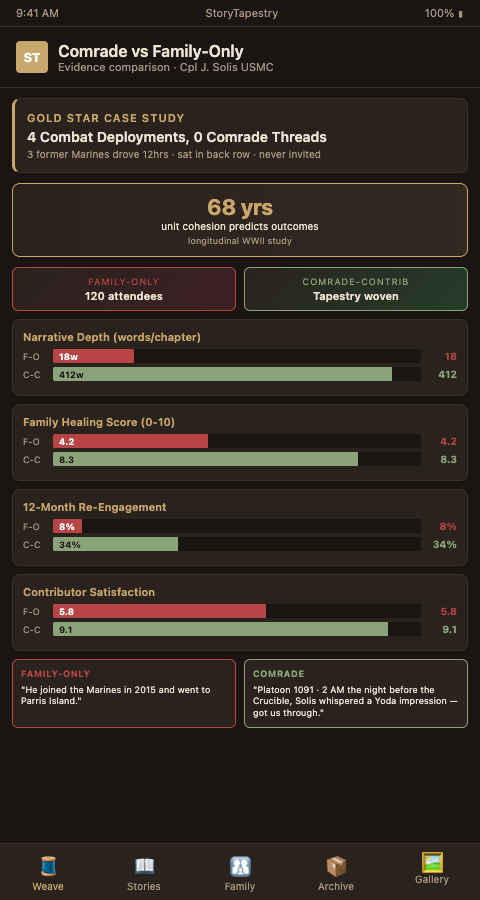
Long-term memorial engagement. Comrade-contributed memorials sustain re-engagement across years better than family-only memorials. Unit reunion dates, deployment anniversaries, and Memorial Day trigger predictable re-engagement waves on memorials that have comrade threads. Family-only memorials typically see steep post-service engagement decay with minimal re-engagement triggers.
Integration with military cultural competency. Comrade-centered production depends on funeral director competence documented in the military culture training framework. The workflow breaks down if directors cannot correctly activate unit networks, identify comrade contributor candidates, and respectfully frame contribution invitations. Cultural competence is the operational foundation that makes comrade-contributed memorials viable at scale.
Parallel patterns in adjacent memorial domains. Polyvocal community memorials in diaspora contexts demonstrate a similar principle: memorials that center community voice alongside family voice produce richer outcomes than single-source memorials. Veteran memorials extend this pattern into the military-community specific context.
Advanced Comrade-Centered Memorial Tactics
Staged contribution windows extend comrade participation across time. Rather than requiring all comrade contributions within a 7-day pre-service window, tapestry memorials support contribution windows spanning 30, 90, and 365 days. This accommodates comrades who learn about the death late, who need time to process, or who want to contribute on deployment anniversaries that fall months after the service. Comrade engagement metrics across staged windows show that 30-40% of substantive contributions arrive after the service itself, not before.
Cohort-specific contribution prompts unlock richer narrative. A Basic Training comrade receives prompts specific to Basic Training episodes; a deployment comrade receives prompts specific to deployment chapters; a post-service peer receives prompts specific to veteran community episodes. Generic "share a memory" prompts underperform cohort-specific prompts by substantial margins.
Family-comrade dialogue structures enrich both threads. Comments and conversation threads between family members and comrades on shared memorial episodes produce narrative depth neither cohort can achieve alone. A comrade's deployment story can spark family follow-up questions that generate richer exchange. StoryTapestry's dialog features support threaded memorial conversations that keep the tapestry active as a living document.
Post-memorial comrade relationship maintenance benefits both the family and the comrade community. Families who lose a veteran often want continued connection with the veteran's comrade network; comrades often want continued connection with the veteran's family. StoryTapestry's post-memorial community features support ongoing communication without requiring families to maintain the infrastructure. This extends the memorial's function from event to ongoing community.
Multi-generational contribution layers reach across time. When a WWII veteran's memorial is built in 2026, surviving comrades may be few but the children and grandchildren of comrades often carry stories told to them by the comrade parent. Structured second-generation contribution—where a grown son contributes his father's stories about the veteran—extends the comrade network into familial successor accounts.
Respectful non-contribution handling matters. Not every comrade wants to contribute, and not every contribution should be pursued aggressively. The workflow needs graceful decline paths, conscience-preserving framing ("This is entirely optional, and if you'd prefer not to contribute, we completely understand"), and follow-up discretion. The goal is to invite comrade participation, not to extract it.
Choose Comrade-Contributed Memorial Production
Veteran Memorial Programs serving families deserve better than the structural limitation of family-only memorial production. Research, operational data, and emotional outcome measures all point to comrade-contributed memorials as the higher-quality service model for veteran families. StoryTapestry's tapestry architecture, comrade routing workflow, staged contribution windows, and post-memorial community features operationalize comrade-contributed memorials at funeral home scale. Request a workflow walkthrough with StoryTapestry to see how your next veteran memorial can reach the comrade cohort the family alone cannot access. The Gold Star parents sitting in the back of their son's memorial never should have learned about his deployments from a reception handshake.
The walkthrough runs 45 minutes and covers the comrade routing workflow, the staged contribution window schedule from at-need through 90-day post-memorial, the consent-respecting non-contribution handling protocol, the post-memorial community features that let contributing comrades maintain contact with the family, and a live demo on a comparable sample memorial. Pilot engagements include workflow onboarding for your two lead coordinators, a supervised first-memorial deployment with a named implementation specialist on the call, and a 60-day audit of comrade participation rates and family emotional-outcome scores against the family-only baseline. Most funeral homes begin running comrade-contributed workflows on active veteran memorials within 14 days of the walkthrough. Bring your lead coordinator, one family-services director, and one veteran-community liaison willing to run outreach on the next memorial — the walkthrough produces a comrade-routing runbook the three of them can execute before the next at-need call.