Training Funeral Directors in Military Culture for Authentic Memorials
The Cultural Competence Gap in Funeral Industry Military Service
A family in Jacksonville sat with a funeral director to plan the service for their father, a Vietnam-era Marine gunnery sergeant. The director—experienced, well-intentioned, and working at a respected firm—made a series of small errors across a 90-minute planning meeting. He referred to the gunny's "tour in Vietnam" as singular (the veteran had served two tours). He used "soldier" to describe the Marine. He suggested a "military ceremony" rather than the specific military funeral honors framework. He did not ask about the veteran's unit, MOS, or deployment dates. The family did not correct him to his face. They did find another funeral home before signing the contract.
This scenario is documented across industry reporting. Military OneSource's Military Funeral Honors program establishes DoD protocol that many funeral directors learn only on the job. The NFDA serving veterans benefits resource and VA NCA's funeral director resources exist precisely because the industry has acknowledged a training gap.
VA HSR&D research on understanding military culture demonstrates that cultural competence for providers working with veterans is not about memorizing branch insignia—it is about understanding rank structures, deployment contexts, unit identity, era-specific service realities, and the communication patterns that distinguish authentic engagement from performative respect. MIRECC's Veteran Cultural Competence Training formalizes this curriculum for VA-aligned providers.
Peer-reviewed evaluation of VCCT found that structured cultural competence training significantly increases provider self-efficacy in veteran-facing services. The JCES curriculum for teaching military cultural competency provides an academic framework adaptable to funeral industry contexts. Without training, funeral directors default to generic respectful-professional patterns that miss the specificity veteran families and comrades expect.
The StoryTapestry Military Culture Curriculum
StoryTapestry's funeral director curriculum weaves cultural competence into the memorial production workflow itself. Rather than training directors in an abstract classroom and hoping the knowledge transfers, the curriculum is delivered through production-integrated modules that fire at the moments where cultural knowledge matters most.
Module 1: Branch and rank literacy. Directors learn the five services (Army, Navy, Marine Corps, Air Force, Space Force, Coast Guard—with Space Force added since 2019) plus the Merchant Marine distinction. Rank literacy covers enlisted (E-1 through E-9), warrant (W-1 through W-5), and officer (O-1 through O-10) structures across branches, with explicit attention to branch-specific rank titles (a Marine sergeant is not an Army sergeant, and a Navy petty officer is not a Marine corporal despite similar E-grade). The directors practice pronunciation, proper written form, and addressing rank across conversation with family members and comrades.
Module 2: Era-specific service context. A WWII veteran, Vietnam veteran, Gulf War veteran, and post-9/11 veteran occupy different cultural worlds. Directors learn era-specific deployment realities, unit cultures, and the generational distinctions that shape how each cohort talks about service. Directors who use the right era-specific vocabulary unlock family trust; directors who use post-9/11 terminology with a WWII widow signal that they have not done the homework. This era competence aligns with the multi-branch memorial scaling framework where temporal context matters as much as branch.
Module 3: Classified-aware communication. Many veterans—especially SOF, intelligence, and technical community members—have service chapters they cannot fully describe. Directors learn to ask open questions that let the family share what they know without pressuring them to produce classified details. This pattern, covered more deeply in classified memory navigation, prevents the awkward exchange where a director asks "What did he do in the service?" and the widow responds "He couldn't talk about it" while the director doesn't know how to pivot.
Module 4: Military funeral honors protocols. Directors learn the specific VA and DoD framework for funeral honors: flag folding, Taps bugler coordination, rifle detail protocols, honor guard requests, and the precise language to use when discussing honors with the family. The VFW's authorized provider partnership fact sheet documents the VSO infrastructure directors need to navigate. Proper honors language signals baseline competence to any family with military background.
Module 5: Unit identity and comrade networks. Directors learn how unit identity works—why the 82nd Airborne, 1st Marine Division, and USS Midway associations matter, how to ask about unit affiliations, and how to hand off memorial contributor outreach to the veteran-serving tapestry coordination workflow. This module directly supports the collaborative memorial production that defines the StoryTapestry approach.
Module 6: Service-connected grief patterns. Military families grieve within a context of deployment cycles, separation history, and deployment-era anticipatory grief that civilian families do not carry. Directors learn to recognize these patterns without pathologizing them, using principles adapted from cross-cultural grief training that apply strongly to military subculture contexts.
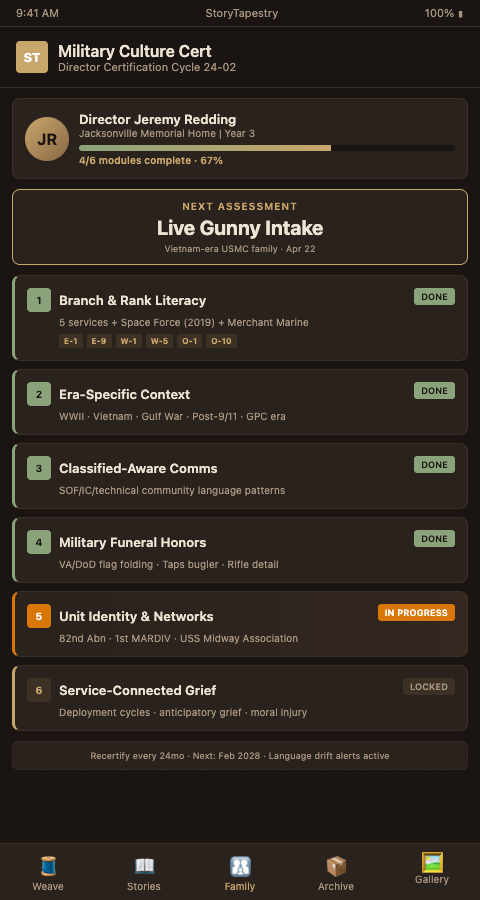
Training format matters. The curriculum pairs asynchronous video modules (90 minutes total) with structured role-play scenarios (family intake interviews, comrade contributor outreach calls). Directors complete a certification assessment that includes both knowledge checks and recorded role-play review. Certification renews every 24 months with updated era context (as post-9/11 becomes historical and the post-post-9/11 cohort emerges as a distinct service era).
Advanced Cultural Competence Tactics
Spouse-and-family cultural context extends beyond the veteran. Directors learn that military spouses carry their own cultural identity—the military wife/husband community has its own vocabulary (PCS, TDY, deployment, FRG, unit holiday parties) that signals insider status. Using this vocabulary correctly with a surviving spouse builds rapport that generic condolence language cannot. Widows of 30-year veterans often know more about unit culture than the director, and acknowledging this without performative deference matters.
Service-specific grief customs vary. Marine Corps bereavement traditions differ from Navy, which differ from Army. Directors learn the distinctive patterns: Marine families often request a specific musical piece ("Marines' Hymn") in ways Army families do not; Navy families often invoke shipmate bonds through fleet reserve association involvement; Air Force families often emphasize MOS and aircraft type in memorial narrative. Recognizing these patterns lets directors ask better questions during intake.
Awards and decorations literacy prevents embarrassing errors. A director who refers to a Silver Star recipient's medal as "silver medal" has signaled cultural incompetence. The curriculum covers the awards structure (unit awards, personal awards, campaign medals, badges) and proper naming conventions. Directors do not need to memorize every award, but they need to know how to ask about them and how to reference them correctly when the family shares.
VSO partnership literacy connects the director to the broader veteran community infrastructure. Directors learn which VSOs serve which veteran populations (VFW for eligible combat veterans, American Legion for all war-era veterans, DAV for disabled veterans, branch-specific associations like Marine Corps League) and how to activate each for memorial contributor outreach. The NFDA industry statistics context frames the scale at which these partnerships matter for director caseloads.
Language drift monitoring ensures the curriculum stays current. Military culture evolves—the Space Force did not exist before 2019, the official service nickname for the Coast Guard's reserve component has changed twice, and post-9/11 service era is increasingly subdivided as the GWOT era gives way to great-power-competition era. Directors who certified five years ago need refresher content. The curriculum includes an annual language update release and a director community-of-practice forum for surfacing emerging cultural shifts.
Certify Your Directors on Military Culture
Veteran Memorial Programs lose families to competitors when directors fail baseline cultural competence tests. StoryTapestry's six-module curriculum certifies your directors across branch literacy, era context, classified-aware communication, honors protocols, unit networks, and service-connected grief patterns—embedded in the memorial production workflow where the knowledge actually gets applied. Schedule a curriculum walkthrough with StoryTapestry to onboard your director team on the current certification cycle. The Jacksonville family should leave your funeral home trusting that your director understands the gunny's service. The walkthrough runs 45 minutes and covers the six-module curriculum map, the workflow-embedded assessment approach that tests competence against active memorial cases rather than quizzes, the cohort enrollment schedule, the continuing-education refresh cadence, and a sample certification portfolio from a recently certified director.
Cohort enrollments include certification access for up to 12 directors, four assessment gates integrated into live memorial workflows, and a named training lead who reviews each director's first three veteran memorials during the certification window. Most funeral homes complete their first cohort within 14 weeks of enrollment and see measurable family-trust score improvements by month five. Bring your owner or general manager, your lead director, and your primary veteran-family intake coordinator — the walkthrough produces a cohort enrollment plan the three of them can present to the director team before the next certification cycle opens.