Training Funeral Staff in Cross-Cultural Grief Communication
The Cost of Cultural Missteps in Memorial Work
A funeral director asks a Vietnamese-American family if they want "open casket or closed" on a form. The question is routine in his usual practice. The family freezes — neither option fits the ritual they intended, and the blunt phrasing signals the director has not considered their practice at all. They politely finish the intake and never return. The branch's Vietnamese referral rate drops for three years before anyone connects the dots.
Research on cultural competence training shows these missteps are preventable but only with structured interventions. A PMC systematic review of cultural competence trainings finds that structured programs shift attitudes and increase knowledge measurably, but that one-off sessions have weak durability. PMC research on cultural competence in refugee services emphasizes respectful engagement, trust-building, and organizational commitment as core pillars. PMC research on cross-cultural education in palliative care documents workshops, case studies, and role plays as the proven formats for end-of-life care contexts.
For the grief context specifically, PMC work on migration, cultural bereavement, and identity explains that migration itself involves loss of cultural norms that grief workers must understand before they can support migrant families. Frontiers research on cross-cultural medical education confirms that globalized service work demands cross-cultural education as baseline, not bonus.
A Curriculum Structure That Sticks
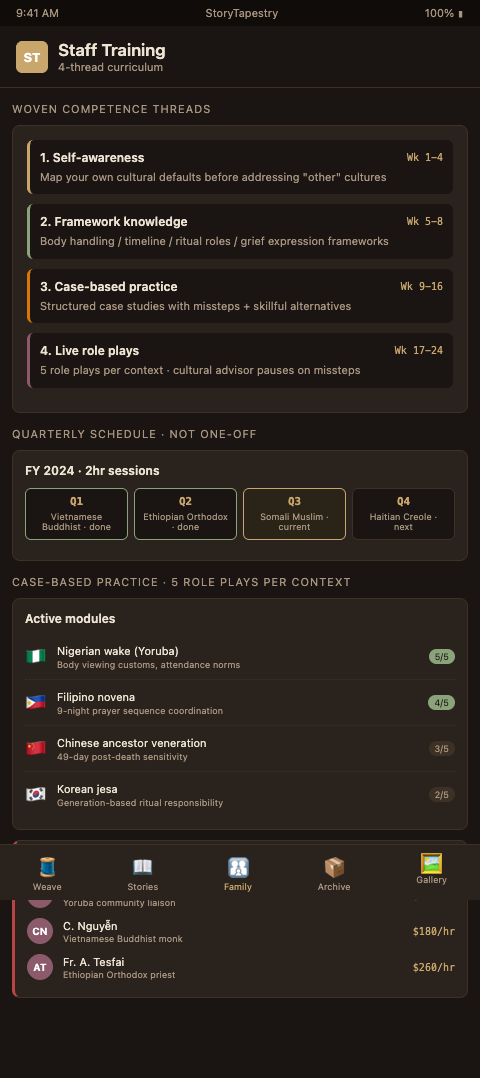
The tapestry metaphor helps here: cross-cultural competence is not a single skill but an interwoven set of capabilities. Treat training as weaving — multiple threads, repeated passes, tension held over time. StoryTapestry supports cross-cultural training rollouts for partner funeral homes with a four-thread curriculum structure, drawn from the HHS cross-cultural communication skills curriculum and the decades of work by the Cross Cultural Health Care Program.
Thread 1: Self-awareness. Staff cannot communicate across cultures without understanding their own cultural defaults. The first training module surfaces the default assumptions in North American funeral practice — the assumed timeline, the assumed body handling, the assumed verbal register. Participants map their own background and its influence on practice. This is uncomfortable work and must happen before any content on "other" cultures.
Thread 2: Framework knowledge. Not encyclopedia knowledge of every tradition, but frameworks for asking the right questions. The key frameworks: body handling preferences, timeline expectations, ritual roles (who leads, who attends, who speaks), grief expression norms, and religious custom navigation. Staff learn to ask about each framework rather than assume.
Thread 3: Case-based practice. Structured case studies drawn from actual memorial work — anonymized, reviewed with cultural advisors — walk staff through specific cultural contexts. A Nigerian wake case study. A Filipino novena case study. A Chinese ancestor veneration case study. Each case includes the missteps that commonly occur and the skillful alternatives. This format mirrors the cognitive-sensitive training approach used in memory care work — different population, same scaffolding logic.
Thread 4: Live role plays with cultural advisors. Staff practice intake conversations, obituary writing, and family coordination with cultural advisors playing family members. The advisor pauses the role play when a misstep occurs, explains the cultural context, and resets. Five role plays per cultural context produce competence; two role plays produce false confidence.
The tapestry holds tension because the threads run together, not in sequence. A staff member in month three of training is still deepening self-awareness while learning new frameworks and doing new case studies. Training ends when staff stop asking "how do I handle this family" and start asking "what does this family need me to ask." That shift is the outcome measure. This continuous scaffolding approach to training integrates cleanly with memorial program scaling across multi-location funeral chains.
The curriculum also addresses a specific competence that generic training programs often miss entirely: interpretive listening across cultural grief registers. A Thai family's composed, soft-spoken grief may sound to an American staff member like emotional distance, when it actually reflects profound cultural discipline. A Greek family's loud, tearful expression may sound to the same staff member like performative excess, when it actually reflects a tradition of emotional honesty. Staff who have trained in interpretive listening understand that the volume of grief expression tells them almost nothing about the depth of feeling, and they avoid the trap of mirroring or contradicting what they misread. This listening competence is often the single most impactful training outcome, because it changes how staff respond in the first five minutes of intake, where most cultural missteps occur.
Advanced Tactics for Training Rollout
Five tactics separate training programs that change practice from those that produce certificates and nothing else:
Schedule training on the calendar quarterly, not once. A single eight-hour training session on cross-cultural competence does not work. Schedule two-hour sessions quarterly, each focused on one cultural context or one skill. Durability comes from spaced repetition. The PMC systematic review on cultural competence supports this structure directly.
Pair trainings with live case reviews. After a cross-cultural case closes, the handling director presents a 20-minute review to peers. What went well. What did not. What the family said. This converts individual experience into organizational knowledge. Do not skip this step because case reviews feel vulnerable; that vulnerability is the point.
Hire cultural advisors as paid roles, not volunteers. Staff cannot be trained well by volunteers. Budget hourly rates for cultural advisors — often community leaders, clergy, or heritage association board members — to serve as training facilitators. Their expertise deserves compensation commensurate with professional consulting.
Track competence at the case level, not the staff level. Rather than certifying individual staff as "culturally competent," track whether each transnational case had appropriate cultural support. A case may require a specific language pack, a specific ritual framework, and access to a specific cultural advisor. Verify these were present. Competence is a case property, not a personal credential.
Rotate training focus by referral pipeline. Analyze your last 24 months of cases by cultural context. Which contexts appear most often? Schedule training around this distribution. A branch serving a large Ethiopian Orthodox community should train on Ethiopian Orthodox practice before generic "African" content. Specificity beats breadth.
Make training materials bilingual. If your branch serves Spanish-speaking families, training materials should include Spanish-language quotations and role plays in Spanish. Asking staff to understand cultural context only through English filtering loses the practice opportunity.
Build peer coaching pairs rather than relying solely on trainer-led instruction. Two staff members working on the same cultural context can practice together, compare notes, and reinforce each other's learning in ways a single workshop cannot. Assign peer pairs for six-month cycles, with structured check-ins and a shared case log. This peer structure distributes learning across the team and creates natural backup coverage when one staff member is unavailable for a case requiring specific cultural fluency.
Incorporate hiring practices that expand cultural competence beyond training alone. Some cultural competence can only be learned through lived experience, and hiring staff from the communities you serve provides that experience directly. A Vietnamese-speaking staff member who grew up in the Vietnamese community brings nuance that a non-Vietnamese staff member cannot acquire in a training workshop regardless of quality. Intentional hiring for cultural diversity is the single strongest long-term investment in cultural competence, and it should complement rather than replace ongoing training for existing staff.
Treat language fluency and cultural fluency as distinct competencies. A staff member who speaks Spanish fluently may still have limited cultural fluency in Guatemalan, Dominican, or Argentine contexts. Similarly, a staff member with deep cultural fluency in a specific community may have limited language fluency. Training should address both axes separately rather than conflating them. Language training alone does not produce cultural competence, and cultural training alone does not produce language fluency; both matter, and both require dedicated investment.
Take the Next Step
StoryTapestry partners with diaspora funeral services on cross-cultural training rollouts through our Cultural Coordinators network. We will audit your current training curriculum, recommend specific cultural-context modules based on your case mix, and introduce you to cultural advisors who can serve as paid facilitators. The initial audit takes 45 minutes. Schedule at the link below and we will assign a partnership lead to your case. The audit covers your current training cadence, the cultural contexts your curriculum addresses, the role-play rigor your practice sessions include, and the case-review discipline your post-service debriefs maintain. We then identify the two or three highest-leverage improvements based on your specific case mix, whether that means adding a Haitian Creole module, expanding Somali Muslim training, deepening your Vietnamese Buddhist competence, or building Orthodox Ethiopian fluency for the first time.
Funeral homes that invest in structured cross-cultural training consistently report measurable reductions in cultural missteps, improvements in intake satisfaction scores, and growth in referrals from specific cultural communities within two to three quarters. Training is not a line item to minimize; it is the foundation on which your funeral home's reputation in diaspora communities is either built or eroded. Done right, a quarterly training investment in the $4,000 to $12,000 range produces returns that compound across every cross-cultural case your staff handles for years afterward.